

3 Aptamer-Based Point of Care Testing Schemes
61
3.3.3 DNA Origami Nanobox
DNA has a great potential as a building material for structures on a nanoscale. The
development of DNA origami, where a large number of short complementary staple
strands fold a long template strand, has led to the nanoscale artifacts with many
shapes and measurements [50]. Staples can be modified to equip origami by other
molecules including metal nanoparticles, fluorophores and enzymes [51, 52]. The
formation of staple strands with functional nucleic acid sequences has advantages due
to its homogeneity with the parent scaffold. Generally, staple strands are elongated
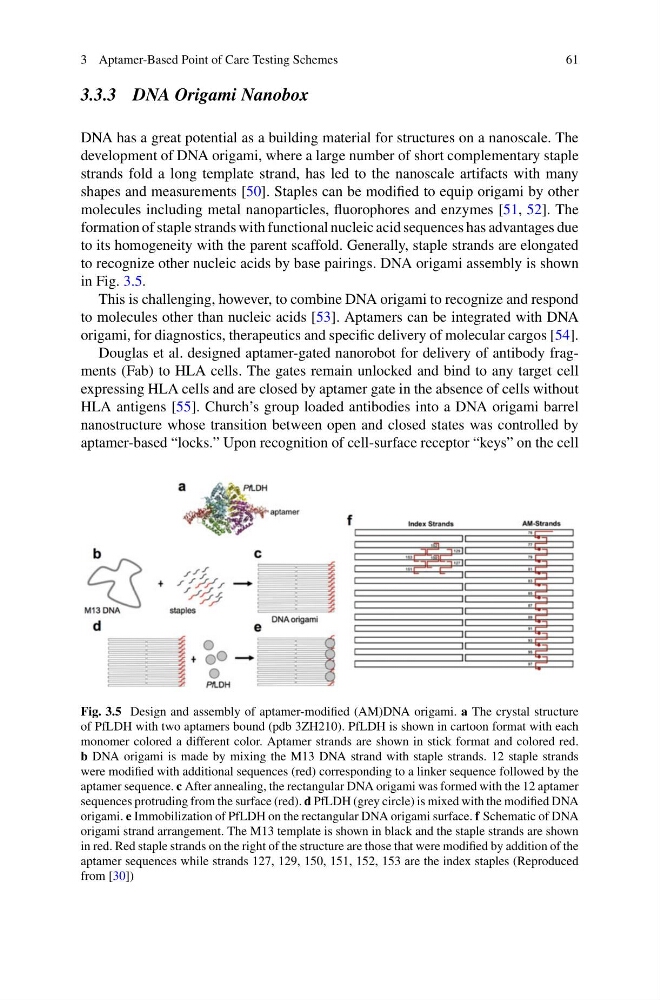
to recognize other nucleic acids by base pairings. DNA origami assembly is shown
in Fig. 3.5.
This is challenging, however, to combine DNA origami to recognize and respond
to molecules other than nucleic acids [53]. Aptamers can be integrated with DNA
origami, for diagnostics, therapeutics and specific delivery of molecular cargos [54].
Douglas et al. designed aptamer-gated nanorobot for delivery of antibody fragments (Fab) to HLA cells. The gates remain unlocked and bind to any target cell
expressing HLA cells and are closed by aptamer gate in the absence of cells without
HLA antigens [55]. Church’s group loaded antibodies into a DNA origami barrel
nanostructure whose transition between open and closed states was controlled by
aptamer-based “locks.” Upon recognition of cell-surface receptor “keys” on the cell
Fig. 3.5 Design and assembly of aptamer-modified (AM)DNA origami. a The crystal structure
of PfLDH with two aptamers bound (pdb 3ZH210). PfLDH is shown in cartoon format with each
monomer colored a different color. Aptamer strands are shown in stick format and colored red.
b DNA origami is made by mixing the M13 DNA strand with staple strands. 12 staple strands
were modified with additional sequences (red) corresponding to a linker sequence followed by the
aptamer sequence. c After annealing, the rectangular DNA origami was formed with the 12 aptamer
sequences protruding from the surface (red). d PfLDH (grey circle) is mixed with the modified DNA
origami. e Immobilization of PfLDH on the rectangular DNA origami surface. f Schematic of DNA
origami strand arrangement. The M13 template is shown in black and the staple strands are shown
in red. Red staple strands on the right of the structure are those that were modified by addition of the
aptamer sequences while strands 127, 129, 150, 151, 152, 153 are the index staples (Reproduced
from [30])
61
3.3.3 DNA Origami Nanobox
DNA has a great potential as a building material for structures on a nanoscale. The
development of DNA origami, where a large number of short complementary staple
strands fold a long template strand, has led to the nanoscale artifacts with many
shapes and measurements [50]. Staples can be modified to equip origami by other
molecules including metal nanoparticles, fluorophores and enzymes [51, 52]. The
formation of staple strands with functional nucleic acid sequences has advantages due
to its homogeneity with the parent scaffold. Generally, staple strands are elongated
to recognize other nucleic acids by base pairings. DNA origami assembly is shown
in Fig. 3.5.
This is challenging, however, to combine DNA origami to recognize and respond
to molecules other than nucleic acids [53]. Aptamers can be integrated with DNA
origami, for diagnostics, therapeutics and specific delivery of molecular cargos [54].
Douglas et al. designed aptamer-gated nanorobot for delivery of antibody fragments (Fab) to HLA cells. The gates remain unlocked and bind to any target cell
expressing HLA cells and are closed by aptamer gate in the absence of cells without
HLA antigens [55]. Church’s group loaded antibodies into a DNA origami barrel
nanostructure whose transition between open and closed states was controlled by
aptamer-based “locks.” Upon recognition of cell-surface receptor “keys” on the cell
Fig. 3.5 Design and assembly of aptamer-modified (AM)DNA origami. a The crystal structure
of PfLDH with two aptamers bound (pdb 3ZH210). PfLDH is shown in cartoon format with each
monomer colored a different color. Aptamer strands are shown in stick format and colored red.
b DNA origami is made by mixing the M13 DNA strand with staple strands. 12 staple strands
were modified with additional sequences (red) corresponding to a linker sequence followed by the
aptamer sequence. c After annealing, the rectangular DNA origami was formed with the 12 aptamer
sequences protruding from the surface (red). d PfLDH (grey circle) is mixed with the modified DNA
origami. e Immobilization of PfLDH on the rectangular DNA origami surface. f Schematic of DNA
origami strand arrangement. The M13 template is shown in black and the staple strands are shown
in red. Red staple strands on the right of the structure are those that were modified by addition of the
aptamer sequences while strands 127, 129, 150, 151, 152, 153 are the index staples (Reproduced
from [30])