

60
G. Murtaza et al.
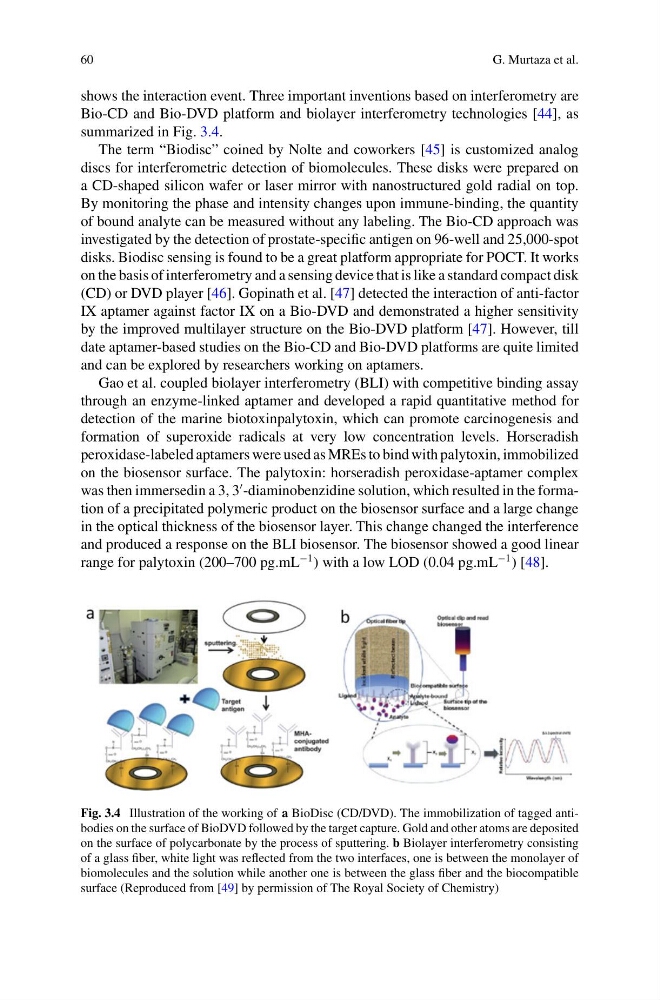
shows the interaction event. Three important inventions based on interferometry are
Bio-CD and Bio-DVD platform and biolayer interferometry technologies [44], as
summarized in Fig. 3.4.
The term “Biodisc” coined by Nolte and coworkers [45] is customized analog
discs for interferometric detection of biomolecules. These disks were prepared on
a CD-shaped silicon wafer or laser mirror with nanostructured gold radial on top.
By monitoring the phase and intensity changes upon immune-binding, the quantity
of bound analyte can be measured without any labeling. The Bio-CD approach was
investigated by the detection of prostate-specific antigen on 96-well and 25,000-spot
disks. Biodisc sensing is found to be a great platform appropriate for POCT. It works
on the basis of interferometry and a sensing device that is like a standard compact disk
(CD) or DVD player [46]. Gopinath et al. [47] detected the interaction of anti-factor
IX aptamer against factor IX on a Bio-DVD and demonstrated a higher sensitivity
by the improved multilayer structure on the Bio-DVD platform [47]. However, till
date aptamer-based studies on the Bio-CD and Bio-DVD platforms are quite limited
and can be explored by researchers working on aptamers.
Gao et al. coupled biolayer interferometry (BLI) with competitive binding assay
through an enzyme-linked aptamer and developed a rapid quantitative method for
detection of the marine biotoxinpalytoxin, which can promote carcinogenesis and
formation of superoxide radicals at very low concentration levels. Horseradish
peroxidase-labeled aptamers were used as MREs to bind with palytoxin, immobilized
on the biosensor surface. The palytoxin: horseradish peroxidase-aptamer complex
was then immersedin a 3, 3
-diaminobenzidine solution, which resulted in the formation of a precipitated polymeric product on the biosensor surface and a large change
in the optical thickness of the biosensor layer. This change changed the interference
and produced a response on the BLI biosensor. The biosensor showed a good linear
range for palytoxin (200–700 pg.mL
−1 ) with a low LOD (0.04 pg.mL
−1 ) [48].
Fig. 3.4 Illustration of the working of a BioDisc (CD/DVD). The immobilization of tagged antibodies on the surface of BioDVD followed by the target capture. Gold and other atoms are deposited
on the surface of polycarbonate by the process of sputtering. b Biolayer interferometry consisting
of a glass fiber, white light was reflected from the two interfaces, one is between the monolayer of
biomolecules and the solution while another one is between the glass fiber and the biocompatible
surface (Reproduced from [49] by permission of The Royal Society of Chemistry)
G. Murtaza et al.
shows the interaction event. Three important inventions based on interferometry are
Bio-CD and Bio-DVD platform and biolayer interferometry technologies [44], as
summarized in Fig. 3.4.
The term “Biodisc” coined by Nolte and coworkers [45] is customized analog
discs for interferometric detection of biomolecules. These disks were prepared on
a CD-shaped silicon wafer or laser mirror with nanostructured gold radial on top.
By monitoring the phase and intensity changes upon immune-binding, the quantity
of bound analyte can be measured without any labeling. The Bio-CD approach was
investigated by the detection of prostate-specific antigen on 96-well and 25,000-spot
disks. Biodisc sensing is found to be a great platform appropriate for POCT. It works
on the basis of interferometry and a sensing device that is like a standard compact disk
(CD) or DVD player [46]. Gopinath et al. [47] detected the interaction of anti-factor
IX aptamer against factor IX on a Bio-DVD and demonstrated a higher sensitivity
by the improved multilayer structure on the Bio-DVD platform [47]. However, till
date aptamer-based studies on the Bio-CD and Bio-DVD platforms are quite limited
and can be explored by researchers working on aptamers.
Gao et al. coupled biolayer interferometry (BLI) with competitive binding assay
through an enzyme-linked aptamer and developed a rapid quantitative method for
detection of the marine biotoxinpalytoxin, which can promote carcinogenesis and
formation of superoxide radicals at very low concentration levels. Horseradish
peroxidase-labeled aptamers were used as MREs to bind with palytoxin, immobilized
on the biosensor surface. The palytoxin: horseradish peroxidase-aptamer complex
was then immersedin a 3, 3
-diaminobenzidine solution, which resulted in the formation of a precipitated polymeric product on the biosensor surface and a large change
in the optical thickness of the biosensor layer. This change changed the interference
and produced a response on the BLI biosensor. The biosensor showed a good linear
range for palytoxin (200–700 pg.mL
−1 ) with a low LOD (0.04 pg.mL
−1 ) [48].
Fig. 3.4 Illustration of the working of a BioDisc (CD/DVD). The immobilization of tagged antibodies on the surface of BioDVD followed by the target capture. Gold and other atoms are deposited
on the surface of polycarbonate by the process of sputtering. b Biolayer interferometry consisting
of a glass fiber, white light was reflected from the two interfaces, one is between the monolayer of
biomolecules and the solution while another one is between the glass fiber and the biocompatible
surface (Reproduced from [49] by permission of The Royal Society of Chemistry)