

2 Aptamer-Based Probes for Molecular Imaging
33
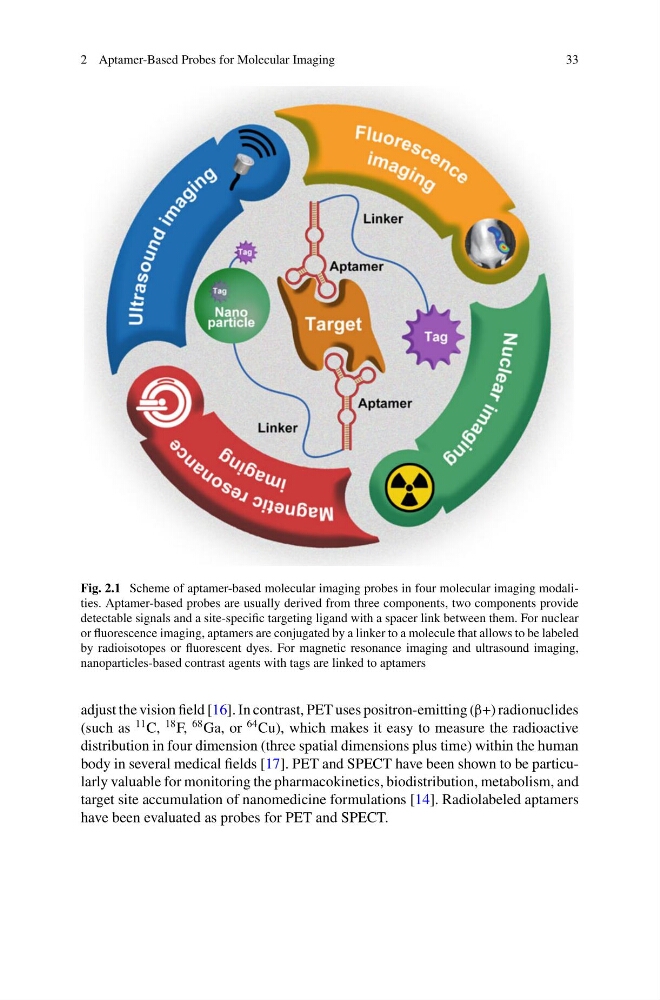
Fig. 2.1 Scheme of aptamer-based molecular imaging probes in four molecular imaging modalities. Aptamer-based probes are usually derived from three components, two components provide
detectable signals and a site-specific targeting ligand with a spacer link between them. For nuclear
or fluorescence imaging, aptamers are conjugated by a linker to a molecule that allows to be labeled
by radioisotopes or fluorescent dyes. For magnetic resonance imaging and ultrasound imaging,
nanoparticles-based contrast agents with tags are linked to aptamers
adjust the vision field [16]. In contrast, PET uses positron-emitting (β+) radionuclides
(such as
11 C,
18 F,
68 Ga, or
64 Cu), which makes it easy to measure the radioactive
distribution in four dimension (three spatial dimensions plus time) within the human
body in several medical fields [17]. PET and SPECT have been shown to be particularly valuable for monitoring the pharmacokinetics, biodistribution, metabolism, and
target site accumulation of nanomedicine formulations [14]. Radiolabeled aptamers
have been evaluated as probes for PET and SPECT.
33
Fig. 2.1 Scheme of aptamer-based molecular imaging probes in four molecular imaging modalities. Aptamer-based probes are usually derived from three components, two components provide
detectable signals and a site-specific targeting ligand with a spacer link between them. For nuclear
or fluorescence imaging, aptamers are conjugated by a linker to a molecule that allows to be labeled
by radioisotopes or fluorescent dyes. For magnetic resonance imaging and ultrasound imaging,
nanoparticles-based contrast agents with tags are linked to aptamers
adjust the vision field [16]. In contrast, PET uses positron-emitting (β+) radionuclides
(such as
11 C,
18 F,
68 Ga, or
64 Cu), which makes it easy to measure the radioactive
distribution in four dimension (three spatial dimensions plus time) within the human
body in several medical fields [17]. PET and SPECT have been shown to be particularly valuable for monitoring the pharmacokinetics, biodistribution, metabolism, and
target site accumulation of nanomedicine formulations [14]. Radiolabeled aptamers
have been evaluated as probes for PET and SPECT.