

386
Y. Dong et al.
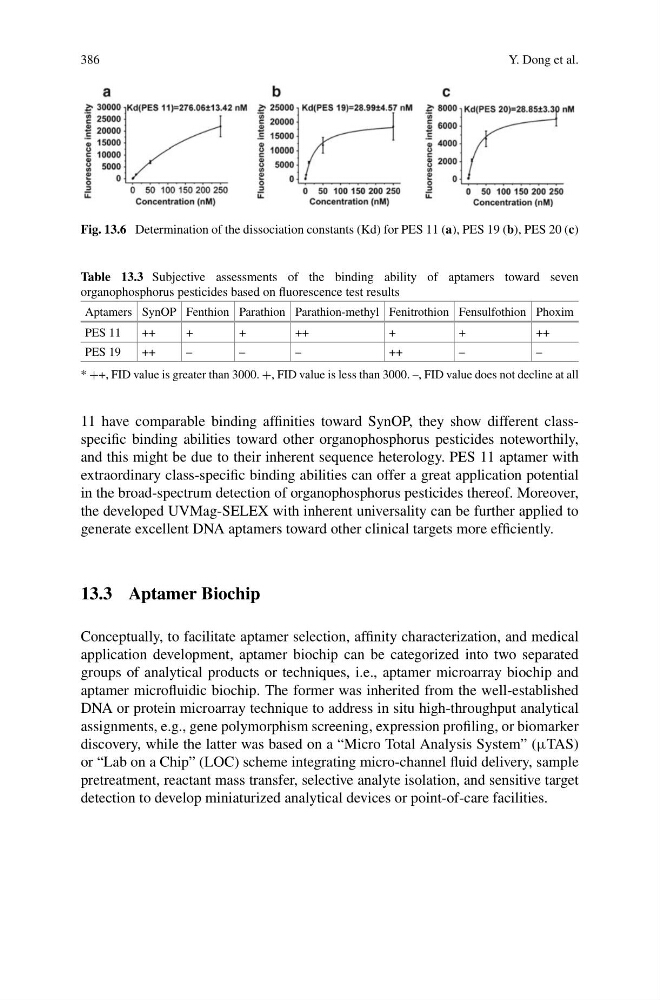
Fig. 13.6 Determination of the dissociation constants (Kd) for PES 11 (a), PES 19 (b), PES 20 (c)
Table 13.3 Subjective assessments of the binding ability of aptamers toward seven
organophosphorus pesticides based on fluorescence test results
Aptamers SynOP Fenthion Parathion Parathion-methyl Fenitrothion Fensulfothion Phoxim
PES 11
++
+
+
++
+
+
++
PES 19
++
–
–
–
++
–
–
* ++, FID value is greater than 3000. +, FID value is less than 3000. –, FID value does not decline at all
11 have comparable binding affinities toward SynOP, they show different classspecific binding abilities toward other organophosphorus pesticides noteworthily,
and this might be due to their inherent sequence heterology. PES 11 aptamer with
extraordinary class-specific binding abilities can offer a great application potential
in the broad-spectrum detection of organophosphorus pesticides thereof. Moreover,
the developed UVMag-SELEX with inherent universality can be further applied to
generate excellent DNA aptamers toward other clinical targets more efficiently.
13.3 Aptamer Biochip
Conceptually, to facilitate aptamer selection, affinity characterization, and medical
application development, aptamer biochip can be categorized into two separated
groups of analytical products or techniques, i.e., aptamer microarray biochip and
aptamer microfluidic biochip. The former was inherited from the well-established
DNA or protein microarray technique to address in situ high-throughput analytical
assignments, e.g., gene polymorphism screening, expression profiling, or biomarker
discovery, while the latter was based on a “Micro Total Analysis System” (µTAS)
or “Lab on a Chip” (LOC) scheme integrating micro-channel fluid delivery, sample
pretreatment, reactant mass transfer, selective analyte isolation, and sensitive target
detection to develop miniaturized analytical devices or point-of-care facilities.
Y. Dong et al.
Fig. 13.6 Determination of the dissociation constants (Kd) for PES 11 (a), PES 19 (b), PES 20 (c)
Table 13.3 Subjective assessments of the binding ability of aptamers toward seven
organophosphorus pesticides based on fluorescence test results
Aptamers SynOP Fenthion Parathion Parathion-methyl Fenitrothion Fensulfothion Phoxim
PES 11
++
+
+
++
+
+
++
PES 19
++
–
–
–
++
–
–
* ++, FID value is greater than 3000. +, FID value is less than 3000. –, FID value does not decline at all
11 have comparable binding affinities toward SynOP, they show different classspecific binding abilities toward other organophosphorus pesticides noteworthily,
and this might be due to their inherent sequence heterology. PES 11 aptamer with
extraordinary class-specific binding abilities can offer a great application potential
in the broad-spectrum detection of organophosphorus pesticides thereof. Moreover,
the developed UVMag-SELEX with inherent universality can be further applied to
generate excellent DNA aptamers toward other clinical targets more efficiently.
13.3 Aptamer Biochip
Conceptually, to facilitate aptamer selection, affinity characterization, and medical
application development, aptamer biochip can be categorized into two separated
groups of analytical products or techniques, i.e., aptamer microarray biochip and
aptamer microfluidic biochip. The former was inherited from the well-established
DNA or protein microarray technique to address in situ high-throughput analytical
assignments, e.g., gene polymorphism screening, expression profiling, or biomarker
discovery, while the latter was based on a “Micro Total Analysis System” (µTAS)
or “Lab on a Chip” (LOC) scheme integrating micro-channel fluid delivery, sample
pretreatment, reactant mass transfer, selective analyte isolation, and sensitive target
detection to develop miniaturized analytical devices or point-of-care facilities.