

12 Aptamers for the Diagnosis and Therapy …
359
on [74, 75]. Hence, monitoring α-syn aggregation and interfering with the process
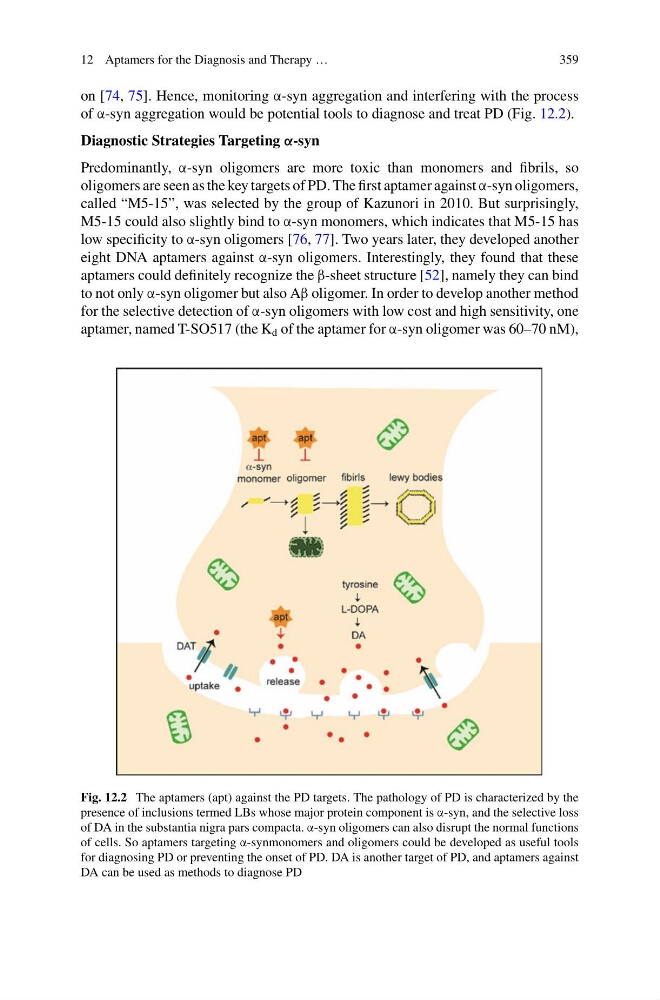
of α-syn aggregation would be potential tools to diagnose and treat PD (Fig. 12.2).
Diagnostic Strategies Targeting α-syn
Predominantly, α-syn oligomers are more toxic than monomers and fibrils, so
oligomers are seen as the key targets of PD. The first aptamer against α-syn oligomers,
called “M5-15”, was selected by the group of Kazunori in 2010. But surprisingly,
M5-15 could also slightly bind to α-syn monomers, which indicates that M5-15 has
low specificity to α-syn oligomers [76, 77]. Two years later, they developed another
eight DNA aptamers against α-syn oligomers. Interestingly, they found that these
aptamers could definitely recognize the β-sheet structure [52], namely they can bind
to not only α-syn oligomer but also Aβ oligomer. In order to develop another method
for the selective detection of α-syn oligomers with low cost and high sensitivity, one
aptamer, named T-SO517 (the K d of the aptamer for α-syn oligomer was 60–70 nM),
Fig. 12.2 The aptamers (apt) against the PD targets. The pathology of PD is characterized by the
presence of inclusions termed LBs whose major protein component is α-syn, and the selective loss
of DA in the substantia nigra pars compacta. α-syn oligomers can also disrupt the normal functions
of cells. So aptamers targeting α-synmonomers and oligomers could be developed as useful tools
for diagnosing PD or preventing the onset of PD. DA is another target of PD, and aptamers against
DA can be used as methods to diagnose PD
359
on [74, 75]. Hence, monitoring α-syn aggregation and interfering with the process
of α-syn aggregation would be potential tools to diagnose and treat PD (Fig. 12.2).
Diagnostic Strategies Targeting α-syn
Predominantly, α-syn oligomers are more toxic than monomers and fibrils, so
oligomers are seen as the key targets of PD. The first aptamer against α-syn oligomers,
called “M5-15”, was selected by the group of Kazunori in 2010. But surprisingly,
M5-15 could also slightly bind to α-syn monomers, which indicates that M5-15 has
low specificity to α-syn oligomers [76, 77]. Two years later, they developed another
eight DNA aptamers against α-syn oligomers. Interestingly, they found that these
aptamers could definitely recognize the β-sheet structure [52], namely they can bind
to not only α-syn oligomer but also Aβ oligomer. In order to develop another method
for the selective detection of α-syn oligomers with low cost and high sensitivity, one
aptamer, named T-SO517 (the K d of the aptamer for α-syn oligomer was 60–70 nM),
Fig. 12.2 The aptamers (apt) against the PD targets. The pathology of PD is characterized by the
presence of inclusions termed LBs whose major protein component is α-syn, and the selective loss
of DA in the substantia nigra pars compacta. α-syn oligomers can also disrupt the normal functions
of cells. So aptamers targeting α-synmonomers and oligomers could be developed as useful tools
for diagnosing PD or preventing the onset of PD. DA is another target of PD, and aptamers against
DA can be used as methods to diagnose PD