

306
W. Li et al.
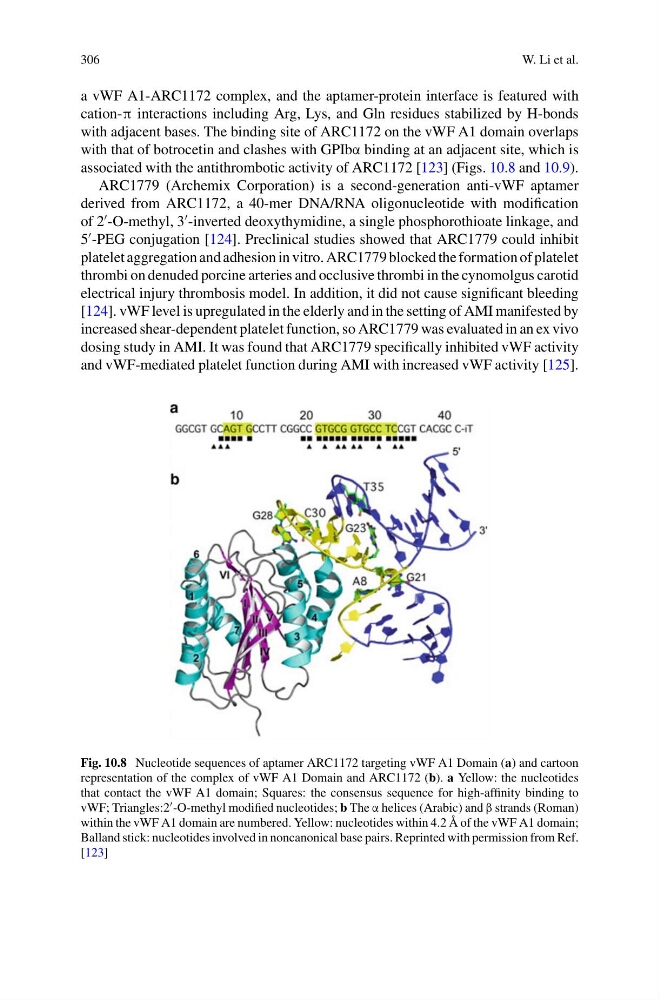
a vWF A1-ARC1172 complex, and the aptamer-protein interface is featured with
cation-π interactions including Arg, Lys, and Gln residues stabilized by H-bonds
with adjacent bases. The binding site of ARC1172 on the vWF A1 domain overlaps
with that of botrocetin and clashes with GPIbα binding at an adjacent site, which is
associated with the antithrombotic activity of ARC1172 [123] (Figs. 10.8 and 10.9).
ARC1779 (Archemix Corporation) is a second-generation anti-vWF aptamer
derived from ARC1172, a 40-mer DNA/RNA oligonucleotide with modification
of 2
-O-methyl, 3
-inverted deoxythymidine, a single phosphorothioate linkage, and
5
-PEG conjugation [124]. Preclinical studies showed that ARC1779 could inhibit
platelet aggregation and adhesion in vitro. ARC1779 blocked the formation of platelet
thrombi on denuded porcine arteries and occlusive thrombi in the cynomolgus carotid
electrical injury thrombosis model. In addition, it did not cause significant bleeding
[124]. vWF level is upregulated in the elderly and in the setting of AMI manifested by
increased shear-dependent platelet function, so ARC1779 was evaluated in an ex vivo
dosing study in AMI. It was found that ARC1779 specifically inhibited vWF activity
and vWF-mediated platelet function during AMI with increased vWF activity [125].
Fig. 10.8 Nucleotide sequences of aptamer ARC1172 targeting vWF A1 Domain (a) and cartoon
representation of the complex of vWF A1 Domain and ARC1172 (b). a Yellow: the nucleotides
that contact the vWF A1 domain; Squares: the consensus sequence for high-affinity binding to
vWF; Triangles:2 -O-methyl modified nucleotides; b The α helices (Arabic) and β strands (Roman)
within the vWF A1 domain are numbered. Yellow: nucleotides within 4.2 Å of the vWF A1 domain;
Balland stick: nucleotides involved in noncanonical base pairs. Reprinted with permission from Ref.
[123]
W. Li et al.
a vWF A1-ARC1172 complex, and the aptamer-protein interface is featured with
cation-π interactions including Arg, Lys, and Gln residues stabilized by H-bonds
with adjacent bases. The binding site of ARC1172 on the vWF A1 domain overlaps
with that of botrocetin and clashes with GPIbα binding at an adjacent site, which is
associated with the antithrombotic activity of ARC1172 [123] (Figs. 10.8 and 10.9).
ARC1779 (Archemix Corporation) is a second-generation anti-vWF aptamer
derived from ARC1172, a 40-mer DNA/RNA oligonucleotide with modification
of 2
-O-methyl, 3
-inverted deoxythymidine, a single phosphorothioate linkage, and
5
-PEG conjugation [124]. Preclinical studies showed that ARC1779 could inhibit
platelet aggregation and adhesion in vitro. ARC1779 blocked the formation of platelet
thrombi on denuded porcine arteries and occlusive thrombi in the cynomolgus carotid
electrical injury thrombosis model. In addition, it did not cause significant bleeding
[124]. vWF level is upregulated in the elderly and in the setting of AMI manifested by
increased shear-dependent platelet function, so ARC1779 was evaluated in an ex vivo
dosing study in AMI. It was found that ARC1779 specifically inhibited vWF activity
and vWF-mediated platelet function during AMI with increased vWF activity [125].
Fig. 10.8 Nucleotide sequences of aptamer ARC1172 targeting vWF A1 Domain (a) and cartoon
representation of the complex of vWF A1 Domain and ARC1172 (b). a Yellow: the nucleotides
that contact the vWF A1 domain; Squares: the consensus sequence for high-affinity binding to
vWF; Triangles:2 -O-methyl modified nucleotides; b The α helices (Arabic) and β strands (Roman)
within the vWF A1 domain are numbered. Yellow: nucleotides within 4.2 Å of the vWF A1 domain;
Balland stick: nucleotides involved in noncanonical base pairs. Reprinted with permission from Ref.
[123]