

10 Aptamers for Thrombotic Diseases
305
only facilitate the treatment of patients in surgical settings, but also be free of both
periprocedural thrombotic and periprocedural hemorrhagic events [118].
vWF, a mediator of platelet adhesion related to the initial platelet accumulation
in thrombosis, is a multimeric glycoprotein synthesized by endothelial cells and
megakaryocytes. It is also a protective carrier of FVIII in circulation. In the presence of intravascular shear forces, endothelial damage, or in atherosclerotic rupture
subendothelial collagen is exposed to circulating blood, and vWF acts as a bridge
between collagen and platelets for hemostasis. vWF binds to GP Ib–IX–V complex
and collagen to mediate initial platelet adhesion, and binds to GPIIb-IIIa for platelet
aggregation, then activates platelet and the coagulation cascade, and coordinates the
fibrin and platelet-rich thrombus formation at last [119]. The interaction results in
outside-in signal transduction and thus platelet activation. vWF level is correlated
with the risk of stroke, myocardial infarction, and death and vWF inhibitors have been
demonstrated to significantly attenuate thrombosis and bleeding in surgery [120–
122]. Since vWF plays a prominent role in various cardiovascular diseases through
vWF-mediated platelet activation, the GPIb-vWF axis is becoming a promising target
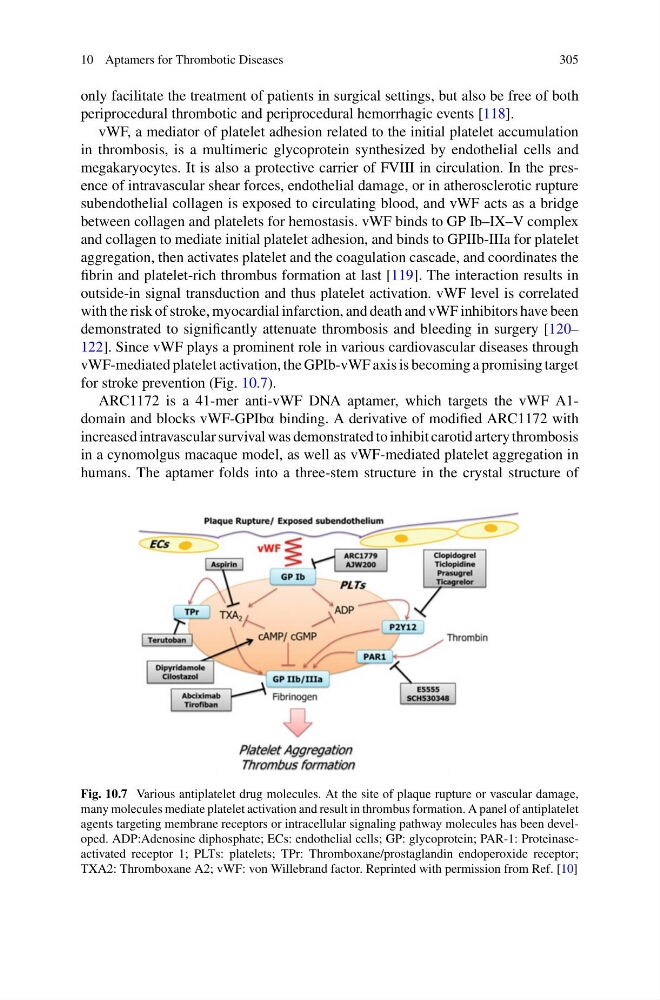
for stroke prevention (Fig. 10.7).
ARC1172 is a 41-mer anti-vWF DNA aptamer, which targets the vWF A1domain and blocks vWF-GPIbα binding. A derivative of modified ARC1172 with
increased intravascular survival was demonstrated to inhibit carotid artery thrombosis
in a cynomolgus macaque model, as well as vWF-mediated platelet aggregation in
humans. The aptamer folds into a three-stem structure in the crystal structure of
Fig. 10.7 Various antiplatelet drug molecules. At the site of plaque rupture or vascular damage,
many molecules mediate platelet activation and result in thrombus formation. A panel of antiplatelet
agents targeting membrane receptors or intracellular signaling pathway molecules has been developed. ADP:Adenosine diphosphate; ECs: endothelial cells; GP: glycoprotein; PAR-1: Proteinaseactivated receptor 1; PLTs: platelets; TPr: Thromboxane/prostaglandin endoperoxide receptor;
TXA2: Thromboxane A2; vWF: von Willebrand factor. Reprinted with permission from Ref. [10]
305
only facilitate the treatment of patients in surgical settings, but also be free of both
periprocedural thrombotic and periprocedural hemorrhagic events [118].
vWF, a mediator of platelet adhesion related to the initial platelet accumulation
in thrombosis, is a multimeric glycoprotein synthesized by endothelial cells and
megakaryocytes. It is also a protective carrier of FVIII in circulation. In the presence of intravascular shear forces, endothelial damage, or in atherosclerotic rupture
subendothelial collagen is exposed to circulating blood, and vWF acts as a bridge
between collagen and platelets for hemostasis. vWF binds to GP Ib–IX–V complex
and collagen to mediate initial platelet adhesion, and binds to GPIIb-IIIa for platelet
aggregation, then activates platelet and the coagulation cascade, and coordinates the
fibrin and platelet-rich thrombus formation at last [119]. The interaction results in
outside-in signal transduction and thus platelet activation. vWF level is correlated
with the risk of stroke, myocardial infarction, and death and vWF inhibitors have been
demonstrated to significantly attenuate thrombosis and bleeding in surgery [120–
122]. Since vWF plays a prominent role in various cardiovascular diseases through
vWF-mediated platelet activation, the GPIb-vWF axis is becoming a promising target
for stroke prevention (Fig. 10.7).
ARC1172 is a 41-mer anti-vWF DNA aptamer, which targets the vWF A1domain and blocks vWF-GPIbα binding. A derivative of modified ARC1172 with
increased intravascular survival was demonstrated to inhibit carotid artery thrombosis
in a cynomolgus macaque model, as well as vWF-mediated platelet aggregation in
humans. The aptamer folds into a three-stem structure in the crystal structure of
Fig. 10.7 Various antiplatelet drug molecules. At the site of plaque rupture or vascular damage,
many molecules mediate platelet activation and result in thrombus formation. A panel of antiplatelet
agents targeting membrane receptors or intracellular signaling pathway molecules has been developed. ADP:Adenosine diphosphate; ECs: endothelial cells; GP: glycoprotein; PAR-1: Proteinaseactivated receptor 1; PLTs: platelets; TPr: Thromboxane/prostaglandin endoperoxide receptor;
TXA2: Thromboxane A2; vWF: von Willebrand factor. Reprinted with permission from Ref. [10]