

10 Aptamers for Thrombotic Diseases
291
reactions showed that RE31 was more effective than 31TBA. RE31 inhibited human
thrombin activity more effectively than that of rat and rabbit, suggesting speciesspecific effect of RE31 [54].
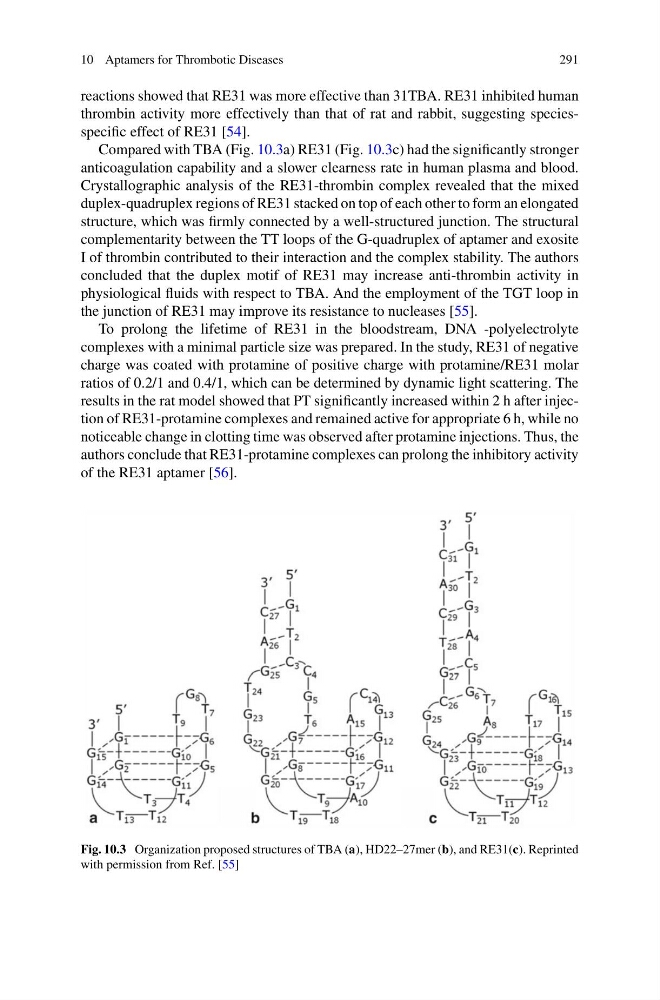
Compared with TBA (Fig. 10.3a) RE31 (Fig. 10.3c) had the significantly stronger
anticoagulation capability and a slower clearness rate in human plasma and blood.
Crystallographic analysis of the RE31-thrombin complex revealed that the mixed
duplex-quadruplex regions of RE31 stacked on top of each other to form an elongated
structure, which was firmly connected by a well-structured junction. The structural
complementarity between the TT loops of the G-quadruplex of aptamer and exosite
I of thrombin contributed to their interaction and the complex stability. The authors
concluded that the duplex motif of RE31 may increase anti-thrombin activity in
physiological fluids with respect to TBA. And the employment of the TGT loop in
the junction of RE31 may improve its resistance to nucleases [55].
To prolong the lifetime of RE31 in the bloodstream, DNA -polyelectrolyte
complexes with a minimal particle size was prepared. In the study, RE31 of negative
charge was coated with protamine of positive charge with protamine/RE31 molar
ratios of 0.2/1 and 0.4/1, which can be determined by dynamic light scattering. The
results in the rat model showed that PT significantly increased within 2 h after injection of RE31-protamine complexes and remained active for appropriate 6 h, while no
noticeable change in clotting time was observed after protamine injections. Thus, the
authors conclude that RE31-protamine complexes can prolong the inhibitory activity
of the RE31 aptamer [56].
Fig. 10.3 Organization proposed structures of TBA (a), HD22–27mer (b), and RE31(c). Reprinted
with permission from Ref. [55]
291
reactions showed that RE31 was more effective than 31TBA. RE31 inhibited human
thrombin activity more effectively than that of rat and rabbit, suggesting speciesspecific effect of RE31 [54].
Compared with TBA (Fig. 10.3a) RE31 (Fig. 10.3c) had the significantly stronger
anticoagulation capability and a slower clearness rate in human plasma and blood.
Crystallographic analysis of the RE31-thrombin complex revealed that the mixed
duplex-quadruplex regions of RE31 stacked on top of each other to form an elongated
structure, which was firmly connected by a well-structured junction. The structural
complementarity between the TT loops of the G-quadruplex of aptamer and exosite
I of thrombin contributed to their interaction and the complex stability. The authors
concluded that the duplex motif of RE31 may increase anti-thrombin activity in
physiological fluids with respect to TBA. And the employment of the TGT loop in
the junction of RE31 may improve its resistance to nucleases [55].
To prolong the lifetime of RE31 in the bloodstream, DNA -polyelectrolyte
complexes with a minimal particle size was prepared. In the study, RE31 of negative
charge was coated with protamine of positive charge with protamine/RE31 molar
ratios of 0.2/1 and 0.4/1, which can be determined by dynamic light scattering. The
results in the rat model showed that PT significantly increased within 2 h after injection of RE31-protamine complexes and remained active for appropriate 6 h, while no
noticeable change in clotting time was observed after protamine injections. Thus, the
authors conclude that RE31-protamine complexes can prolong the inhibitory activity
of the RE31 aptamer [56].
Fig. 10.3 Organization proposed structures of TBA (a), HD22–27mer (b), and RE31(c). Reprinted
with permission from Ref. [55]