

1 Introduction of Aptamer, SELEX, and Different SELEX Variants
15
cells gives rise to several RNA aptamers toward ITGAV with dissociation constants
ranging from 300 to 400 nM. Thus, the impediment of endogenous expression of
target proteins in mocked cells or the heterogeneity of surface proteins between
selection and counter-selection cells was successfully overcome, as expected.
Prostate Specific Membrane Antigen (PSMA), overexpressed in prostate cancer, is
a highly specific marker and therefore can be used for diagnosis of the prostate cancer
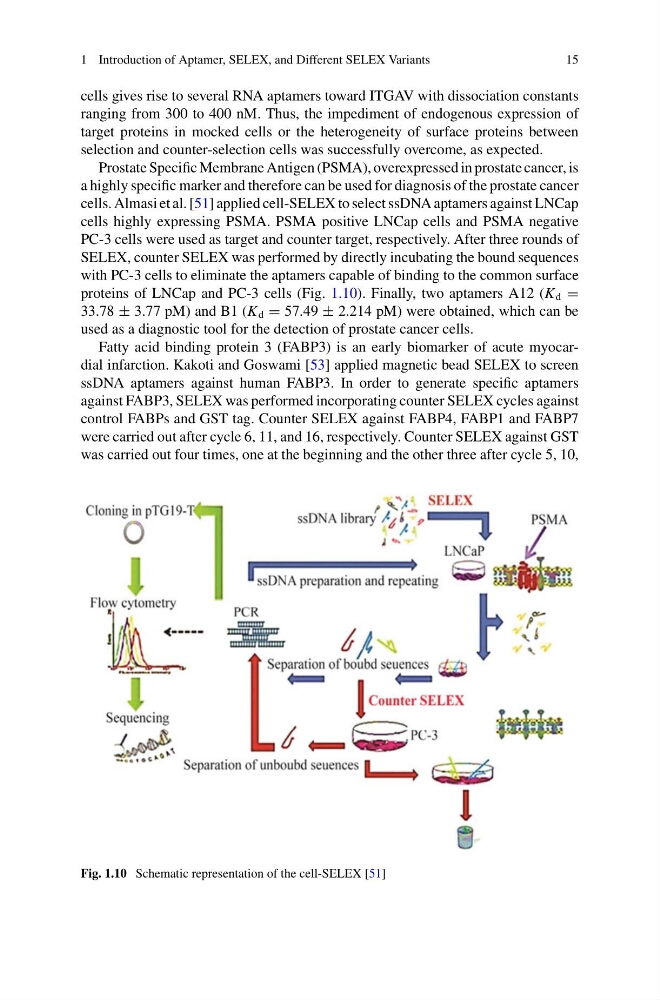
cells. Almasi et al. [51] applied cell-SELEX to select ssDNA aptamers against LNCap
cells highly expressing PSMA. PSMA positive LNCap cells and PSMA negative
PC-3 cells were used as target and counter target, respectively. After three rounds of
SELEX, counter SELEX was performed by directly incubating the bound sequences
with PC-3 cells to eliminate the aptamers capable of binding to the common surface
proteins of LNCap and PC-3 cells (Fig. 1.10). Finally, two aptamers A12 (K d =
33.78 ± 3.77 pM) and B1 (K d = 57.49 ± 2.214 pM) were obtained, which can be
used as a diagnostic tool for the detection of prostate cancer cells.
Fatty acid binding protein 3 (FABP3) is an early biomarker of acute myocardial infarction. Kakoti and Goswami [53] applied magnetic bead SELEX to screen
ssDNA aptamers against human FABP3. In order to generate specific aptamers
against FABP3, SELEX was performed incorporating counter SELEX cycles against
control FABPs and GST tag. Counter SELEX against FABP4, FABP1 and FABP7
were carried out after cycle 6, 11, and 16, respectively. Counter SELEX against GST
was carried out four times, one at the beginning and the other three after cycle 5, 10,
Fig. 1.10 Schematic representation of the cell-SELEX [51]
15
cells gives rise to several RNA aptamers toward ITGAV with dissociation constants
ranging from 300 to 400 nM. Thus, the impediment of endogenous expression of
target proteins in mocked cells or the heterogeneity of surface proteins between
selection and counter-selection cells was successfully overcome, as expected.
Prostate Specific Membrane Antigen (PSMA), overexpressed in prostate cancer, is
a highly specific marker and therefore can be used for diagnosis of the prostate cancer
cells. Almasi et al. [51] applied cell-SELEX to select ssDNA aptamers against LNCap
cells highly expressing PSMA. PSMA positive LNCap cells and PSMA negative
PC-3 cells were used as target and counter target, respectively. After three rounds of
SELEX, counter SELEX was performed by directly incubating the bound sequences
with PC-3 cells to eliminate the aptamers capable of binding to the common surface
proteins of LNCap and PC-3 cells (Fig. 1.10). Finally, two aptamers A12 (K d =
33.78 ± 3.77 pM) and B1 (K d = 57.49 ± 2.214 pM) were obtained, which can be
used as a diagnostic tool for the detection of prostate cancer cells.
Fatty acid binding protein 3 (FABP3) is an early biomarker of acute myocardial infarction. Kakoti and Goswami [53] applied magnetic bead SELEX to screen
ssDNA aptamers against human FABP3. In order to generate specific aptamers
against FABP3, SELEX was performed incorporating counter SELEX cycles against
control FABPs and GST tag. Counter SELEX against FABP4, FABP1 and FABP7
were carried out after cycle 6, 11, and 16, respectively. Counter SELEX against GST
was carried out four times, one at the beginning and the other three after cycle 5, 10,
Fig. 1.10 Schematic representation of the cell-SELEX [51]