

14
L. Hao and H. Gu
purification support agarose matrix in the column as negative selection. The nonspecific binding sequences were removed from each pool. The affinity of the resultant
aptamers was about 10 times higher than that of aptamers obtained without negative selection. After that, most of the modified SELEX incorporated this process to
eliminate nonspecific sequences generated by their binding to the immobilization
matrices.
1.3.4.2 Counter SELEX
With the similar purpose of negative SELEX, counter SELEX is performed to remove
nonspecific binding or erroneous recognition with structurally similar compounds
of target analytes to enhance the specificity of aptamers. This is especially the case
when target molecules of low abundance are in complex matrices, such as cell lysates,
whole blood, or other body fluids. The obvious difference between counter SELEX
and negative SELEX is the different incubation objects which they used.
In 1994, Jenison et al. [48] introduced caffeine, a structural analog of theophylline,
to traditional SELEX. The screening process was first named counter SELEX.
Finally, one RNA aptamer was obtained, which bound to theophylline with a dissociation constant K d of 0.1 μM. This binding affinity is 10,000-fold greater than the RNA
molecule’s affinity for caffeine, which differs from theophylline only by a methyl
group at nitrogen atom N-7. It shows binding discrimination between theophylline
and caffeine that is ten-fold better than that for available antibodies. Then, the counter
SELEX procedure has been dramatically applied to other modified SELEX methods
to obtain more specific aptamers [49–51].
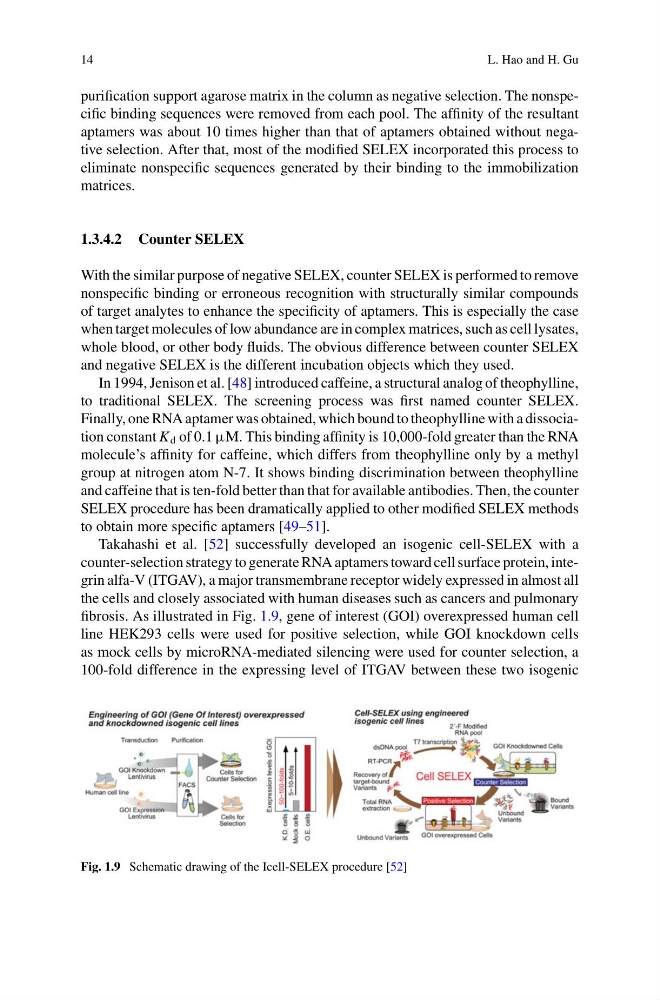
Takahashi et al. [52] successfully developed an isogenic cell-SELEX with a
counter-selection strategy to generate RNA aptamers toward cell surface protein, integrin alfa-V (ITGAV), a major transmembrane receptor widely expressed in almost all
the cells and closely associated with human diseases such as cancers and pulmonary
fibrosis. As illustrated in Fig. 1.9, gene of interest (GOI) overexpressed human cell
line HEK293 cells were used for positive selection, while GOI knockdown cells
as mock cells by microRNA-mediated silencing were used for counter selection, a
100-fold difference in the expressing level of ITGAV between these two isogenic
Fig. 1.9 Schematic drawing of the Icell-SELEX procedure [52]
L. Hao and H. Gu
purification support agarose matrix in the column as negative selection. The nonspecific binding sequences were removed from each pool. The affinity of the resultant
aptamers was about 10 times higher than that of aptamers obtained without negative selection. After that, most of the modified SELEX incorporated this process to
eliminate nonspecific sequences generated by their binding to the immobilization
matrices.
1.3.4.2 Counter SELEX
With the similar purpose of negative SELEX, counter SELEX is performed to remove
nonspecific binding or erroneous recognition with structurally similar compounds
of target analytes to enhance the specificity of aptamers. This is especially the case
when target molecules of low abundance are in complex matrices, such as cell lysates,
whole blood, or other body fluids. The obvious difference between counter SELEX
and negative SELEX is the different incubation objects which they used.
In 1994, Jenison et al. [48] introduced caffeine, a structural analog of theophylline,
to traditional SELEX. The screening process was first named counter SELEX.
Finally, one RNA aptamer was obtained, which bound to theophylline with a dissociation constant K d of 0.1 μM. This binding affinity is 10,000-fold greater than the RNA
molecule’s affinity for caffeine, which differs from theophylline only by a methyl
group at nitrogen atom N-7. It shows binding discrimination between theophylline
and caffeine that is ten-fold better than that for available antibodies. Then, the counter
SELEX procedure has been dramatically applied to other modified SELEX methods
to obtain more specific aptamers [49–51].
Takahashi et al. [52] successfully developed an isogenic cell-SELEX with a
counter-selection strategy to generate RNA aptamers toward cell surface protein, integrin alfa-V (ITGAV), a major transmembrane receptor widely expressed in almost all
the cells and closely associated with human diseases such as cancers and pulmonary
fibrosis. As illustrated in Fig. 1.9, gene of interest (GOI) overexpressed human cell
line HEK293 cells were used for positive selection, while GOI knockdown cells
as mock cells by microRNA-mediated silencing were used for counter selection, a
100-fold difference in the expressing level of ITGAV between these two isogenic
Fig. 1.9 Schematic drawing of the Icell-SELEX procedure [52]