

1 Introduction of Aptamer, SELEX, and Different SELEX Variants
7
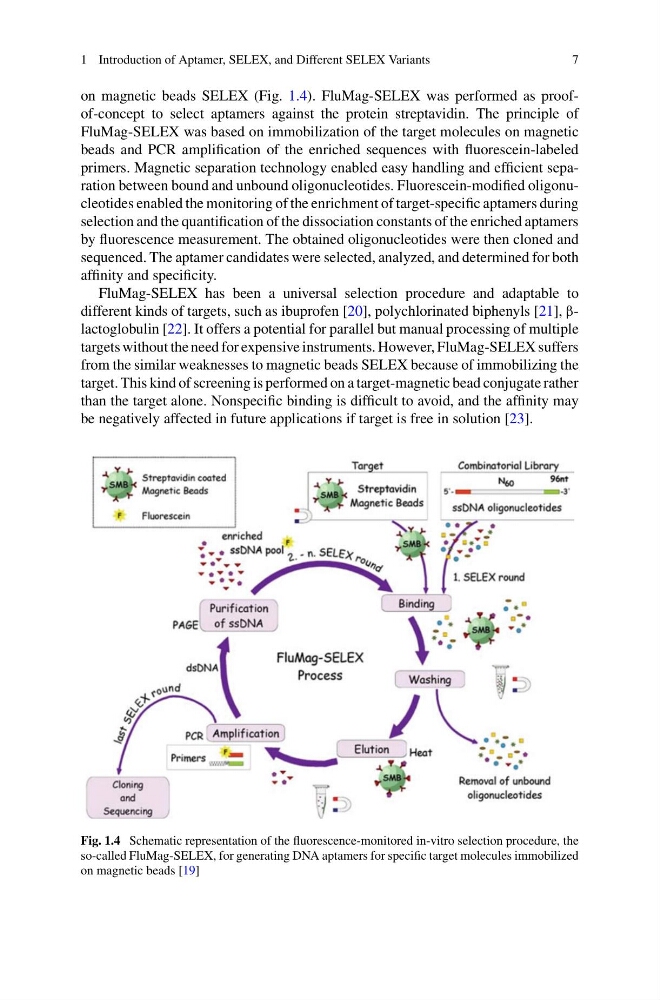
on magnetic beads SELEX (Fig. 1.4). FluMag-SELEX was performed as proofof-concept to select aptamers against the protein streptavidin. The principle of
FluMag-SELEX was based on immobilization of the target molecules on magnetic
beads and PCR amplification of the enriched sequences with fluorescein-labeled
primers. Magnetic separation technology enabled easy handling and efficient separation between bound and unbound oligonucleotides. Fluorescein-modified oligonucleotides enabled the monitoring of the enrichment of target-specific aptamers during
selection and the quantification of the dissociation constants of the enriched aptamers
by fluorescence measurement. The obtained oligonucleotides were then cloned and
sequenced. The aptamer candidates were selected, analyzed, and determined for both
affinity and specificity.
FluMag-SELEX has been a universal selection procedure and adaptable to
different kinds of targets, such as ibuprofen [20], polychlorinated biphenyls [21], βlactoglobulin [22]. It offers a potential for parallel but manual processing of multiple
targets without the need for expensive instruments. However, FluMag-SELEX suffers
from the similar weaknesses to magnetic beads SELEX because of immobilizing the
target. This kind of screening is performed on a target-magnetic bead conjugate rather
than the target alone. Nonspecific binding is difficult to avoid, and the affinity may
be negatively affected in future applications if target is free in solution [23].
Fig. 1.4 Schematic representation of the fluorescence-monitored in-vitro selection procedure, the
so-called FluMag-SELEX, for generating DNA aptamers for specific target molecules immobilized
on magnetic beads [19]
7
on magnetic beads SELEX (Fig. 1.4). FluMag-SELEX was performed as proofof-concept to select aptamers against the protein streptavidin. The principle of
FluMag-SELEX was based on immobilization of the target molecules on magnetic
beads and PCR amplification of the enriched sequences with fluorescein-labeled
primers. Magnetic separation technology enabled easy handling and efficient separation between bound and unbound oligonucleotides. Fluorescein-modified oligonucleotides enabled the monitoring of the enrichment of target-specific aptamers during
selection and the quantification of the dissociation constants of the enriched aptamers
by fluorescence measurement. The obtained oligonucleotides were then cloned and
sequenced. The aptamer candidates were selected, analyzed, and determined for both
affinity and specificity.
FluMag-SELEX has been a universal selection procedure and adaptable to
different kinds of targets, such as ibuprofen [20], polychlorinated biphenyls [21], βlactoglobulin [22]. It offers a potential for parallel but manual processing of multiple
targets without the need for expensive instruments. However, FluMag-SELEX suffers
from the similar weaknesses to magnetic beads SELEX because of immobilizing the
target. This kind of screening is performed on a target-magnetic bead conjugate rather
than the target alone. Nonspecific binding is difficult to avoid, and the affinity may
be negatively affected in future applications if target is free in solution [23].
Fig. 1.4 Schematic representation of the fluorescence-monitored in-vitro selection procedure, the
so-called FluMag-SELEX, for generating DNA aptamers for specific target molecules immobilized
on magnetic beads [19]