

152
G. Yang and Y. Huang
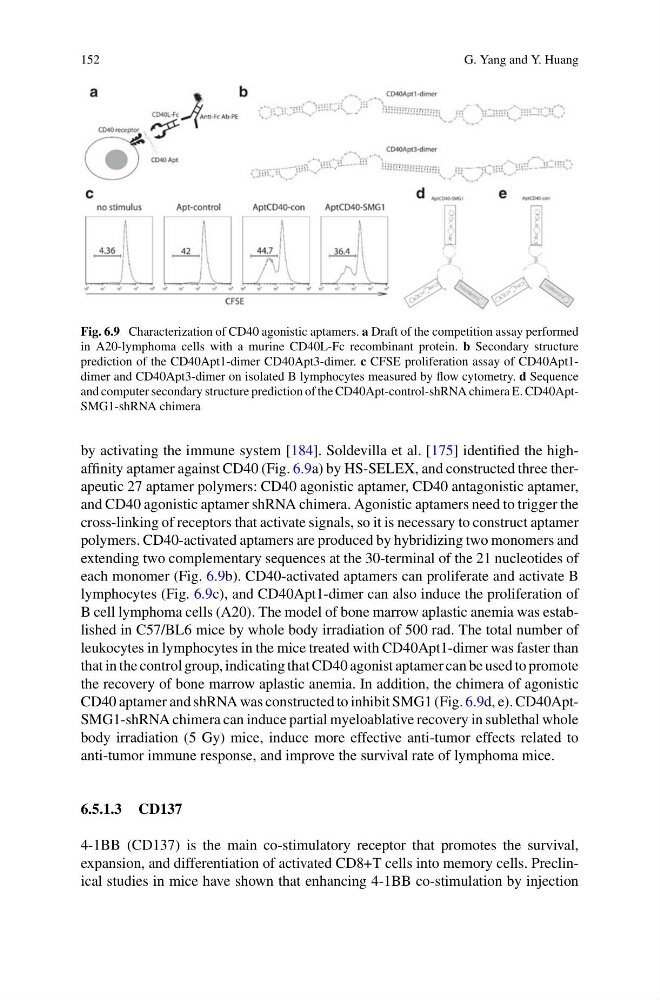
Fig. 6.9 Characterization of CD40 agonistic aptamers. a Draft of the competition assay performed
in A20-lymphoma cells with a murine CD40L-Fc recombinant protein. b Secondary structure
prediction of the CD40Apt1-dimer CD40Apt3-dimer. c CFSE proliferation assay of CD40Apt1dimer and CD40Apt3-dimer on isolated B lymphocytes measured by flow cytometry. d Sequence
and computer secondary structure prediction of the CD40Apt-control-shRNA chimera E. CD40AptSMG1-shRNA chimera
by activating the immune system [184]. Soldevilla et al. [175] identified the highaffinity aptamer against CD40 (Fig. 6.9a) by HS-SELEX, and constructed three therapeutic 27 aptamer polymers: CD40 agonistic aptamer, CD40 antagonistic aptamer,
and CD40 agonistic aptamer shRNA chimera. Agonistic aptamers need to trigger the
cross-linking of receptors that activate signals, so it is necessary to construct aptamer
polymers. CD40-activated aptamers are produced by hybridizing two monomers and
extending two complementary sequences at the 30-terminal of the 21 nucleotides of
each monomer (Fig. 6.9b). CD40-activated aptamers can proliferate and activate B
lymphocytes (Fig. 6.9c), and CD40Apt1-dimer can also induce the proliferation of
B cell lymphoma cells (A20). The model of bone marrow aplastic anemia was established in C57/BL6 mice by whole body irradiation of 500 rad. The total number of
leukocytes in lymphocytes in the mice treated with CD40Apt1-dimer was faster than
that in the control group, indicating that CD40 agonist aptamer can be used to promote
the recovery of bone marrow aplastic anemia. In addition, the chimera of agonistic
CD40 aptamer and shRNA was constructed to inhibit SMG1 (Fig. 6.9d, e). CD40AptSMG1-shRNA chimera can induce partial myeloablative recovery in sublethal whole
body irradiation (5 Gy) mice, induce more effective anti-tumor effects related to
anti-tumor immune response, and improve the survival rate of lymphoma mice.
6.5.1.3 CD137
4-1BB (CD137) is the main co-stimulatory receptor that promotes the survival,
expansion, and differentiation of activated CD8+T cells into memory cells. Preclinical studies in mice have shown that enhancing 4-1BB co-stimulation by injection
G. Yang and Y. Huang
Fig. 6.9 Characterization of CD40 agonistic aptamers. a Draft of the competition assay performed
in A20-lymphoma cells with a murine CD40L-Fc recombinant protein. b Secondary structure
prediction of the CD40Apt1-dimer CD40Apt3-dimer. c CFSE proliferation assay of CD40Apt1dimer and CD40Apt3-dimer on isolated B lymphocytes measured by flow cytometry. d Sequence
and computer secondary structure prediction of the CD40Apt-control-shRNA chimera E. CD40AptSMG1-shRNA chimera
by activating the immune system [184]. Soldevilla et al. [175] identified the highaffinity aptamer against CD40 (Fig. 6.9a) by HS-SELEX, and constructed three therapeutic 27 aptamer polymers: CD40 agonistic aptamer, CD40 antagonistic aptamer,
and CD40 agonistic aptamer shRNA chimera. Agonistic aptamers need to trigger the
cross-linking of receptors that activate signals, so it is necessary to construct aptamer
polymers. CD40-activated aptamers are produced by hybridizing two monomers and
extending two complementary sequences at the 30-terminal of the 21 nucleotides of
each monomer (Fig. 6.9b). CD40-activated aptamers can proliferate and activate B
lymphocytes (Fig. 6.9c), and CD40Apt1-dimer can also induce the proliferation of
B cell lymphoma cells (A20). The model of bone marrow aplastic anemia was established in C57/BL6 mice by whole body irradiation of 500 rad. The total number of
leukocytes in lymphocytes in the mice treated with CD40Apt1-dimer was faster than
that in the control group, indicating that CD40 agonist aptamer can be used to promote
the recovery of bone marrow aplastic anemia. In addition, the chimera of agonistic
CD40 aptamer and shRNA was constructed to inhibit SMG1 (Fig. 6.9d, e). CD40AptSMG1-shRNA chimera can induce partial myeloablative recovery in sublethal whole
body irradiation (5 Gy) mice, induce more effective anti-tumor effects related to
anti-tumor immune response, and improve the survival rate of lymphoma mice.
6.5.1.3 CD137
4-1BB (CD137) is the main co-stimulatory receptor that promotes the survival,
expansion, and differentiation of activated CD8+T cells into memory cells. Preclinical studies in mice have shown that enhancing 4-1BB co-stimulation by injection