

130
G. Yang and Y. Huang
Table 6.1 Aptamers undergone clinical trials
Aptamer
Target
Diseases
Length Nucleotide Modification Phase
Macugen
VEGF 165
AMD
28 nt
RNA
PEGylation,
Muclease
stabilization
Launched
E10030
PDGF
AMD
29 nt
DNA
Ditto.
Phase 3
ARC1905
C5
AMD
39 nt
RNA
Ditto.
Phase 3
REG1
IXa Factor ACS
34 nt
RNA
Ditto.
Phase 2
ARC1779
vWF
AMI,
Thrombosis
40 nt
RNA
Ditto.
Phase 2
ARC19499 TFPI
Hemophilia
34 nt
RNA
Ditto.
Phase 1
Nu172
Thrombin Anticoagulation 26 nt
DNA
Muclease
stabilization
Phase 2
NOX-A12 SDF-1
CLL, RMN
45 nt
L-RNA
PEGylation
Phase 2
NOX-E36
MCP-1
T2DM, DN
40 nt
L-RNA
PEGylation
Phase 2
NOX-H94 Hepcidin
Anemia
44 nt
L-RNA
PEGylation
Phase 2
AS1411
Nucleolin AML, MRCC
26 nt
DNA
None
Phase 2
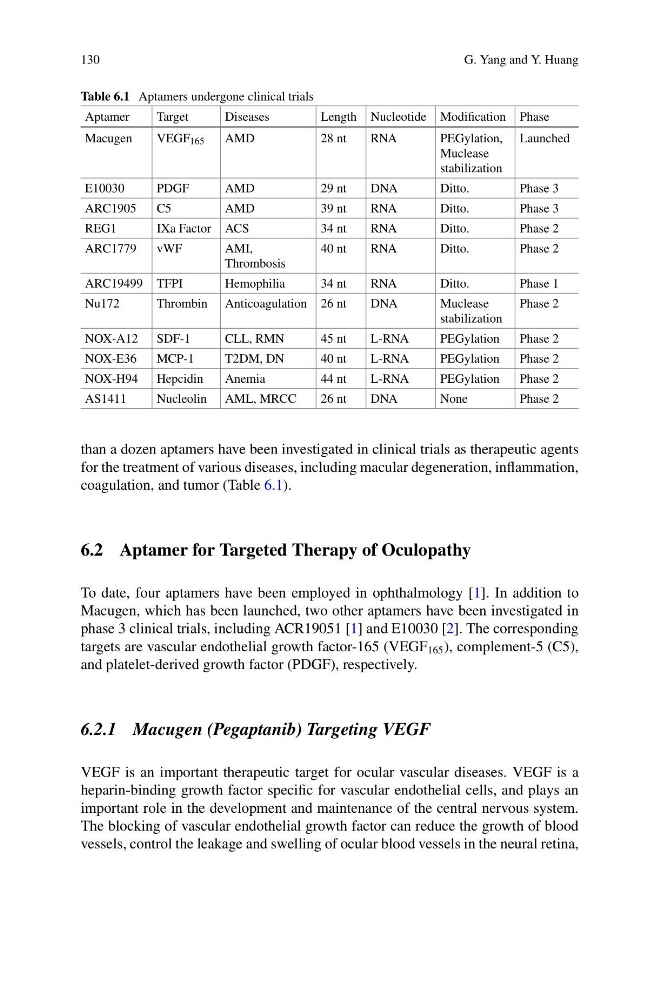
than a dozen aptamers have been investigated in clinical trials as therapeutic agents
for the treatment of various diseases, including macular degeneration, inflammation,
coagulation, and tumor (Table 6.1).
6.2 Aptamer for Targeted Therapy of Oculopathy
To date, four aptamers have been employed in ophthalmology [1]. In addition to
Macugen, which has been launched, two other aptamers have been investigated in
phase 3 clinical trials, including ACR19051 [1] and E10030 [2]. The corresponding
targets are vascular endothelial growth factor-165 (VEGF 165 ), complement-5 (C5),
and platelet-derived growth factor (PDGF), respectively.
6.2.1 Macugen (Pegaptanib) Targeting VEGF
VEGF is an important therapeutic target for ocular vascular diseases. VEGF is a
heparin-binding growth factor specific for vascular endothelial cells, and plays an
important role in the development and maintenance of the central nervous system.
The blocking of vascular endothelial growth factor can reduce the growth of blood
vessels, control the leakage and swelling of ocular blood vessels in the neural retina,
G. Yang and Y. Huang
Table 6.1 Aptamers undergone clinical trials
Aptamer
Target
Diseases
Length Nucleotide Modification Phase
Macugen
VEGF 165
AMD
28 nt
RNA
PEGylation,
Muclease
stabilization
Launched
E10030
PDGF
AMD
29 nt
DNA
Ditto.
Phase 3
ARC1905
C5
AMD
39 nt
RNA
Ditto.
Phase 3
REG1
IXa Factor ACS
34 nt
RNA
Ditto.
Phase 2
ARC1779
vWF
AMI,
Thrombosis
40 nt
RNA
Ditto.
Phase 2
ARC19499 TFPI
Hemophilia
34 nt
RNA
Ditto.
Phase 1
Nu172
Thrombin Anticoagulation 26 nt
DNA
Muclease
stabilization
Phase 2
NOX-A12 SDF-1
CLL, RMN
45 nt
L-RNA
PEGylation
Phase 2
NOX-E36
MCP-1
T2DM, DN
40 nt
L-RNA
PEGylation
Phase 2
NOX-H94 Hepcidin
Anemia
44 nt
L-RNA
PEGylation
Phase 2
AS1411
Nucleolin AML, MRCC
26 nt
DNA
None
Phase 2
than a dozen aptamers have been investigated in clinical trials as therapeutic agents
for the treatment of various diseases, including macular degeneration, inflammation,
coagulation, and tumor (Table 6.1).
6.2 Aptamer for Targeted Therapy of Oculopathy
To date, four aptamers have been employed in ophthalmology [1]. In addition to
Macugen, which has been launched, two other aptamers have been investigated in
phase 3 clinical trials, including ACR19051 [1] and E10030 [2]. The corresponding
targets are vascular endothelial growth factor-165 (VEGF 165 ), complement-5 (C5),
and platelet-derived growth factor (PDGF), respectively.
6.2.1 Macugen (Pegaptanib) Targeting VEGF
VEGF is an important therapeutic target for ocular vascular diseases. VEGF is a
heparin-binding growth factor specific for vascular endothelial cells, and plays an
important role in the development and maintenance of the central nervous system.
The blocking of vascular endothelial growth factor can reduce the growth of blood
vessels, control the leakage and swelling of ocular blood vessels in the neural retina,