

Kinematic and Kinetic Analysis of a Biomechanical Model
63
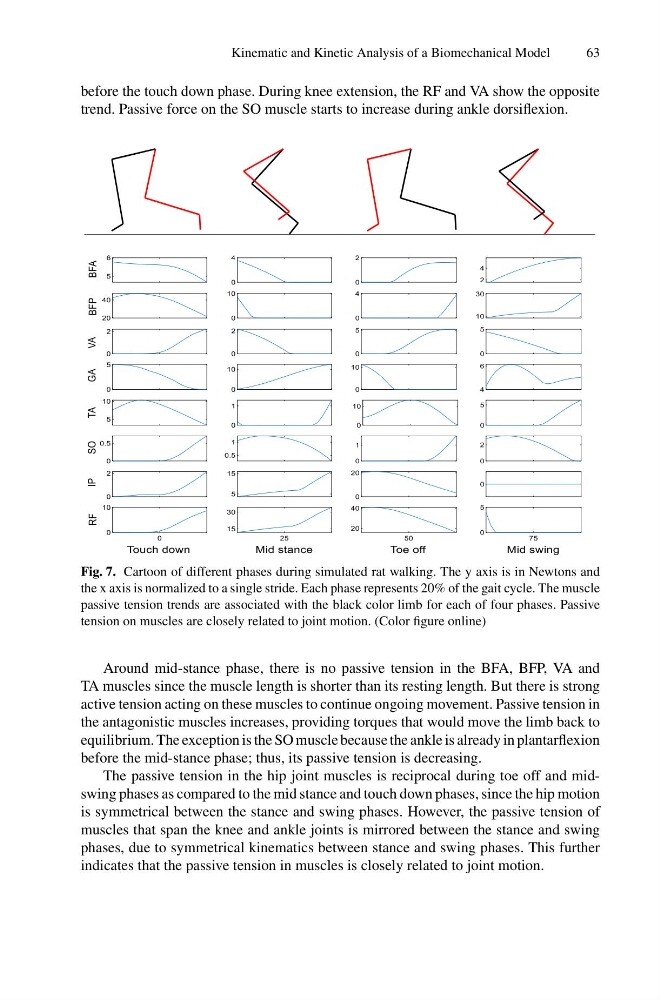
before the touch down phase. During knee extension, the RF and VA show the opposite
trend. Passive force on the SO muscle starts to increase during ankle dorsiflexion.
Fig. 7. Cartoon of different phases during simulated rat walking. The y axis is in Newtons and
the x axis is normalized to a single stride. Each phase represents 20% of the gait cycle. The muscle
passive tension trends are associated with the black color limb for each of four phases. Passive
tension on muscles are closely related to joint motion. (Color figure online)
Around mid-stance phase, there is no passive tension in the BFA, BFP, VA and
TA muscles since the muscle length is shorter than its resting length. But there is strong
active tension acting on these muscles to continue ongoing movement. Passive tension in
the antagonistic muscles increases, providing torques that would move the limb back to
equilibrium. The exception is the SO muscle because the ankle is already in plantarflexion
before the mid-stance phase; thus, its passive tension is decreasing.
The passive tension in the hip joint muscles is reciprocal during toe off and midswing phases as compared to the mid stance and touch down phases, since the hip motion
is symmetrical between the stance and swing phases. However, the passive tension of
muscles that span the knee and ankle joints is mirrored between the stance and swing
phases, due to symmetrical kinematics between stance and swing phases. This further
indicates that the passive tension in muscles is closely related to joint motion.
63
before the touch down phase. During knee extension, the RF and VA show the opposite
trend. Passive force on the SO muscle starts to increase during ankle dorsiflexion.
Fig. 7. Cartoon of different phases during simulated rat walking. The y axis is in Newtons and
the x axis is normalized to a single stride. Each phase represents 20% of the gait cycle. The muscle
passive tension trends are associated with the black color limb for each of four phases. Passive
tension on muscles are closely related to joint motion. (Color figure online)
Around mid-stance phase, there is no passive tension in the BFA, BFP, VA and
TA muscles since the muscle length is shorter than its resting length. But there is strong
active tension acting on these muscles to continue ongoing movement. Passive tension in
the antagonistic muscles increases, providing torques that would move the limb back to
equilibrium. The exception is the SO muscle because the ankle is already in plantarflexion
before the mid-stance phase; thus, its passive tension is decreasing.
The passive tension in the hip joint muscles is reciprocal during toe off and midswing phases as compared to the mid stance and touch down phases, since the hip motion
is symmetrical between the stance and swing phases. However, the passive tension of
muscles that span the knee and ankle joints is mirrored between the stance and swing
phases, due to symmetrical kinematics between stance and swing phases. This further
indicates that the passive tension in muscles is closely related to joint motion.