

42
T. Cheng et al.
A
B
C
D
E
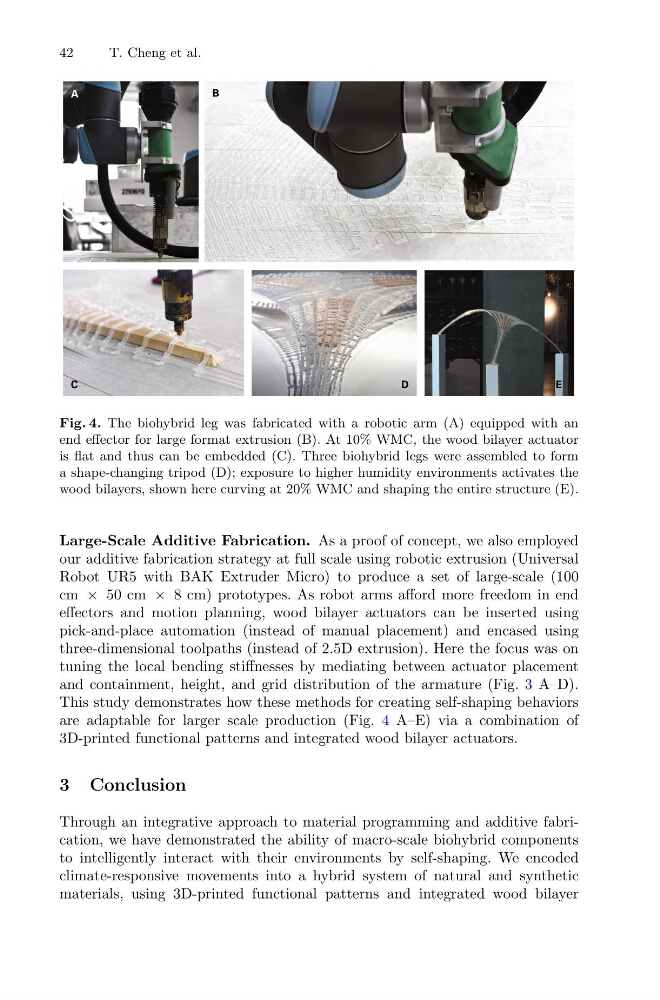
Fig. 4. The biohybrid leg was fabricated with a robotic arm (A) equipped with an
end effector for large format extrusion (B). At 10% WMC, the wood bilayer actuator
is flat and thus can be embedded (C). Three biohybrid legs were assembled to form
a shape-changing tripod (D); exposure to higher humidity environments activates the
wood bilayers, shown here curving at 20% WMC and shaping the entire structure (E).
Large-Scale Additive Fabrication. As a proof of concept, we also employed
our additive fabrication strategy at full scale using robotic extrusion (Universal
Robot UR5 with BAK Extruder Micro) to produce a set of large-scale (100
cm × 50 cm × 8 cm) prototypes. As robot arms afford more freedom in end
effectors and motion planning, wood bilayer actuators can be inserted using
pick-and-place automation (instead of manual placement) and encased using
three-dimensional toolpaths (instead of 2.5D extrusion). Here the focus was on
tuning the local bending stiffnesses by mediating between actuator placement
and containment, height, and grid distribution of the armature (Fig. 3 A–D).
This study demonstrates how these methods for creating self-shaping behaviors
are adaptable for larger scale production (Fig. 4 A–E) via a combination of
3D-printed functional patterns and integrated wood bilayer actuators.
3 Conclusion
Through an integrative approach to material programming and additive fabrication, we have demonstrated the ability of macro-scale biohybrid components
to intelligently interact with their environments by self-shaping. We encoded
climate-responsive movements into a hybrid system of natural and synthetic
materials, using 3D-printed functional patterns and integrated wood bilayer
T. Cheng et al.
A
B
C
D
E
Fig. 4. The biohybrid leg was fabricated with a robotic arm (A) equipped with an
end effector for large format extrusion (B). At 10% WMC, the wood bilayer actuator
is flat and thus can be embedded (C). Three biohybrid legs were assembled to form
a shape-changing tripod (D); exposure to higher humidity environments activates the
wood bilayers, shown here curving at 20% WMC and shaping the entire structure (E).
Large-Scale Additive Fabrication. As a proof of concept, we also employed
our additive fabrication strategy at full scale using robotic extrusion (Universal
Robot UR5 with BAK Extruder Micro) to produce a set of large-scale (100
cm × 50 cm × 8 cm) prototypes. As robot arms afford more freedom in end
effectors and motion planning, wood bilayer actuators can be inserted using
pick-and-place automation (instead of manual placement) and encased using
three-dimensional toolpaths (instead of 2.5D extrusion). Here the focus was on
tuning the local bending stiffnesses by mediating between actuator placement
and containment, height, and grid distribution of the armature (Fig. 3 A–D).
This study demonstrates how these methods for creating self-shaping behaviors
are adaptable for larger scale production (Fig. 4 A–E) via a combination of
3D-printed functional patterns and integrated wood bilayer actuators.
3 Conclusion
Through an integrative approach to material programming and additive fabrication, we have demonstrated the ability of macro-scale biohybrid components
to intelligently interact with their environments by self-shaping. We encoded
climate-responsive movements into a hybrid system of natural and synthetic
materials, using 3D-printed functional patterns and integrated wood bilayer