

Integrated Topological Planning and Scheduling
31
MILP problem formulation is an extension of our previous work on large scale
HRC orchestration [16], that is able to handle variable spatial distances and
agent and process assignment constraints to specific workstations. Through this
constraints, the search space is limited which results in a faster optimization.
4 Experimental Validation
Initial experimental validation is performed in order to evaluate the precise contribution of the proposed multi-stage optimization approach. We perform a series
of evaluations on problems of different size with respect to included agents,
workstations and processes. This type of evaluation through the use of synthetic
problem definitions is typical in resource allocation and scheduling. In our evaluations, we consider problem instances of up to 10 agents, 10 workstations and
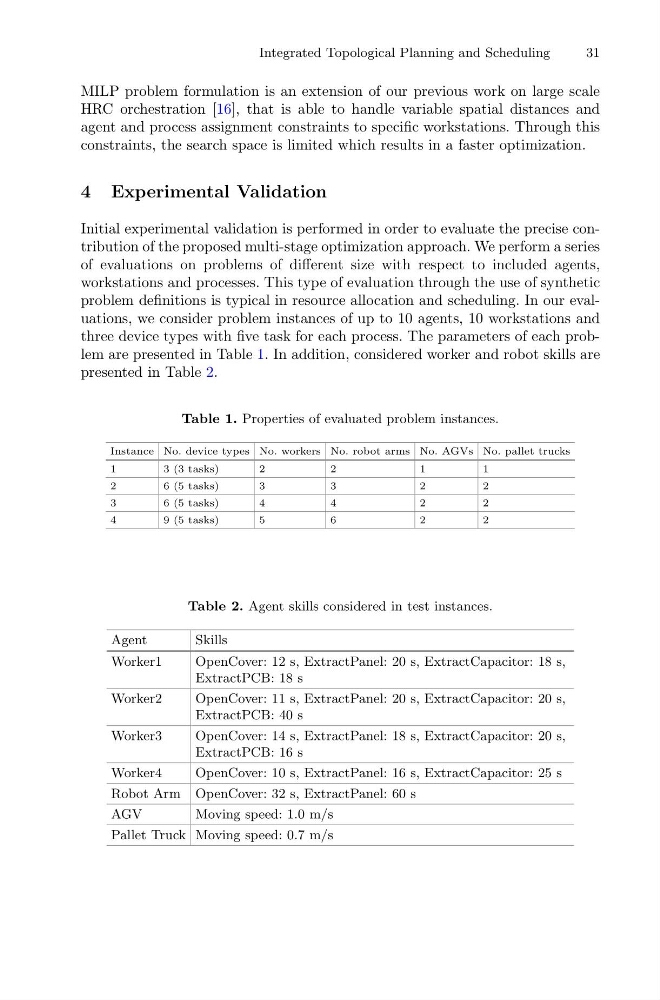
three device types with five task for each process. The parameters of each problem are presented in Table 1. In addition, considered worker and robot skills are
presented in Table 2.
Table 1. Properties of evaluated problem instances.
Instance No. device types No. workers No. robot arms No. AGVs No. pallet trucks
1
3 (3 tasks)
2
2
1
1
2
6 (5 tasks)
3
3
2
2
3
6 (5 tasks)
4
4
2
2
4
9 (5 tasks)
5
6
2
2
Table 2. Agent skills considered in test instances.
Agent
Skills
Worker1
OpenCover: 12 s, ExtractPanel: 20 s, ExtractCapacitor: 18 s,
ExtractPCB: 18 s
Worker2
OpenCover: 11 s, ExtractPanel: 20 s, ExtractCapacitor: 20 s,
ExtractPCB: 40 s
Worker3
OpenCover: 14 s, ExtractPanel: 18 s, ExtractCapacitor: 20 s,
ExtractPCB: 16 s
Worker4
OpenCover: 10 s, ExtractPanel: 16 s, ExtractCapacitor: 25 s
Robot Arm OpenCover: 32 s, ExtractPanel: 60 s
AGV
Moving speed: 1.0 m/s
Pallet Truck Moving speed: 0.7 m/s
31
MILP problem formulation is an extension of our previous work on large scale
HRC orchestration [16], that is able to handle variable spatial distances and
agent and process assignment constraints to specific workstations. Through this
constraints, the search space is limited which results in a faster optimization.
4 Experimental Validation
Initial experimental validation is performed in order to evaluate the precise contribution of the proposed multi-stage optimization approach. We perform a series
of evaluations on problems of different size with respect to included agents,
workstations and processes. This type of evaluation through the use of synthetic
problem definitions is typical in resource allocation and scheduling. In our evaluations, we consider problem instances of up to 10 agents, 10 workstations and
three device types with five task for each process. The parameters of each problem are presented in Table 1. In addition, considered worker and robot skills are
presented in Table 2.
Table 1. Properties of evaluated problem instances.
Instance No. device types No. workers No. robot arms No. AGVs No. pallet trucks
1
3 (3 tasks)
2
2
1
1
2
6 (5 tasks)
3
3
2
2
3
6 (5 tasks)
4
4
2
2
4
9 (5 tasks)
5
6
2
2
Table 2. Agent skills considered in test instances.
Agent
Skills
Worker1
OpenCover: 12 s, ExtractPanel: 20 s, ExtractCapacitor: 18 s,
ExtractPCB: 18 s
Worker2
OpenCover: 11 s, ExtractPanel: 20 s, ExtractCapacitor: 20 s,
ExtractPCB: 40 s
Worker3
OpenCover: 14 s, ExtractPanel: 18 s, ExtractCapacitor: 20 s,
ExtractPCB: 16 s
Worker4
OpenCover: 10 s, ExtractPanel: 16 s, ExtractCapacitor: 25 s
Robot Arm OpenCover: 32 s, ExtractPanel: 60 s
AGV
Moving speed: 1.0 m/s
Pallet Truck Moving speed: 0.7 m/s