

Using Animatlab for Neuromechanical Analysis
403
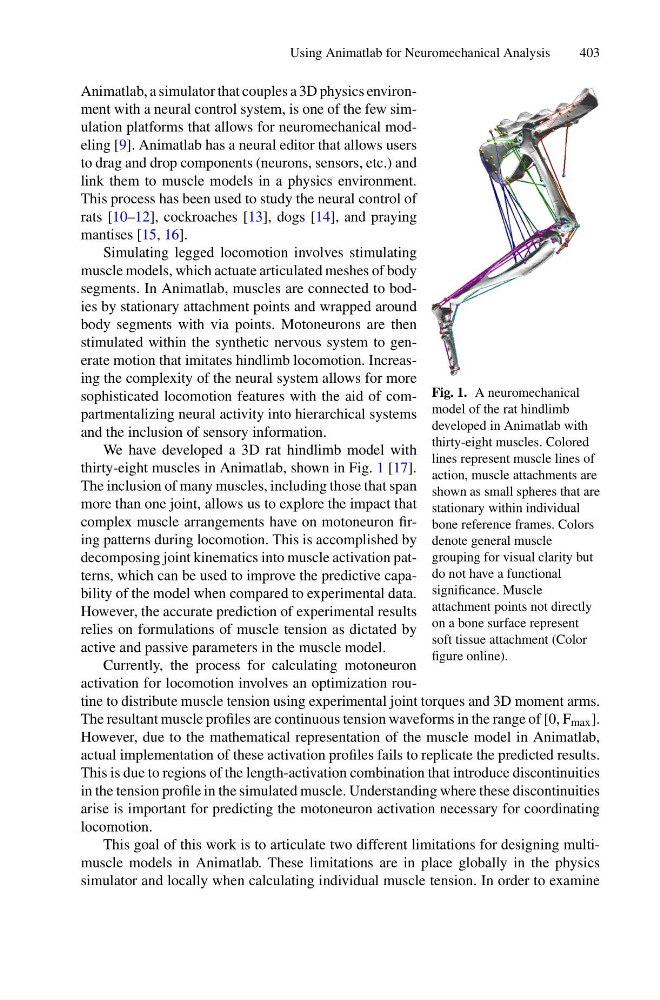
Fig. 1. A neuromechanical
model of the rat hindlimb
developed in Animatlab with
thirty-eight muscles. Colored
lines represent muscle lines of
action, muscle attachments are
shown as small spheres that are
stationary within individual
bone reference frames. Colors
denote general muscle
grouping for visual clarity but
do not have a functional
significance. Muscle
attachment points not directly
on a bone surface represent
soft tissue attachment (Color
figure online).
Animatlab, a simulator that couples a 3D physics environment with a neural control system, is one of the few simulation platforms that allows for neuromechanical modeling [9]. Animatlab has a neural editor that allows users
to drag and drop components (neurons, sensors, etc.) and
link them to muscle models in a physics environment.
This process has been used to study the neural control of
rats [10–12], cockroaches [13], dogs [14], and praying
mantises [15, 16].
Simulating legged locomotion involves stimulating
muscle models, which actuate articulated meshes of body
segments. In Animatlab, muscles are connected to bodies by stationary attachment points and wrapped around
body segments with via points. Motoneurons are then
stimulated within the synthetic nervous system to generate motion that imitates hindlimb locomotion. Increasing the complexity of the neural system allows for more
sophisticated locomotion features with the aid of compartmentalizing neural activity into hierarchical systems
and the inclusion of sensory information.
We have developed a 3D rat hindlimb model with
thirty-eight muscles in Animatlab, shown in Fig. 1 [17].
The inclusion of many muscles, including those that span
more than one joint, allows us to explore the impact that
complex muscle arrangements have on motoneuron firing patterns during locomotion. This is accomplished by
decomposing joint kinematics into muscle activation patterns, which can be used to improve the predictive capability of the model when compared to experimental data.
However, the accurate prediction of experimental results
relies on formulations of muscle tension as dictated by
active and passive parameters in the muscle model.
Currently, the process for calculating motoneuron
activation for locomotion involves an optimization routine to distribute muscle tension using experimental joint torques and 3D moment arms.
The resultant muscle profiles are continuous tension waveforms in the range of [0, F max ].
However, due to the mathematical representation of the muscle model in Animatlab,
actual implementation of these activation profiles fails to replicate the predicted results.
This is due to regions of the length-activation combination that introduce discontinuities
in the tension profile in the simulated muscle. Understanding where these discontinuities
arise is important for predicting the motoneuron activation necessary for coordinating
locomotion.
This goal of this work is to articulate two different limitations for designing multimuscle models in Animatlab. These limitations are in place globally in the physics
simulator and locally when calculating individual muscle tension. In order to examine
403
Fig. 1. A neuromechanical
model of the rat hindlimb
developed in Animatlab with
thirty-eight muscles. Colored
lines represent muscle lines of
action, muscle attachments are
shown as small spheres that are
stationary within individual
bone reference frames. Colors
denote general muscle
grouping for visual clarity but
do not have a functional
significance. Muscle
attachment points not directly
on a bone surface represent
soft tissue attachment (Color
figure online).
Animatlab, a simulator that couples a 3D physics environment with a neural control system, is one of the few simulation platforms that allows for neuromechanical modeling [9]. Animatlab has a neural editor that allows users
to drag and drop components (neurons, sensors, etc.) and
link them to muscle models in a physics environment.
This process has been used to study the neural control of
rats [10–12], cockroaches [13], dogs [14], and praying
mantises [15, 16].
Simulating legged locomotion involves stimulating
muscle models, which actuate articulated meshes of body
segments. In Animatlab, muscles are connected to bodies by stationary attachment points and wrapped around
body segments with via points. Motoneurons are then
stimulated within the synthetic nervous system to generate motion that imitates hindlimb locomotion. Increasing the complexity of the neural system allows for more
sophisticated locomotion features with the aid of compartmentalizing neural activity into hierarchical systems
and the inclusion of sensory information.
We have developed a 3D rat hindlimb model with
thirty-eight muscles in Animatlab, shown in Fig. 1 [17].
The inclusion of many muscles, including those that span
more than one joint, allows us to explore the impact that
complex muscle arrangements have on motoneuron firing patterns during locomotion. This is accomplished by
decomposing joint kinematics into muscle activation patterns, which can be used to improve the predictive capability of the model when compared to experimental data.
However, the accurate prediction of experimental results
relies on formulations of muscle tension as dictated by
active and passive parameters in the muscle model.
Currently, the process for calculating motoneuron
activation for locomotion involves an optimization routine to distribute muscle tension using experimental joint torques and 3D moment arms.
The resultant muscle profiles are continuous tension waveforms in the range of [0, F max ].
However, due to the mathematical representation of the muscle model in Animatlab,
actual implementation of these activation profiles fails to replicate the predicted results.
This is due to regions of the length-activation combination that introduce discontinuities
in the tension profile in the simulated muscle. Understanding where these discontinuities
arise is important for predicting the motoneuron activation necessary for coordinating
locomotion.
This goal of this work is to articulate two different limitations for designing multimuscle models in Animatlab. These limitations are in place globally in the physics
simulator and locally when calculating individual muscle tension. In order to examine