

Fast Reverse Replays in a Robotic Hippocampal Model
393
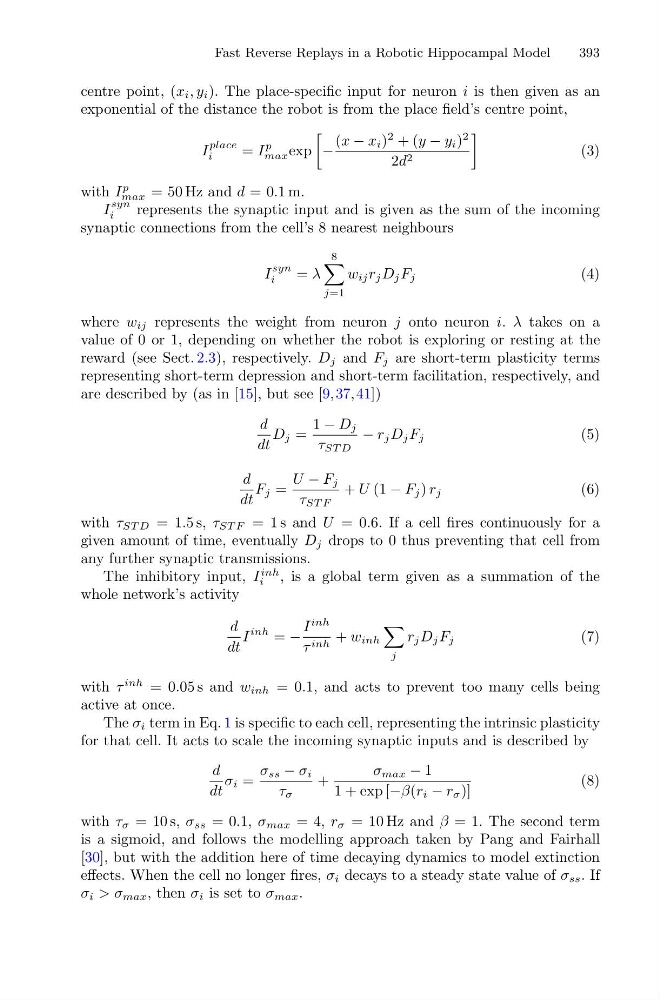
centre point, (x i , y i ). The place-specific input for neuron i is then given as an
exponential of the distance the robot is from the place field’s centre point,
I
place
i
= I
p
max exp
−
(x − x i )
2 + (y − y i )
2
2d 2
(3)
with I
p
max = 50 Hz and d = 0.1 m.
I
syn
i
represents the synaptic input and is given as the sum of the incoming
synaptic connections from the cell’s 8 nearest neighbours
I
syn
i
= λ
8
j=1
w ij r j D j F j
(4)
where w ij represents the weight from neuron j onto neuron i. λ takes on a
value of 0 or 1, depending on whether the robot is exploring or resting at the
reward (see Sect. 2.3), respectively. D j and F j are short-term plasticity terms
representing short-term depression and short-term facilitation, respectively, and
are described by (as in [15], but see [9,37,41])
d
dt
D j =
1 − D j
τ ST D
− r j D j F j
(5)
d
dt
F j =
U − F j
τ ST F
+ U (1 − F j ) r j
(6)
with τ ST D = 1.5 s, τ ST F = 1 s and U = 0.6. If a cell fires continuously for a
given amount of time, eventually D j drops to 0 thus preventing that cell from
any further synaptic transmissions.
The inhibitory input, I
inh
i
, is a global term given as a summation of the
whole network’s activity
d
dt
I
inh = −
I
inh
τ inh + w inh
j
r j D j F j
(7)
with τ
inh = 0.05 s and w inh = 0.1, and acts to prevent too many cells being
active at once.
The σ i term in Eq. 1 is specific to each cell, representing the intrinsic plasticity
for that cell. It acts to scale the incoming synaptic inputs and is described by
d
dt
σ i =
σ ss − σ i
τ σ
+
σ max − 1
1 + exp [−β(r i − r σ )]
(8)
with τ σ = 10 s, σ ss = 0.1, σ max = 4, r σ = 10 Hz and β = 1. The second term
is a sigmoid, and follows the modelling approach taken by Pang and Fairhall
[30], but with the addition here of time decaying dynamics to model extinction
effects. When the cell no longer fires, σ i decays to a steady state value of σ ss . If
σ i > σ max , then σ i is set to σ max .
393
centre point, (x i , y i ). The place-specific input for neuron i is then given as an
exponential of the distance the robot is from the place field’s centre point,
I
place
i
= I
p
max exp
−
(x − x i )
2 + (y − y i )
2
2d 2
(3)
with I
p
max = 50 Hz and d = 0.1 m.
I
syn
i
represents the synaptic input and is given as the sum of the incoming
synaptic connections from the cell’s 8 nearest neighbours
I
syn
i
= λ
8
j=1
w ij r j D j F j
(4)
where w ij represents the weight from neuron j onto neuron i. λ takes on a
value of 0 or 1, depending on whether the robot is exploring or resting at the
reward (see Sect. 2.3), respectively. D j and F j are short-term plasticity terms
representing short-term depression and short-term facilitation, respectively, and
are described by (as in [15], but see [9,37,41])
d
dt
D j =
1 − D j
τ ST D
− r j D j F j
(5)
d
dt
F j =
U − F j
τ ST F
+ U (1 − F j ) r j
(6)
with τ ST D = 1.5 s, τ ST F = 1 s and U = 0.6. If a cell fires continuously for a
given amount of time, eventually D j drops to 0 thus preventing that cell from
any further synaptic transmissions.
The inhibitory input, I
inh
i
, is a global term given as a summation of the
whole network’s activity
d
dt
I
inh = −
I
inh
τ inh + w inh
j
r j D j F j
(7)
with τ
inh = 0.05 s and w inh = 0.1, and acts to prevent too many cells being
active at once.
The σ i term in Eq. 1 is specific to each cell, representing the intrinsic plasticity
for that cell. It acts to scale the incoming synaptic inputs and is described by
d
dt
σ i =
σ ss − σ i
τ σ
+
σ max − 1
1 + exp [−β(r i − r σ )]
(8)
with τ σ = 10 s, σ ss = 0.1, σ max = 4, r σ = 10 Hz and β = 1. The second term
is a sigmoid, and follows the modelling approach taken by Pang and Fairhall
[30], but with the addition here of time decaying dynamics to model extinction
effects. When the cell no longer fires, σ i decays to a steady state value of σ ss . If
σ i > σ max , then σ i is set to σ max .