

392
M. T. Whelan et al.
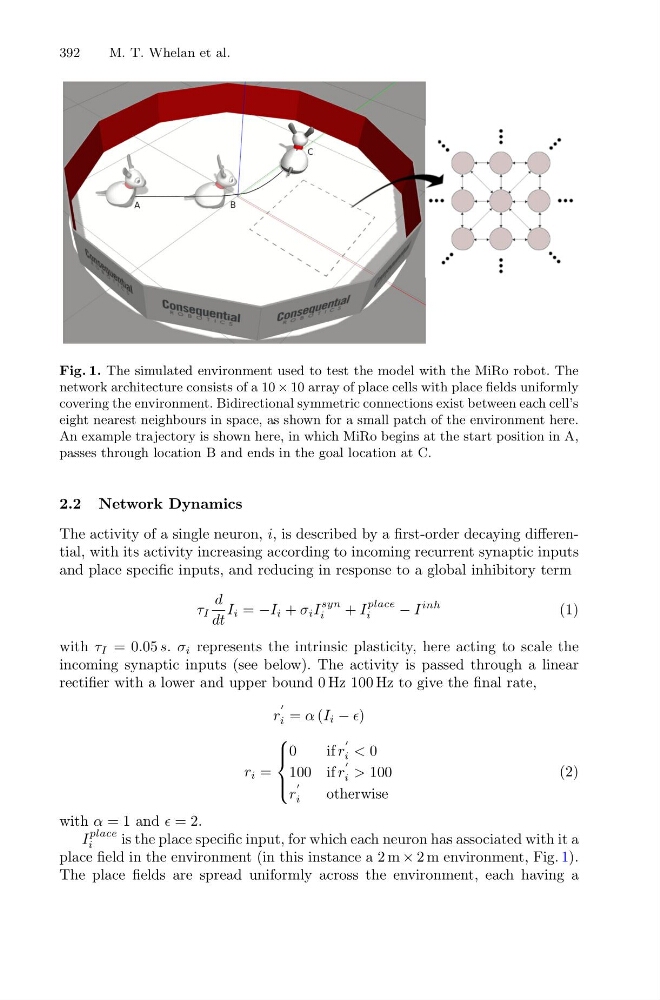
Fig. 1. The simulated environment used to test the model with the MiRo robot. The
network architecture consists of a 10 × 10 array of place cells with place fields uniformly
covering the environment. Bidirectional symmetric connections exist between each cell’s
eight nearest neighbours in space, as shown for a small patch of the environment here.
An example trajectory is shown here, in which MiRo begins at the start position in A,
passes through location B and ends in the goal location at C.
2.2 Network Dynamics
The activity of a single neuron, i, is described by a first-order decaying differential, with its activity increasing according to incoming recurrent synaptic inputs
and place specific inputs, and reducing in response to a global inhibitory term
τ I
d
dt
I i = −I i + σ i I
syn
i
+ I
place
i
− I
inh
(1)
with τ I = 0.05 s. σ i represents the intrinsic plasticity, here acting to scale the
incoming synaptic inputs (see below). The activity is passed through a linear
rectifier with a lower and upper bound 0 Hz 100 Hz to give the final rate,
r
i = α (I i − )
r i =
⎧
⎪ ⎨
⎪ ⎩
0
ifr
i < 0
100 if r
i > 100
r
i
otherwise
(2)
with α = 1 and = 2.
I
place
i
is the place specific input, for which each neuron has associated with it a
place field in the environment (in this instance a 2 m × 2 m environment, Fig. 1).
The place fields are spread uniformly across the environment, each having a
M. T. Whelan et al.
Fig. 1. The simulated environment used to test the model with the MiRo robot. The
network architecture consists of a 10 × 10 array of place cells with place fields uniformly
covering the environment. Bidirectional symmetric connections exist between each cell’s
eight nearest neighbours in space, as shown for a small patch of the environment here.
An example trajectory is shown here, in which MiRo begins at the start position in A,
passes through location B and ends in the goal location at C.
2.2 Network Dynamics
The activity of a single neuron, i, is described by a first-order decaying differential, with its activity increasing according to incoming recurrent synaptic inputs
and place specific inputs, and reducing in response to a global inhibitory term
τ I
d
dt
I i = −I i + σ i I
syn
i
+ I
place
i
− I
inh
(1)
with τ I = 0.05 s. σ i represents the intrinsic plasticity, here acting to scale the
incoming synaptic inputs (see below). The activity is passed through a linear
rectifier with a lower and upper bound 0 Hz 100 Hz to give the final rate,
r
i = α (I i − )
r i =
⎧
⎪ ⎨
⎪ ⎩
0
ifr
i < 0
100 if r
i > 100
r
i
otherwise
(2)
with α = 1 and = 2.
I
place
i
is the place specific input, for which each neuron has associated with it a
place field in the environment (in this instance a 2 m × 2 m environment, Fig. 1).
The place fields are spread uniformly across the environment, each having a