

368
S. C. van den Berg et al.
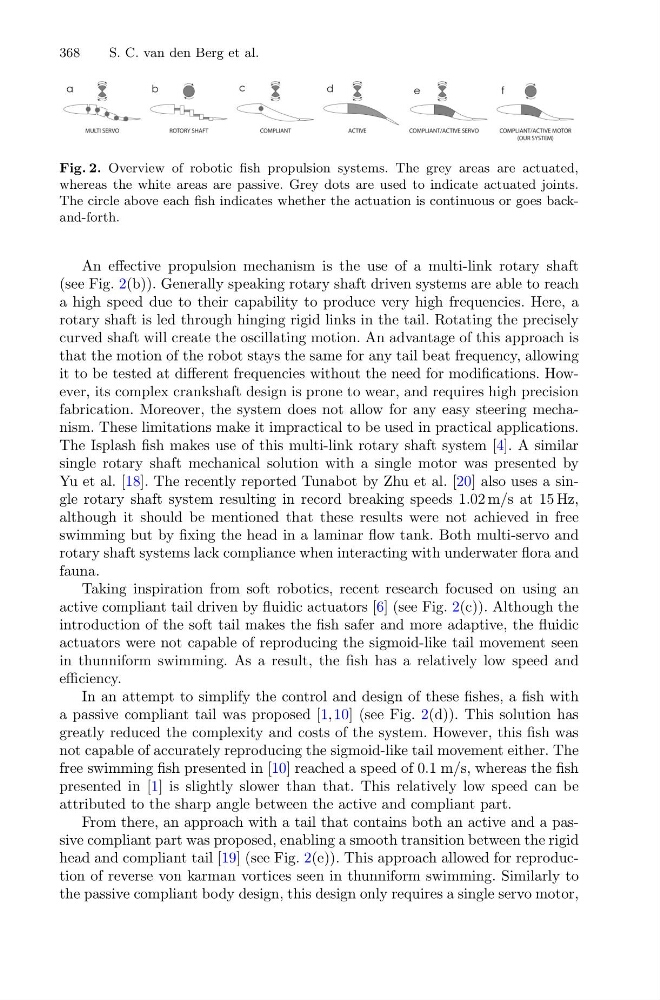
Fig. 2. Overview of robotic fish propulsion systems. The grey areas are actuated,
whereas the white areas are passive. Grey dots are used to indicate actuated joints.
The circle above each fish indicates whether the actuation is continuous or goes backand-forth.
An effective propulsion mechanism is the use of a multi-link rotary shaft
(see Fig. 2(b)). Generally speaking rotary shaft driven systems are able to reach
a high speed due to their capability to produce very high frequencies. Here, a
rotary shaft is led through hinging rigid links in the tail. Rotating the precisely
curved shaft will create the oscillating motion. An advantage of this approach is
that the motion of the robot stays the same for any tail beat frequency, allowing
it to be tested at different frequencies without the need for modifications. However, its complex crankshaft design is prone to wear, and requires high precision
fabrication. Moreover, the system does not allow for any easy steering mechanism. These limitations make it impractical to be used in practical applications.
The Isplash fish makes use of this multi-link rotary shaft system [4]. A similar
single rotary shaft mechanical solution with a single motor was presented by
Yu et al. [18]. The recently reported Tunabot by Zhu et al. [20] also uses a single rotary shaft system resulting in record breaking speeds 1.02 m/s at 15 Hz,
although it should be mentioned that these results were not achieved in free
swimming but by fixing the head in a laminar flow tank. Both multi-servo and
rotary shaft systems lack compliance when interacting with underwater flora and
fauna.
Taking inspiration from soft robotics, recent research focused on using an
active compliant tail driven by fluidic actuators [6] (see Fig. 2(c)). Although the
introduction of the soft tail makes the fish safer and more adaptive, the fluidic
actuators were not capable of reproducing the sigmoid-like tail movement seen
in thunniform swimming. As a result, the fish has a relatively low speed and
efficiency.
In an attempt to simplify the control and design of these fishes, a fish with
a passive compliant tail was proposed [1,10] (see Fig. 2(d)). This solution has
greatly reduced the complexity and costs of the system. However, this fish was
not capable of accurately reproducing the sigmoid-like tail movement either. The
free swimming fish presented in [10] reached a speed of 0.1 m/s, whereas the fish
presented in [1] is slightly slower than that. This relatively low speed can be
attributed to the sharp angle between the active and compliant part.
From there, an approach with a tail that contains both an active and a passive compliant part was proposed, enabling a smooth transition between the rigid
head and compliant tail [19] (see Fig. 2(e)). This approach allowed for reproduction of reverse von karman vortices seen in thunniform swimming. Similarly to
the passive compliant body design, this design only requires a single servo motor,
S. C. van den Berg et al.
Fig. 2. Overview of robotic fish propulsion systems. The grey areas are actuated,
whereas the white areas are passive. Grey dots are used to indicate actuated joints.
The circle above each fish indicates whether the actuation is continuous or goes backand-forth.
An effective propulsion mechanism is the use of a multi-link rotary shaft
(see Fig. 2(b)). Generally speaking rotary shaft driven systems are able to reach
a high speed due to their capability to produce very high frequencies. Here, a
rotary shaft is led through hinging rigid links in the tail. Rotating the precisely
curved shaft will create the oscillating motion. An advantage of this approach is
that the motion of the robot stays the same for any tail beat frequency, allowing
it to be tested at different frequencies without the need for modifications. However, its complex crankshaft design is prone to wear, and requires high precision
fabrication. Moreover, the system does not allow for any easy steering mechanism. These limitations make it impractical to be used in practical applications.
The Isplash fish makes use of this multi-link rotary shaft system [4]. A similar
single rotary shaft mechanical solution with a single motor was presented by
Yu et al. [18]. The recently reported Tunabot by Zhu et al. [20] also uses a single rotary shaft system resulting in record breaking speeds 1.02 m/s at 15 Hz,
although it should be mentioned that these results were not achieved in free
swimming but by fixing the head in a laminar flow tank. Both multi-servo and
rotary shaft systems lack compliance when interacting with underwater flora and
fauna.
Taking inspiration from soft robotics, recent research focused on using an
active compliant tail driven by fluidic actuators [6] (see Fig. 2(c)). Although the
introduction of the soft tail makes the fish safer and more adaptive, the fluidic
actuators were not capable of reproducing the sigmoid-like tail movement seen
in thunniform swimming. As a result, the fish has a relatively low speed and
efficiency.
In an attempt to simplify the control and design of these fishes, a fish with
a passive compliant tail was proposed [1,10] (see Fig. 2(d)). This solution has
greatly reduced the complexity and costs of the system. However, this fish was
not capable of accurately reproducing the sigmoid-like tail movement either. The
free swimming fish presented in [10] reached a speed of 0.1 m/s, whereas the fish
presented in [1] is slightly slower than that. This relatively low speed can be
attributed to the sharp angle between the active and compliant part.
From there, an approach with a tail that contains both an active and a passive compliant part was proposed, enabling a smooth transition between the rigid
head and compliant tail [19] (see Fig. 2(e)). This approach allowed for reproduction of reverse von karman vortices seen in thunniform swimming. Similarly to
the passive compliant body design, this design only requires a single servo motor,