

Biomimetic Design of a Soft Robotic Fish for High Speed Locomotion
367
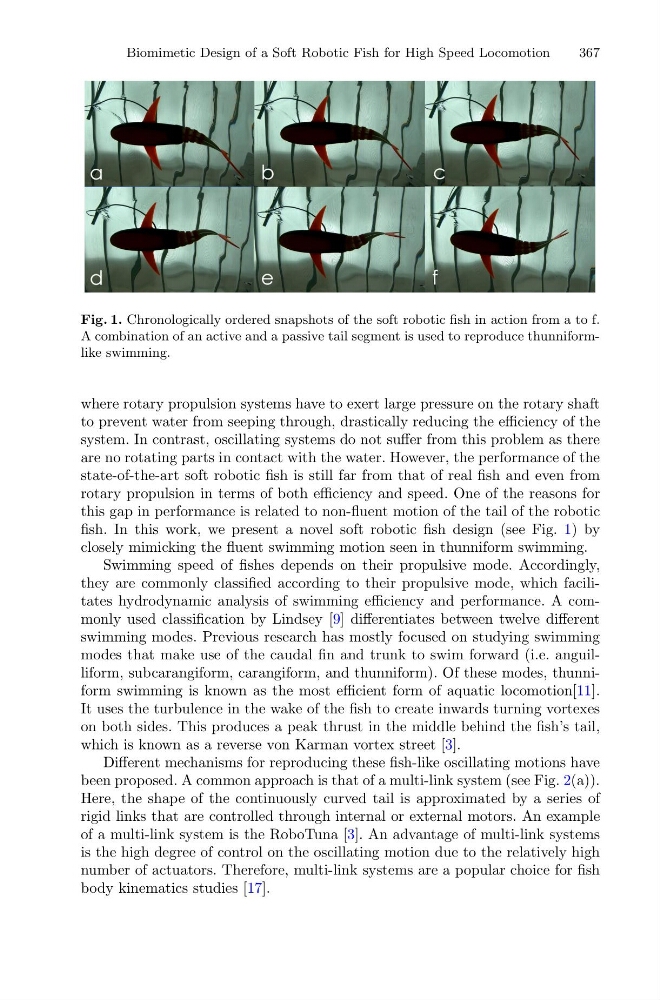
Fig. 1. Chronologically ordered snapshots of the soft robotic fish in action from a to f.
A combination of an active and a passive tail segment is used to reproduce thunniformlike swimming.
where rotary propulsion systems have to exert large pressure on the rotary shaft
to prevent water from seeping through, drastically reducing the efficiency of the
system. In contrast, oscillating systems do not suffer from this problem as there
are no rotating parts in contact with the water. However, the performance of the
state-of-the-art soft robotic fish is still far from that of real fish and even from
rotary propulsion in terms of both efficiency and speed. One of the reasons for
this gap in performance is related to non-fluent motion of the tail of the robotic
fish. In this work, we present a novel soft robotic fish design (see Fig. 1) by
closely mimicking the fluent swimming motion seen in thunniform swimming.
Swimming speed of fishes depends on their propulsive mode. Accordingly,
they are commonly classified according to their propulsive mode, which facilitates hydrodynamic analysis of swimming efficiency and performance. A commonly used classification by Lindsey [9] differentiates between twelve different
swimming modes. Previous research has mostly focused on studying swimming
modes that make use of the caudal fin and trunk to swim forward (i.e. anguilliform, subcarangiform, carangiform, and thunniform). Of these modes, thunniform swimming is known as the most efficient form of aquatic locomotion[11].
It uses the turbulence in the wake of the fish to create inwards turning vortexes
on both sides. This produces a peak thrust in the middle behind the fish’s tail,
which is known as a reverse von Karman vortex street [3].
Different mechanisms for reproducing these fish-like oscillating motions have
been proposed. A common approach is that of a multi-link system (see Fig. 2(a)).
Here, the shape of the continuously curved tail is approximated by a series of
rigid links that are controlled through internal or external motors. An example
of a multi-link system is the RoboTuna [3]. An advantage of multi-link systems
is the high degree of control on the oscillating motion due to the relatively high
number of actuators. Therefore, multi-link systems are a popular choice for fish
body kinematics studies [17].
367
Fig. 1. Chronologically ordered snapshots of the soft robotic fish in action from a to f.
A combination of an active and a passive tail segment is used to reproduce thunniformlike swimming.
where rotary propulsion systems have to exert large pressure on the rotary shaft
to prevent water from seeping through, drastically reducing the efficiency of the
system. In contrast, oscillating systems do not suffer from this problem as there
are no rotating parts in contact with the water. However, the performance of the
state-of-the-art soft robotic fish is still far from that of real fish and even from
rotary propulsion in terms of both efficiency and speed. One of the reasons for
this gap in performance is related to non-fluent motion of the tail of the robotic
fish. In this work, we present a novel soft robotic fish design (see Fig. 1) by
closely mimicking the fluent swimming motion seen in thunniform swimming.
Swimming speed of fishes depends on their propulsive mode. Accordingly,
they are commonly classified according to their propulsive mode, which facilitates hydrodynamic analysis of swimming efficiency and performance. A commonly used classification by Lindsey [9] differentiates between twelve different
swimming modes. Previous research has mostly focused on studying swimming
modes that make use of the caudal fin and trunk to swim forward (i.e. anguilliform, subcarangiform, carangiform, and thunniform). Of these modes, thunniform swimming is known as the most efficient form of aquatic locomotion[11].
It uses the turbulence in the wake of the fish to create inwards turning vortexes
on both sides. This produces a peak thrust in the middle behind the fish’s tail,
which is known as a reverse von Karman vortex street [3].
Different mechanisms for reproducing these fish-like oscillating motions have
been proposed. A common approach is that of a multi-link system (see Fig. 2(a)).
Here, the shape of the continuously curved tail is approximated by a series of
rigid links that are controlled through internal or external motors. An example
of a multi-link system is the RoboTuna [3]. An advantage of multi-link systems
is the high degree of control on the oscillating motion due to the relatively high
number of actuators. Therefore, multi-link systems are a popular choice for fish
body kinematics studies [17].