

Evaluation of Possible Flight Strategies
361
3.3 Influence of Distances, Speed, Acceleration, Width-to-Distance,
and Height-to-Distance on the Decision
The previous results do not show if the decision of the bumblebees depends on other
parameters as well. It is also not clear if the distance itself or any parameter depending
on the distance, as the height-to-distance ratio, leads to a specific choice. Therefore, a
linear regression analysis of the ten parameters listed in Sect. 2.2 was conducted on ten
randomly chosen flights per obstacle situation. The linear regression showed that the
gate distance alone predicts whether the bee is flying over or around the obstacle with
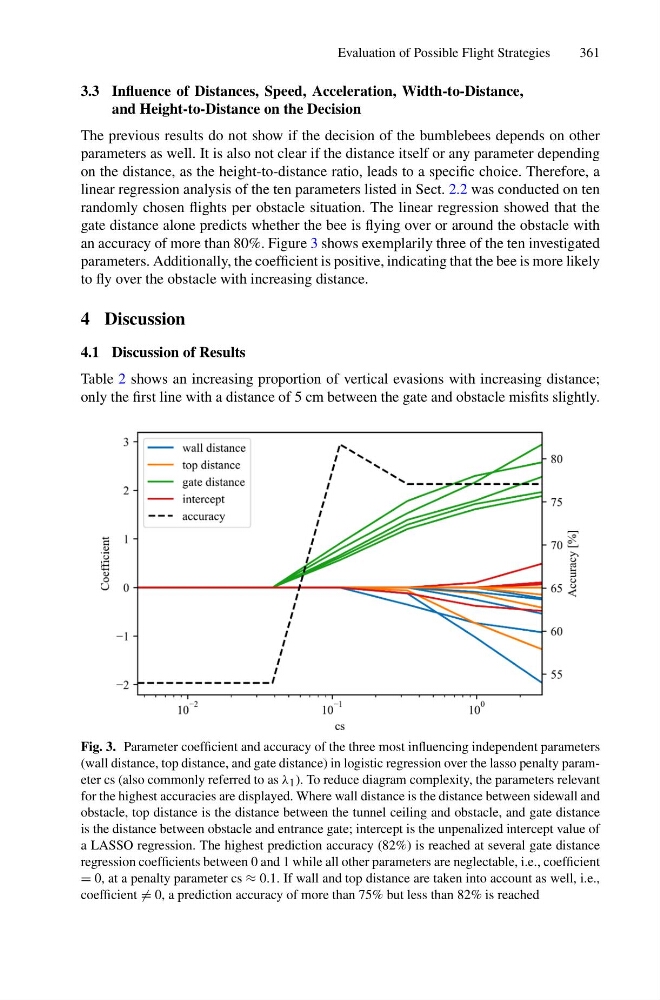
an accuracy of more than 80%. Figure 3 shows exemplarily three of the ten investigated
parameters. Additionally, the coefficient is positive, indicating that the bee is more likely
to fly over the obstacle with increasing distance.
4 Discussion
4.1 Discussion of Results
Table 2 shows an increasing proportion of vertical evasions with increasing distance;
only the first line with a distance of 5 cm between the gate and obstacle misfits slightly.
Fig. 3. Parameter coefficient and accuracy of the three most influencing independent parameters
(wall distance, top distance, and gate distance) in logistic regression over the lasso penalty parameter cs (also commonly referred to as λ 1 ). To reduce diagram complexity, the parameters relevant
for the highest accuracies are displayed. Where wall distance is the distance between sidewall and
obstacle, top distance is the distance between the tunnel ceiling and obstacle, and gate distance
is the distance between obstacle and entrance gate; intercept is the unpenalized intercept value of
a LASSO regression. The highest prediction accuracy (82%) is reached at several gate distance
regression coefficients between 0 and 1 while all other parameters are neglectable, i.e., coefficient
= 0, at a penalty parameter cs ≈ 0.1. If wall and top distance are taken into account as well, i.e.,
coefficient = 0, a prediction accuracy of more than 75% but less than 82% is reached
361
3.3 Influence of Distances, Speed, Acceleration, Width-to-Distance,
and Height-to-Distance on the Decision
The previous results do not show if the decision of the bumblebees depends on other
parameters as well. It is also not clear if the distance itself or any parameter depending
on the distance, as the height-to-distance ratio, leads to a specific choice. Therefore, a
linear regression analysis of the ten parameters listed in Sect. 2.2 was conducted on ten
randomly chosen flights per obstacle situation. The linear regression showed that the
gate distance alone predicts whether the bee is flying over or around the obstacle with
an accuracy of more than 80%. Figure 3 shows exemplarily three of the ten investigated
parameters. Additionally, the coefficient is positive, indicating that the bee is more likely
to fly over the obstacle with increasing distance.
4 Discussion
4.1 Discussion of Results
Table 2 shows an increasing proportion of vertical evasions with increasing distance;
only the first line with a distance of 5 cm between the gate and obstacle misfits slightly.
Fig. 3. Parameter coefficient and accuracy of the three most influencing independent parameters
(wall distance, top distance, and gate distance) in logistic regression over the lasso penalty parameter cs (also commonly referred to as λ 1 ). To reduce diagram complexity, the parameters relevant
for the highest accuracies are displayed. Where wall distance is the distance between sidewall and
obstacle, top distance is the distance between the tunnel ceiling and obstacle, and gate distance
is the distance between obstacle and entrance gate; intercept is the unpenalized intercept value of
a LASSO regression. The highest prediction accuracy (82%) is reached at several gate distance
regression coefficients between 0 and 1 while all other parameters are neglectable, i.e., coefficient
= 0, at a penalty parameter cs ≈ 0.1. If wall and top distance are taken into account as well, i.e.,
coefficient = 0, a prediction accuracy of more than 75% but less than 82% is reached