

Evaluation of Possible Flight Strategies
357
one week to habituate to the new environment before experiments started by flying at
Libitum through the tunnel.
The walls of the tunnel were partly covered with a 1/f pink noise red pattern. The
wall around the test area was transparent to allow filming the bumblebees. The floor was
white, while the whole ceiling was transparent. The transparent tunnel wall was invisible
for the bees, giving them the visual impression that no confinement is present to the side
and the top. The bees collided multiple times during habituation with the transparent
wall and ceiling.
To minimize the difference in the position before avoiding an obstacle, gates with
one circular hole were used, forcing the bees to fly through specific waypoints. Before
the experiments, the bees were trained to fly through the gates. The gate had a 3 cm
radius circular hole in the center to allow the bumblebees to fly quickly through it. One
gate was placed in front of the test track, one behind.
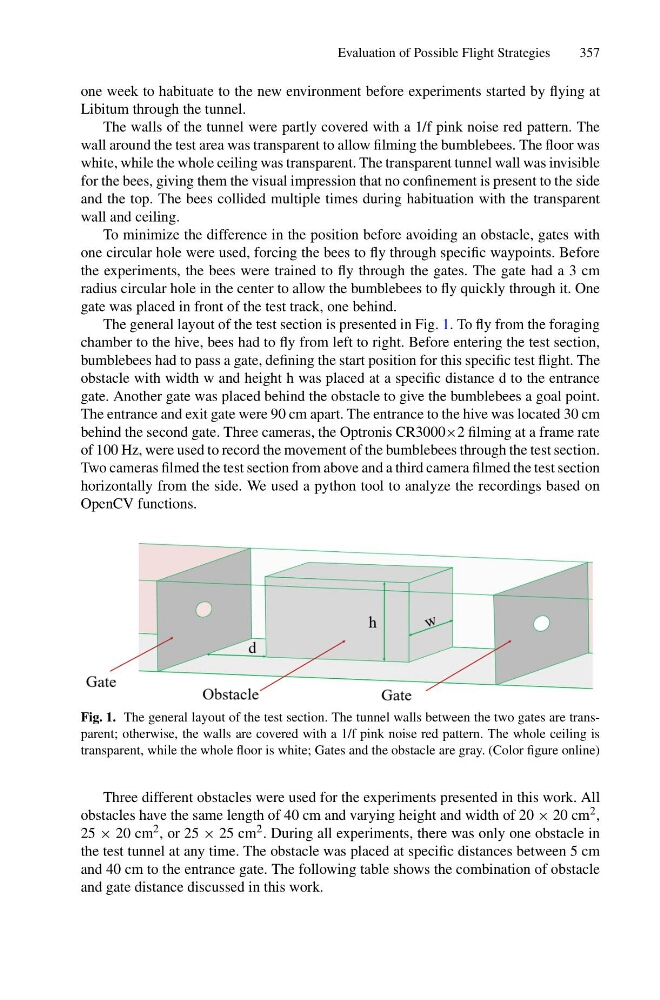
The general layout of the test section is presented in Fig. 1. To fly from the foraging
chamber to the hive, bees had to fly from left to right. Before entering the test section,
bumblebees had to pass a gate, defining the start position for this specific test flight. The
obstacle with width w and height h was placed at a specific distance d to the entrance
gate. Another gate was placed behind the obstacle to give the bumblebees a goal point.
The entrance and exit gate were 90 cm apart. The entrance to the hive was located 30 cm
behind the second gate. Three cameras, the Optronis CR3000×2 filming at a frame rate
of 100 Hz, were used to record the movement of the bumblebees through the test section.
Two cameras filmed the test section from above and a third camera filmed the test section
horizontally from the side. We used a python tool to analyze the recordings based on
OpenCV functions.
Fig. 1. The general layout of the test section. The tunnel walls between the two gates are transparent; otherwise, the walls are covered with a 1/f pink noise red pattern. The whole ceiling is
transparent, while the whole floor is white; Gates and the obstacle are gray. (Color figure online)
Three different obstacles were used for the experiments presented in this work. All
obstacles have the same length of 40 cm and varying height and width of 20 × 20 cm 2 ,
25 × 20 cm 2 , or 25 × 25 cm 2 . During all experiments, there was only one obstacle in
the test tunnel at any time. The obstacle was placed at specific distances between 5 cm
and 40 cm to the entrance gate. The following table shows the combination of obstacle
and gate distance discussed in this work.
357
one week to habituate to the new environment before experiments started by flying at
Libitum through the tunnel.
The walls of the tunnel were partly covered with a 1/f pink noise red pattern. The
wall around the test area was transparent to allow filming the bumblebees. The floor was
white, while the whole ceiling was transparent. The transparent tunnel wall was invisible
for the bees, giving them the visual impression that no confinement is present to the side
and the top. The bees collided multiple times during habituation with the transparent
wall and ceiling.
To minimize the difference in the position before avoiding an obstacle, gates with
one circular hole were used, forcing the bees to fly through specific waypoints. Before
the experiments, the bees were trained to fly through the gates. The gate had a 3 cm
radius circular hole in the center to allow the bumblebees to fly quickly through it. One
gate was placed in front of the test track, one behind.
The general layout of the test section is presented in Fig. 1. To fly from the foraging
chamber to the hive, bees had to fly from left to right. Before entering the test section,
bumblebees had to pass a gate, defining the start position for this specific test flight. The
obstacle with width w and height h was placed at a specific distance d to the entrance
gate. Another gate was placed behind the obstacle to give the bumblebees a goal point.
The entrance and exit gate were 90 cm apart. The entrance to the hive was located 30 cm
behind the second gate. Three cameras, the Optronis CR3000×2 filming at a frame rate
of 100 Hz, were used to record the movement of the bumblebees through the test section.
Two cameras filmed the test section from above and a third camera filmed the test section
horizontally from the side. We used a python tool to analyze the recordings based on
OpenCV functions.
Fig. 1. The general layout of the test section. The tunnel walls between the two gates are transparent; otherwise, the walls are covered with a 1/f pink noise red pattern. The whole ceiling is
transparent, while the whole floor is white; Gates and the obstacle are gray. (Color figure online)
Three different obstacles were used for the experiments presented in this work. All
obstacles have the same length of 40 cm and varying height and width of 20 × 20 cm 2 ,
25 × 20 cm 2 , or 25 × 25 cm 2 . During all experiments, there was only one obstacle in
the test tunnel at any time. The obstacle was placed at specific distances between 5 cm
and 40 cm to the entrance gate. The following table shows the combination of obstacle
and gate distance discussed in this work.