

Modeling the Dynamic Sensory Discharges of Insect CS
351
4 Discussion
In this manuscript, we assembled a dynamic model of the sensory discharges observed
from afferent nerves from insect campaniform sensilla (CS). CS discharges are proportional to the bending forces applied to the leg, but also demonstrate strong adaptive
responses and hysteresis. Additionally, such adaptation does not match the output of
a linear model [14], so we derived a method for designing a nonlinear low-pass filter
that can replicate the response properties of CS afferent nerves. We then subjected this
model to stimuli like those applied to insect legs and used some experimental data to
tune the constants in the model. Once complete, the model could capture the results
of experiments whose data were not used to tune the model, including the response to
highly dynamic inputs. In addition, the model exhibited the same gross responses seen
in the animal: Linear encoding of the applied force level; power law reflection of the
rate of the applied force; and hysteresis in response to cyclic loading.
The model we developed is only a phenomenological model, but may have benefits
for experimental neuroscience and robotics. With a phenomenological description of CS
response to a given force input, experimental stimuli can be derived that may produce
more natural CS responses. For example, previous studies have shown that the history of
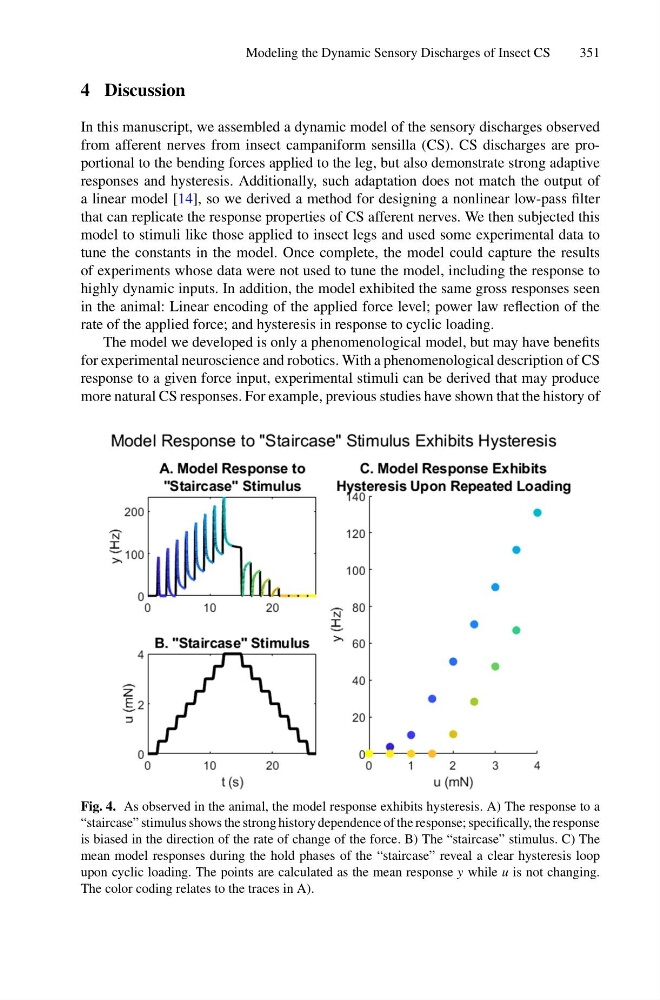
Fig. 4. As observed in the animal, the model response exhibits hysteresis. A) The response to a
“staircase” stimulus shows the strong history dependence of the response; specifically, the response
is biased in the direction of the rate of change of the force. B) The “staircase” stimulus. C) The
mean model responses during the hold phases of the “staircase” reveal a clear hysteresis loop
upon cyclic loading. The points are calculated as the mean response y while u is not changing.
The color coding relates to the traces in A).
351
4 Discussion
In this manuscript, we assembled a dynamic model of the sensory discharges observed
from afferent nerves from insect campaniform sensilla (CS). CS discharges are proportional to the bending forces applied to the leg, but also demonstrate strong adaptive
responses and hysteresis. Additionally, such adaptation does not match the output of
a linear model [14], so we derived a method for designing a nonlinear low-pass filter
that can replicate the response properties of CS afferent nerves. We then subjected this
model to stimuli like those applied to insect legs and used some experimental data to
tune the constants in the model. Once complete, the model could capture the results
of experiments whose data were not used to tune the model, including the response to
highly dynamic inputs. In addition, the model exhibited the same gross responses seen
in the animal: Linear encoding of the applied force level; power law reflection of the
rate of the applied force; and hysteresis in response to cyclic loading.
The model we developed is only a phenomenological model, but may have benefits
for experimental neuroscience and robotics. With a phenomenological description of CS
response to a given force input, experimental stimuli can be derived that may produce
more natural CS responses. For example, previous studies have shown that the history of
Fig. 4. As observed in the animal, the model response exhibits hysteresis. A) The response to a
“staircase” stimulus shows the strong history dependence of the response; specifically, the response
is biased in the direction of the rate of change of the force. B) The “staircase” stimulus. C) The
mean model responses during the hold phases of the “staircase” reveal a clear hysteresis loop
upon cyclic loading. The points are calculated as the mean response y while u is not changing.
The color coding relates to the traces in A).