

350
N. S. Szczecinski et al.
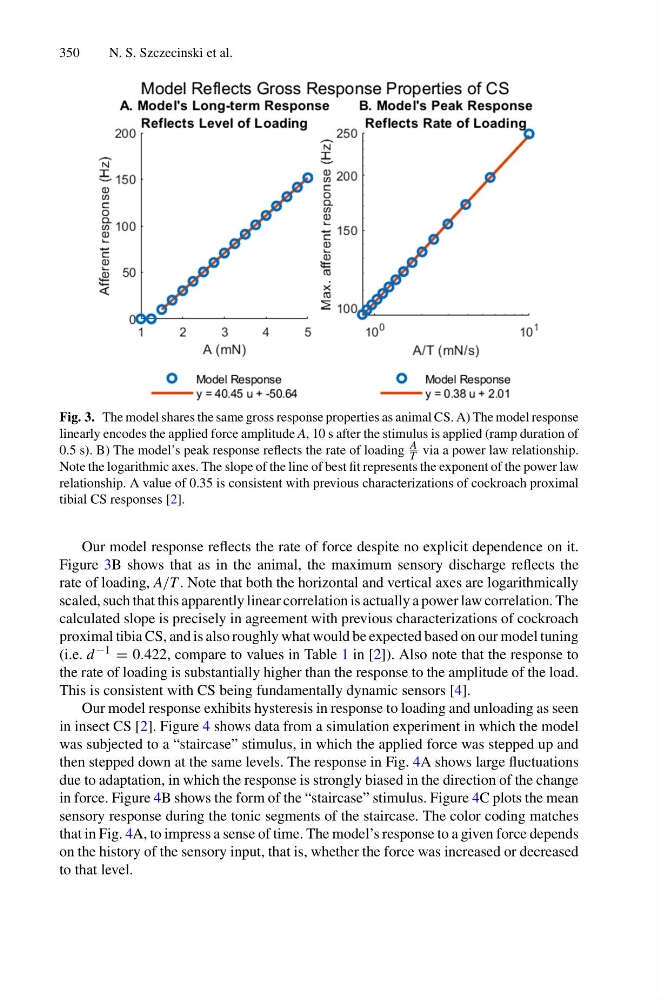
Fig. 3. The model shares the same gross response properties as animal CS. A) The model response
linearly encodes the applied force amplitude A, 10 s after the stimulus is applied (ramp duration of
0.5 s). B) The model’s peak response reflects the rate of loading A
T via a power law relationship.
Note the logarithmic axes. The slope of the line of best fit represents the exponent of the power law
relationship. A value of 0.35 is consistent with previous characterizations of cockroach proximal
tibial CS responses [2].
Our model response reflects the rate of force despite no explicit dependence on it.
Figure 3B shows that as in the animal, the maximum sensory discharge reflects the
rate of loading, A/T . Note that both the horizontal and vertical axes are logarithmically
scaled, such that this apparently linear correlation is actually a power law correlation. The
calculated slope is precisely in agreement with previous characterizations of cockroach
proximal tibia CS, and is also roughly what would be expected based on our model tuning
(i.e. d −1 = 0.422, compare to values in Table 1 in [2]). Also note that the response to
the rate of loading is substantially higher than the response to the amplitude of the load.
This is consistent with CS being fundamentally dynamic sensors [4].
Our model response exhibits hysteresis in response to loading and unloading as seen
in insect CS [2]. Figure 4 shows data from a simulation experiment in which the model
was subjected to a “staircase” stimulus, in which the applied force was stepped up and
then stepped down at the same levels. The response in Fig. 4A shows large fluctuations
due to adaptation, in which the response is strongly biased in the direction of the change
in force. Figure 4B shows the form of the “staircase” stimulus. Figure 4C plots the mean
sensory response during the tonic segments of the staircase. The color coding matches
that in Fig. 4A, to impress a sense of time. The model’s response to a given force depends
on the history of the sensory input, that is, whether the force was increased or decreased
to that level.
N. S. Szczecinski et al.
Fig. 3. The model shares the same gross response properties as animal CS. A) The model response
linearly encodes the applied force amplitude A, 10 s after the stimulus is applied (ramp duration of
0.5 s). B) The model’s peak response reflects the rate of loading A
T via a power law relationship.
Note the logarithmic axes. The slope of the line of best fit represents the exponent of the power law
relationship. A value of 0.35 is consistent with previous characterizations of cockroach proximal
tibial CS responses [2].
Our model response reflects the rate of force despite no explicit dependence on it.
Figure 3B shows that as in the animal, the maximum sensory discharge reflects the
rate of loading, A/T . Note that both the horizontal and vertical axes are logarithmically
scaled, such that this apparently linear correlation is actually a power law correlation. The
calculated slope is precisely in agreement with previous characterizations of cockroach
proximal tibia CS, and is also roughly what would be expected based on our model tuning
(i.e. d −1 = 0.422, compare to values in Table 1 in [2]). Also note that the response to
the rate of loading is substantially higher than the response to the amplitude of the load.
This is consistent with CS being fundamentally dynamic sensors [4].
Our model response exhibits hysteresis in response to loading and unloading as seen
in insect CS [2]. Figure 4 shows data from a simulation experiment in which the model
was subjected to a “staircase” stimulus, in which the applied force was stepped up and
then stepped down at the same levels. The response in Fig. 4A shows large fluctuations
due to adaptation, in which the response is strongly biased in the direction of the change
in force. Figure 4B shows the form of the “staircase” stimulus. Figure 4C plots the mean
sensory response during the tonic segments of the staircase. The color coding matches
that in Fig. 4A, to impress a sense of time. The model’s response to a given force depends
on the history of the sensory input, that is, whether the force was increased or decreased
to that level.