

Modeling the Dynamic Sensory Discharges of Insect CS
347
3 Results
3.1 Model Tuning and Generalization
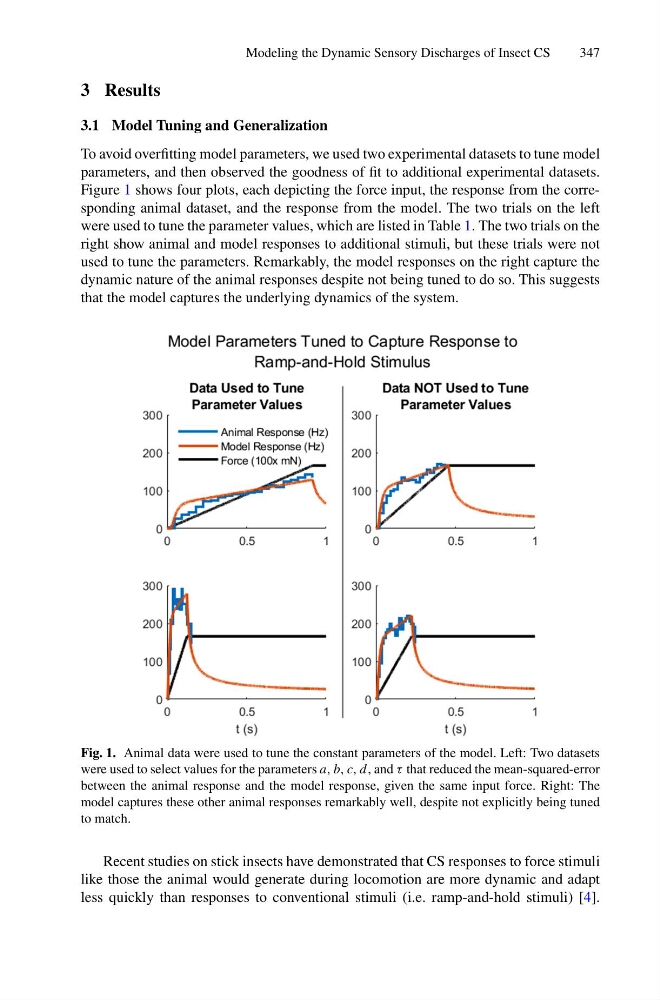
To avoid overfitting model parameters, we used two experimental datasets to tune model
parameters, and then observed the goodness of fit to additional experimental datasets.
Figure 1 shows four plots, each depicting the force input, the response from the corresponding animal dataset, and the response from the model. The two trials on the left
were used to tune the parameter values, which are listed in Table 1. The two trials on the
right show animal and model responses to additional stimuli, but these trials were not
used to tune the parameters. Remarkably, the model responses on the right capture the
dynamic nature of the animal responses despite not being tuned to do so. This suggests
that the model captures the underlying dynamics of the system.
Fig. 1. Animal data were used to tune the constant parameters of the model. Left: Two datasets
were used to select values for the parameters a, b, c, d , and τ that reduced the mean-squared-error
between the animal response and the model response, given the same input force. Right: The
model captures these other animal responses remarkably well, despite not explicitly being tuned
to match.
Recent studies on stick insects have demonstrated that CS responses to force stimuli
like those the animal would generate during locomotion are more dynamic and adapt
less quickly than responses to conventional stimuli (i.e. ramp-and-hold stimuli) [4].
347
3 Results
3.1 Model Tuning and Generalization
To avoid overfitting model parameters, we used two experimental datasets to tune model
parameters, and then observed the goodness of fit to additional experimental datasets.
Figure 1 shows four plots, each depicting the force input, the response from the corresponding animal dataset, and the response from the model. The two trials on the left
were used to tune the parameter values, which are listed in Table 1. The two trials on the
right show animal and model responses to additional stimuli, but these trials were not
used to tune the parameters. Remarkably, the model responses on the right capture the
dynamic nature of the animal responses despite not being tuned to do so. This suggests
that the model captures the underlying dynamics of the system.
Fig. 1. Animal data were used to tune the constant parameters of the model. Left: Two datasets
were used to select values for the parameters a, b, c, d , and τ that reduced the mean-squared-error
between the animal response and the model response, given the same input force. Right: The
model captures these other animal responses remarkably well, despite not explicitly being tuned
to match.
Recent studies on stick insects have demonstrated that CS responses to force stimuli
like those the animal would generate during locomotion are more dynamic and adapt
less quickly than responses to conventional stimuli (i.e. ramp-and-hold stimuli) [4].