

340
F. Steinbeck et al.
A
B
C
E
D
t [ms]
3000
v [d/ms]
Phi [°]
Spike density
Familiarity
d
0
30
0.6
0.6
0.6
0
1
Mean
Median
BB
Cyclops
BBCPG
E1
I1
I2
E2
E3
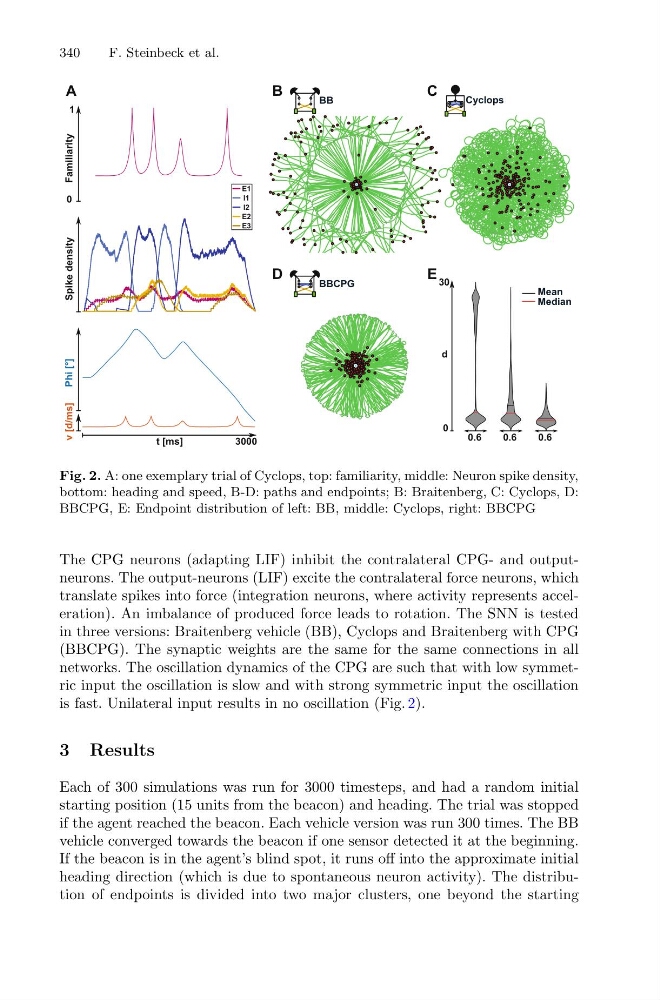
Fig. 2. A: one exemplary trial of Cyclops, top: familiarity, middle: Neuron spike density,
bottom: heading and speed, B-D: paths and endpoints; B: Braitenberg, C: Cyclops, D:
BBCPG, E: Endpoint distribution of left: BB, middle: Cyclops, right: BBCPG
The CPG neurons (adapting LIF) inhibit the contralateral CPG- and outputneurons. The output-neurons (LIF) excite the contralateral force neurons, which
translate spikes into force (integration neurons, where activity represents acceleration). An imbalance of produced force leads to rotation. The SNN is tested
in three versions: Braitenberg vehicle (BB), Cyclops and Braitenberg with CPG
(BBCPG). The synaptic weights are the same for the same connections in all
networks. The oscillation dynamics of the CPG are such that with low symmetric input the oscillation is slow and with strong symmetric input the oscillation
is fast. Unilateral input results in no oscillation (Fig. 2).
3 Results
Each of 300 simulations was run for 3000 timesteps, and had a random initial
starting position (15 units from the beacon) and heading. The trial was stopped
if the agent reached the beacon. Each vehicle version was run 300 times. The BB
vehicle converged towards the beacon if one sensor detected it at the beginning.
If the beacon is in the agent’s blind spot, it runs off into the approximate initial
heading direction (which is due to spontaneous neuron activity). The distribution of endpoints is divided into two major clusters, one beyond the starting
F. Steinbeck et al.
A
B
C
E
D
t [ms]
3000
v [d/ms]
Phi [°]
Spike density
Familiarity
d
0
30
0.6
0.6
0.6
0
1
Mean
Median
BB
Cyclops
BBCPG
E1
I1
I2
E2
E3
Fig. 2. A: one exemplary trial of Cyclops, top: familiarity, middle: Neuron spike density,
bottom: heading and speed, B-D: paths and endpoints; B: Braitenberg, C: Cyclops, D:
BBCPG, E: Endpoint distribution of left: BB, middle: Cyclops, right: BBCPG
The CPG neurons (adapting LIF) inhibit the contralateral CPG- and outputneurons. The output-neurons (LIF) excite the contralateral force neurons, which
translate spikes into force (integration neurons, where activity represents acceleration). An imbalance of produced force leads to rotation. The SNN is tested
in three versions: Braitenberg vehicle (BB), Cyclops and Braitenberg with CPG
(BBCPG). The synaptic weights are the same for the same connections in all
networks. The oscillation dynamics of the CPG are such that with low symmetric input the oscillation is slow and with strong symmetric input the oscillation
is fast. Unilateral input results in no oscillation (Fig. 2).
3 Results
Each of 300 simulations was run for 3000 timesteps, and had a random initial
starting position (15 units from the beacon) and heading. The trial was stopped
if the agent reached the beacon. Each vehicle version was run 300 times. The BB
vehicle converged towards the beacon if one sensor detected it at the beginning.
If the beacon is in the agent’s blind spot, it runs off into the approximate initial
heading direction (which is due to spontaneous neuron activity). The distribution of endpoints is divided into two major clusters, one beyond the starting