

Can Small Scale Search Behaviours Enhance Large-Scale Navigation?
339
A
Input
E1 & E2
Output
E3 & E4
CPG
I1 & I2
Force
Sensory Signals B
C
E
D
Binocular
Cyclops
f [%]
angle [°]
0
360
1
f [%]
angle [°]
0
360
1
25
100
100
Input frequency right [Hz]
Input frequency left [Hz]
CPG flipping [Hz]
0
3
t [ms]
SDF
SDF
3000
0
I1
I2
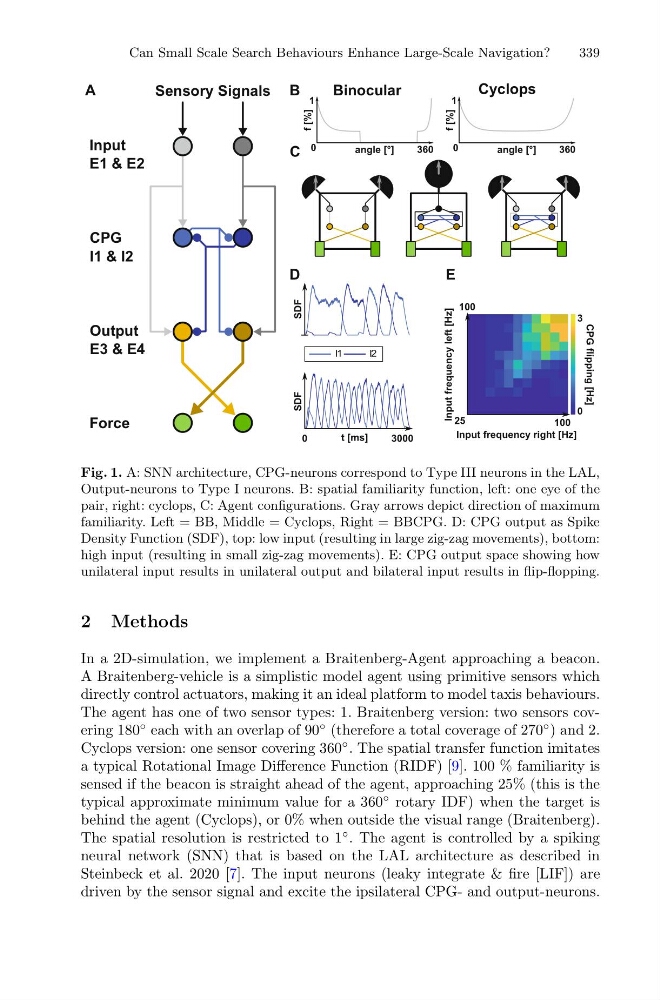
Fig. 1. A: SNN architecture, CPG-neurons correspond to Type III neurons in the LAL,
Output-neurons to Type I neurons. B: spatial familiarity function, left: one eye of the
pair, right: cyclops, C: Agent configurations. Gray arrows depict direction of maximum
familiarity. Left = BB, Middle = Cyclops, Right = BBCPG. D: CPG output as Spike
Density Function (SDF), top: low input (resulting in large zig-zag movements), bottom:
high input (resulting in small zig-zag movements). E: CPG output space showing how
unilateral input results in unilateral output and bilateral input results in flip-flopping.
2 Methods
In a 2D-simulation, we implement a Braitenberg-Agent approaching a beacon.
A Braitenberg-vehicle is a simplistic model agent using primitive sensors which
directly control actuators, making it an ideal platform to model taxis behaviours.
The agent has one of two sensor types: 1. Braitenberg version: two sensors covering 180
◦ each with an overlap of 90
◦ (therefore a total coverage of 270
◦ ) and 2.
Cyclops version: one sensor covering 360
◦ . The spatial transfer function imitates
a typical Rotational Image Difference Function (RIDF) [9]. 100 % familiarity is
sensed if the beacon is straight ahead of the agent, approaching 25% (this is the
typical approximate minimum value for a 360
◦ rotary IDF) when the target is
behind the agent (Cyclops), or 0% when outside the visual range (Braitenberg).
The spatial resolution is restricted to 1
◦ . The agent is controlled by a spiking
neural network (SNN) that is based on the LAL architecture as described in
Steinbeck et al. 2020 [7]. The input neurons (leaky integrate & fire [LIF]) are
driven by the sensor signal and excite the ipsilateral CPG- and output-neurons.
339
A
Input
E1 & E2
Output
E3 & E4
CPG
I1 & I2
Force
Sensory Signals B
C
E
D
Binocular
Cyclops
f [%]
angle [°]
0
360
1
f [%]
angle [°]
0
360
1
25
100
100
Input frequency right [Hz]
Input frequency left [Hz]
CPG flipping [Hz]
0
3
t [ms]
SDF
SDF
3000
0
I1
I2
Fig. 1. A: SNN architecture, CPG-neurons correspond to Type III neurons in the LAL,
Output-neurons to Type I neurons. B: spatial familiarity function, left: one eye of the
pair, right: cyclops, C: Agent configurations. Gray arrows depict direction of maximum
familiarity. Left = BB, Middle = Cyclops, Right = BBCPG. D: CPG output as Spike
Density Function (SDF), top: low input (resulting in large zig-zag movements), bottom:
high input (resulting in small zig-zag movements). E: CPG output space showing how
unilateral input results in unilateral output and bilateral input results in flip-flopping.
2 Methods
In a 2D-simulation, we implement a Braitenberg-Agent approaching a beacon.
A Braitenberg-vehicle is a simplistic model agent using primitive sensors which
directly control actuators, making it an ideal platform to model taxis behaviours.
The agent has one of two sensor types: 1. Braitenberg version: two sensors covering 180
◦ each with an overlap of 90
◦ (therefore a total coverage of 270
◦ ) and 2.
Cyclops version: one sensor covering 360
◦ . The spatial transfer function imitates
a typical Rotational Image Difference Function (RIDF) [9]. 100 % familiarity is
sensed if the beacon is straight ahead of the agent, approaching 25% (this is the
typical approximate minimum value for a 360
◦ rotary IDF) when the target is
behind the agent (Cyclops), or 0% when outside the visual range (Braitenberg).
The spatial resolution is restricted to 1
◦ . The agent is controlled by a spiking
neural network (SNN) that is based on the LAL architecture as described in
Steinbeck et al. 2020 [7]. The input neurons (leaky integrate & fire [LIF]) are
driven by the sensor signal and excite the ipsilateral CPG- and output-neurons.