

Optimization of Artificial Muscle Placements
267
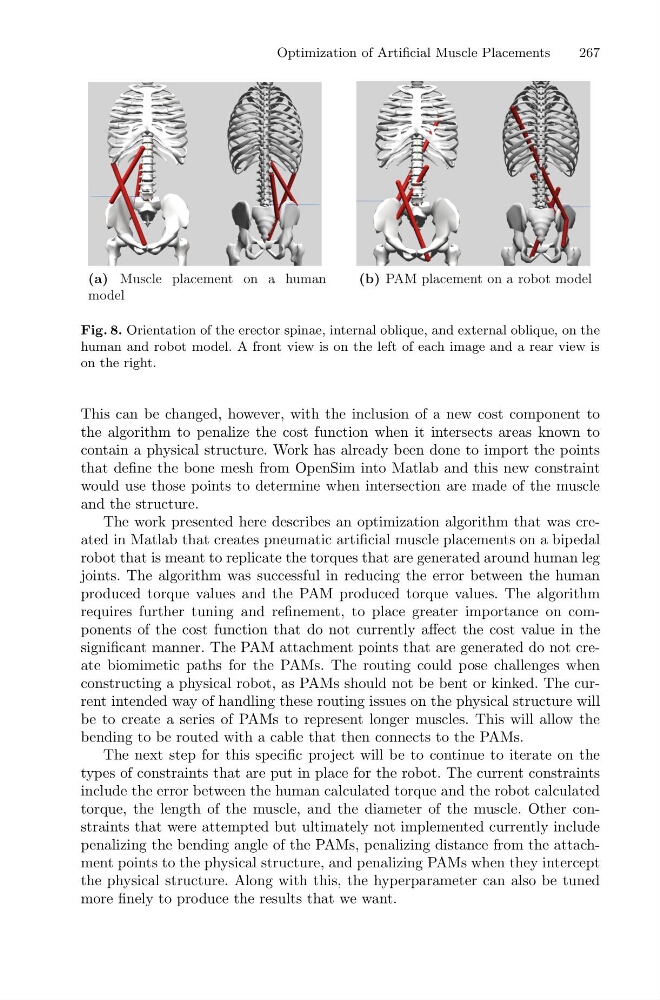
(a) Muscle placement on a human
model
(b) PAM placement on a robot model
Fig. 8. Orientation of the erector spinae, internal oblique, and external oblique, on the
human and robot model. A front view is on the left of each image and a rear view is
on the right.
This can be changed, however, with the inclusion of a new cost component to
the algorithm to penalize the cost function when it intersects areas known to
contain a physical structure. Work has already been done to import the points
that define the bone mesh from OpenSim into Matlab and this new constraint
would use those points to determine when intersection are made of the muscle
and the structure.
The work presented here describes an optimization algorithm that was created in Matlab that creates pneumatic artificial muscle placements on a bipedal
robot that is meant to replicate the torques that are generated around human leg
joints. The algorithm was successful in reducing the error between the human
produced torque values and the PAM produced torque values. The algorithm
requires further tuning and refinement, to place greater importance on components of the cost function that do not currently affect the cost value in the
significant manner. The PAM attachment points that are generated do not create biomimetic paths for the PAMs. The routing could pose challenges when
constructing a physical robot, as PAMs should not be bent or kinked. The current intended way of handling these routing issues on the physical structure will
be to create a series of PAMs to represent longer muscles. This will allow the
bending to be routed with a cable that then connects to the PAMs.
The next step for this specific project will be to continue to iterate on the
types of constraints that are put in place for the robot. The current constraints
include the error between the human calculated torque and the robot calculated
torque, the length of the muscle, and the diameter of the muscle. Other constraints that were attempted but ultimately not implemented currently include
penalizing the bending angle of the PAMs, penalizing distance from the attachment points to the physical structure, and penalizing PAMs when they intercept
the physical structure. Along with this, the hyperparameter can also be tuned
more finely to produce the results that we want.
267
(a) Muscle placement on a human
model
(b) PAM placement on a robot model
Fig. 8. Orientation of the erector spinae, internal oblique, and external oblique, on the
human and robot model. A front view is on the left of each image and a rear view is
on the right.
This can be changed, however, with the inclusion of a new cost component to
the algorithm to penalize the cost function when it intersects areas known to
contain a physical structure. Work has already been done to import the points
that define the bone mesh from OpenSim into Matlab and this new constraint
would use those points to determine when intersection are made of the muscle
and the structure.
The work presented here describes an optimization algorithm that was created in Matlab that creates pneumatic artificial muscle placements on a bipedal
robot that is meant to replicate the torques that are generated around human leg
joints. The algorithm was successful in reducing the error between the human
produced torque values and the PAM produced torque values. The algorithm
requires further tuning and refinement, to place greater importance on components of the cost function that do not currently affect the cost value in the
significant manner. The PAM attachment points that are generated do not create biomimetic paths for the PAMs. The routing could pose challenges when
constructing a physical robot, as PAMs should not be bent or kinked. The current intended way of handling these routing issues on the physical structure will
be to create a series of PAMs to represent longer muscles. This will allow the
bending to be routed with a cable that then connects to the PAMs.
The next step for this specific project will be to continue to iterate on the
types of constraints that are put in place for the robot. The current constraints
include the error between the human calculated torque and the robot calculated
torque, the length of the muscle, and the diameter of the muscle. Other constraints that were attempted but ultimately not implemented currently include
penalizing the bending angle of the PAMs, penalizing distance from the attachment points to the physical structure, and penalizing PAMs when they intercept
the physical structure. Along with this, the hyperparameter can also be tuned
more finely to produce the results that we want.