

242
F. Meder et al.
3.4 Powering LEDs and a Thermal Sensor Under Wind Excitation
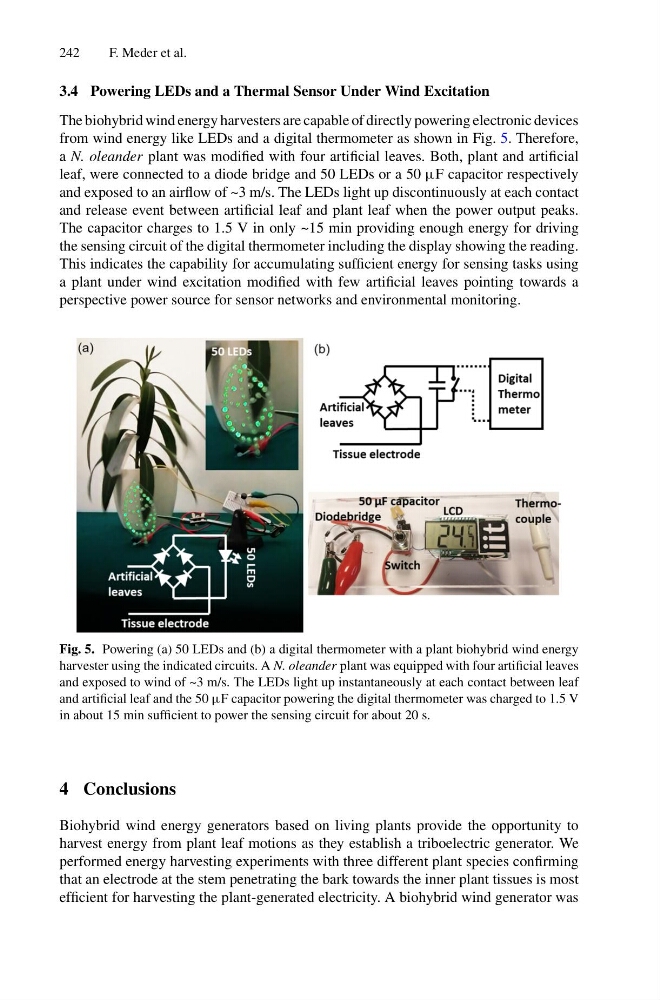
The biohybrid wind energy harvesters are capable of directly powering electronic devices
from wind energy like LEDs and a digital thermometer as shown in Fig. 5. Therefore,
a N. oleander plant was modified with four artificial leaves. Both, plant and artificial
leaf, were connected to a diode bridge and 50 LEDs or a 50 µF capacitor respectively
and exposed to an airflow of ~3 m/s. The LEDs light up discontinuously at each contact
and release event between artificial leaf and plant leaf when the power output peaks.
The capacitor charges to 1.5 V in only ~15 min providing enough energy for driving
the sensing circuit of the digital thermometer including the display showing the reading.
This indicates the capability for accumulating sufficient energy for sensing tasks using
a plant under wind excitation modified with few artificial leaves pointing towards a
perspective power source for sensor networks and environmental monitoring.
Fig. 5. Powering (a) 50 LEDs and (b) a digital thermometer with a plant biohybrid wind energy
harvester using the indicated circuits. A N. oleander plant was equipped with four artificial leaves
and exposed to wind of ~3 m/s. The LEDs light up instantaneously at each contact between leaf
and artificial leaf and the 50 µF capacitor powering the digital thermometer was charged to 1.5 V
in about 15 min sufficient to power the sensing circuit for about 20 s.
4 Conclusions
Biohybrid wind energy generators based on living plants provide the opportunity to
harvest energy from plant leaf motions as they establish a triboelectric generator. We
performed energy harvesting experiments with three different plant species confirming
that an electrode at the stem penetrating the bark towards the inner plant tissues is most
efficient for harvesting the plant-generated electricity. A biohybrid wind generator was
F. Meder et al.
3.4 Powering LEDs and a Thermal Sensor Under Wind Excitation
The biohybrid wind energy harvesters are capable of directly powering electronic devices
from wind energy like LEDs and a digital thermometer as shown in Fig. 5. Therefore,
a N. oleander plant was modified with four artificial leaves. Both, plant and artificial
leaf, were connected to a diode bridge and 50 LEDs or a 50 µF capacitor respectively
and exposed to an airflow of ~3 m/s. The LEDs light up discontinuously at each contact
and release event between artificial leaf and plant leaf when the power output peaks.
The capacitor charges to 1.5 V in only ~15 min providing enough energy for driving
the sensing circuit of the digital thermometer including the display showing the reading.
This indicates the capability for accumulating sufficient energy for sensing tasks using
a plant under wind excitation modified with few artificial leaves pointing towards a
perspective power source for sensor networks and environmental monitoring.
Fig. 5. Powering (a) 50 LEDs and (b) a digital thermometer with a plant biohybrid wind energy
harvester using the indicated circuits. A N. oleander plant was equipped with four artificial leaves
and exposed to wind of ~3 m/s. The LEDs light up instantaneously at each contact between leaf
and artificial leaf and the 50 µF capacitor powering the digital thermometer was charged to 1.5 V
in about 15 min sufficient to power the sensing circuit for about 20 s.
4 Conclusions
Biohybrid wind energy generators based on living plants provide the opportunity to
harvest energy from plant leaf motions as they establish a triboelectric generator. We
performed energy harvesting experiments with three different plant species confirming
that an electrode at the stem penetrating the bark towards the inner plant tissues is most
efficient for harvesting the plant-generated electricity. A biohybrid wind generator was