

Split-Belt Adaptation Model of a Decerebrate Cat
219
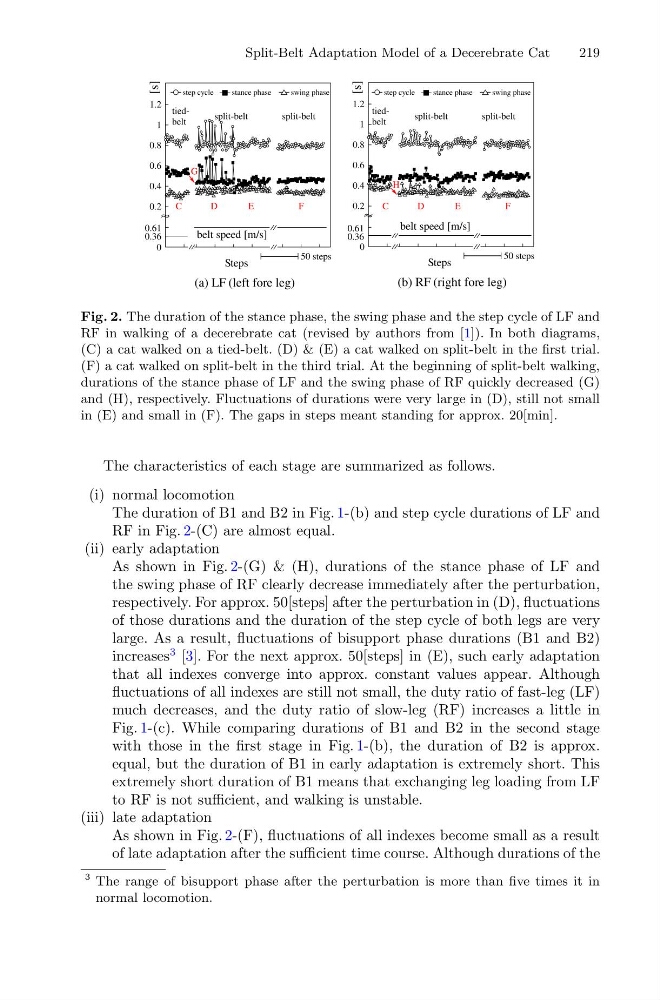
Fig. 2. The duration of the stance phase, the swing phase and the step cycle of LF and
RF in walking of a decerebrate cat (revised by authors from [1]). In both diagrams,
(C) a cat walked on a tied-belt. (D) & (E) a cat walked on split-belt in the first trial.
(F) a cat walked on split-belt in the third trial. At the beginning of split-belt walking,
durations of the stance phase of LF and the swing phase of RF quickly decreased (G)
and (H), respectively. Fluctuations of durations were very large in (D), still not small
in (E) and small in (F). The gaps in steps meant standing for approx. 20[min].
The characteristics of each stage are summarized as follows.
(i) normal locomotion
The duration of B1 and B2 in Fig. 1-(b) and step cycle durations of LF and
RF in Fig. 2-(C) are almost equal.
(ii) early adaptation
As shown in Fig. 2-(G) & (H), durations of the stance phase of LF and
the swing phase of RF clearly decrease immediately after the perturbation,
respectively. For approx. 50[steps] after the perturbation in (D), fluctuations
of those durations and the duration of the step cycle of both legs are very
large. As a result, fluctuations of bisupport phase durations (B1 and B2)
increases
3 [3]. For the next approx. 50[steps] in (E), such early adaptation
that all indexes converge into approx. constant values appear. Although
fluctuations of all indexes are still not small, the duty ratio of fast-leg (LF)
much decreases, and the duty ratio of slow-leg (RF) increases a little in
Fig. 1-(c). While comparing durations of B1 and B2 in the second stage
with those in the first stage in Fig. 1-(b), the duration of B2 is approx.
equal, but the duration of B1 in early adaptation is extremely short. This
extremely short duration of B1 means that exchanging leg loading from LF
to RF is not sufficient, and walking is unstable.
(iii) late adaptation
As shown in Fig. 2-(F), fluctuations of all indexes become small as a result
of late adaptation after the sufficient time course. Although durations of the
3 The range of bisupport phase after the perturbation is more than five times it in
normal locomotion.
219
Fig. 2. The duration of the stance phase, the swing phase and the step cycle of LF and
RF in walking of a decerebrate cat (revised by authors from [1]). In both diagrams,
(C) a cat walked on a tied-belt. (D) & (E) a cat walked on split-belt in the first trial.
(F) a cat walked on split-belt in the third trial. At the beginning of split-belt walking,
durations of the stance phase of LF and the swing phase of RF quickly decreased (G)
and (H), respectively. Fluctuations of durations were very large in (D), still not small
in (E) and small in (F). The gaps in steps meant standing for approx. 20[min].
The characteristics of each stage are summarized as follows.
(i) normal locomotion
The duration of B1 and B2 in Fig. 1-(b) and step cycle durations of LF and
RF in Fig. 2-(C) are almost equal.
(ii) early adaptation
As shown in Fig. 2-(G) & (H), durations of the stance phase of LF and
the swing phase of RF clearly decrease immediately after the perturbation,
respectively. For approx. 50[steps] after the perturbation in (D), fluctuations
of those durations and the duration of the step cycle of both legs are very
large. As a result, fluctuations of bisupport phase durations (B1 and B2)
increases
3 [3]. For the next approx. 50[steps] in (E), such early adaptation
that all indexes converge into approx. constant values appear. Although
fluctuations of all indexes are still not small, the duty ratio of fast-leg (LF)
much decreases, and the duty ratio of slow-leg (RF) increases a little in
Fig. 1-(c). While comparing durations of B1 and B2 in the second stage
with those in the first stage in Fig. 1-(b), the duration of B2 is approx.
equal, but the duration of B1 in early adaptation is extremely short. This
extremely short duration of B1 means that exchanging leg loading from LF
to RF is not sufficient, and walking is unstable.
(iii) late adaptation
As shown in Fig. 2-(F), fluctuations of all indexes become small as a result
of late adaptation after the sufficient time course. Although durations of the
3 The range of bisupport phase after the perturbation is more than five times it in
normal locomotion.