

218
K. Kodono and H. Kimura
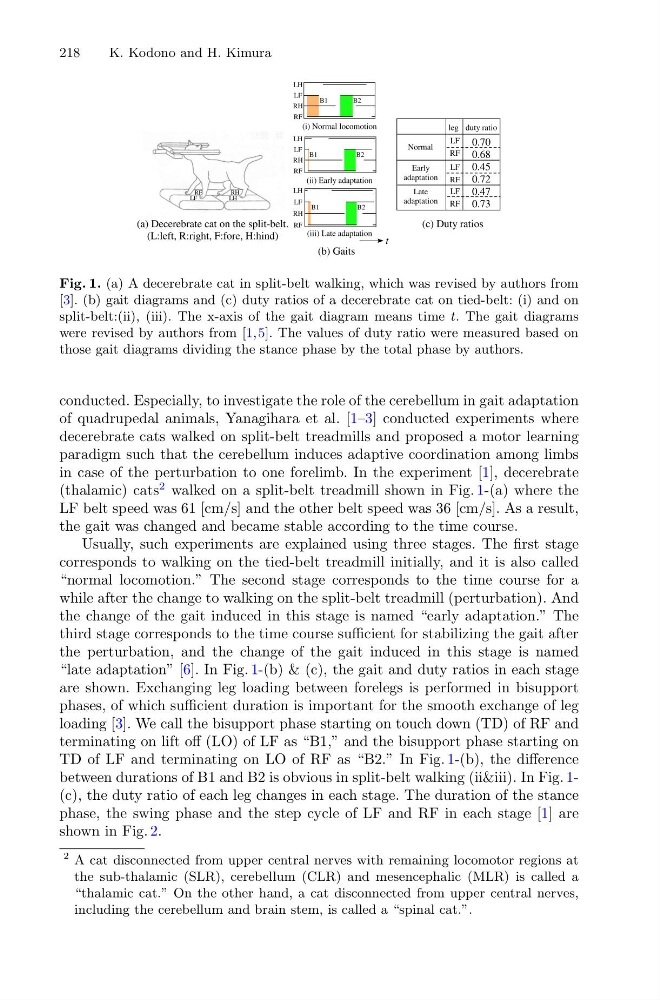
Fig. 1. (a) A decerebrate cat in split-belt walking, which was revised by authors from
[3]. (b) gait diagrams and (c) duty ratios of a decerebrate cat on tied-belt: (i) and on
split-belt:(ii), (iii). The x-axis of the gait diagram means time t. The gait diagrams
were revised by authors from [1, 5]. The values of duty ratio were measured based on
those gait diagrams dividing the stance phase by the total phase by authors.
conducted. Especially, to investigate the role of the cerebellum in gait adaptation
of quadrupedal animals, Yanagihara et al. [1–3] conducted experiments where
decerebrate cats walked on split-belt treadmills and proposed a motor learning
paradigm such that the cerebellum induces adaptive coordination among limbs
in case of the perturbation to one forelimb. In the experiment [1], decerebrate
(thalamic) cats
2 walked on a split-belt treadmill shown in Fig. 1-(a) where the
LF belt speed was 61 [cm/s] and the other belt speed was 36 [cm/s]. As a result,
the gait was changed and became stable according to the time course.
Usually, such experiments are explained using three stages. The first stage
corresponds to walking on the tied-belt treadmill initially, and it is also called
“normal locomotion.” The second stage corresponds to the time course for a
while after the change to walking on the split-belt treadmill (perturbation). And
the change of the gait induced in this stage is named “early adaptation.” The
third stage corresponds to the time course sufficient for stabilizing the gait after
the perturbation, and the change of the gait induced in this stage is named
“late adaptation” [6]. In Fig. 1-(b) & (c), the gait and duty ratios in each stage
are shown. Exchanging leg loading between forelegs is performed in bisupport
phases, of which sufficient duration is important for the smooth exchange of leg
loading [3]. We call the bisupport phase starting on touch down (TD) of RF and
terminating on lift off (LO) of LF as “B1,” and the bisupport phase starting on
TD of LF and terminating on LO of RF as “B2.” In Fig. 1-(b), the difference
between durations of B1 and B2 is obvious in split-belt walking (ii&iii). In Fig. 1(c), the duty ratio of each leg changes in each stage. The duration of the stance
phase, the swing phase and the step cycle of LF and RF in each stage [1] are
shown in Fig. 2.
2 A cat disconnected from upper central nerves with remaining locomotor regions at
the sub-thalamic (SLR), cerebellum (CLR) and mesencephalic (MLR) is called a
“thalamic cat.” On the other hand, a cat disconnected from upper central nerves,
including the cerebellum and brain stem, is called a “spinal cat.”.
K. Kodono and H. Kimura
Fig. 1. (a) A decerebrate cat in split-belt walking, which was revised by authors from
[3]. (b) gait diagrams and (c) duty ratios of a decerebrate cat on tied-belt: (i) and on
split-belt:(ii), (iii). The x-axis of the gait diagram means time t. The gait diagrams
were revised by authors from [1, 5]. The values of duty ratio were measured based on
those gait diagrams dividing the stance phase by the total phase by authors.
conducted. Especially, to investigate the role of the cerebellum in gait adaptation
of quadrupedal animals, Yanagihara et al. [1–3] conducted experiments where
decerebrate cats walked on split-belt treadmills and proposed a motor learning
paradigm such that the cerebellum induces adaptive coordination among limbs
in case of the perturbation to one forelimb. In the experiment [1], decerebrate
(thalamic) cats
2 walked on a split-belt treadmill shown in Fig. 1-(a) where the
LF belt speed was 61 [cm/s] and the other belt speed was 36 [cm/s]. As a result,
the gait was changed and became stable according to the time course.
Usually, such experiments are explained using three stages. The first stage
corresponds to walking on the tied-belt treadmill initially, and it is also called
“normal locomotion.” The second stage corresponds to the time course for a
while after the change to walking on the split-belt treadmill (perturbation). And
the change of the gait induced in this stage is named “early adaptation.” The
third stage corresponds to the time course sufficient for stabilizing the gait after
the perturbation, and the change of the gait induced in this stage is named
“late adaptation” [6]. In Fig. 1-(b) & (c), the gait and duty ratios in each stage
are shown. Exchanging leg loading between forelegs is performed in bisupport
phases, of which sufficient duration is important for the smooth exchange of leg
loading [3]. We call the bisupport phase starting on touch down (TD) of RF and
terminating on lift off (LO) of LF as “B1,” and the bisupport phase starting on
TD of LF and terminating on LO of RF as “B2.” In Fig. 1-(b), the difference
between durations of B1 and B2 is obvious in split-belt walking (ii&iii). In Fig. 1(c), the duty ratio of each leg changes in each stage. The duration of the stance
phase, the swing phase and the step cycle of LF and RF in each stage [1] are
shown in Fig. 2.
2 A cat disconnected from upper central nerves with remaining locomotor regions at
the sub-thalamic (SLR), cerebellum (CLR) and mesencephalic (MLR) is called a
“thalamic cat.” On the other hand, a cat disconnected from upper central nerves,
including the cerebellum and brain stem, is called a “spinal cat.”.