

View Based Navigation Exploiting Temporal Information
211
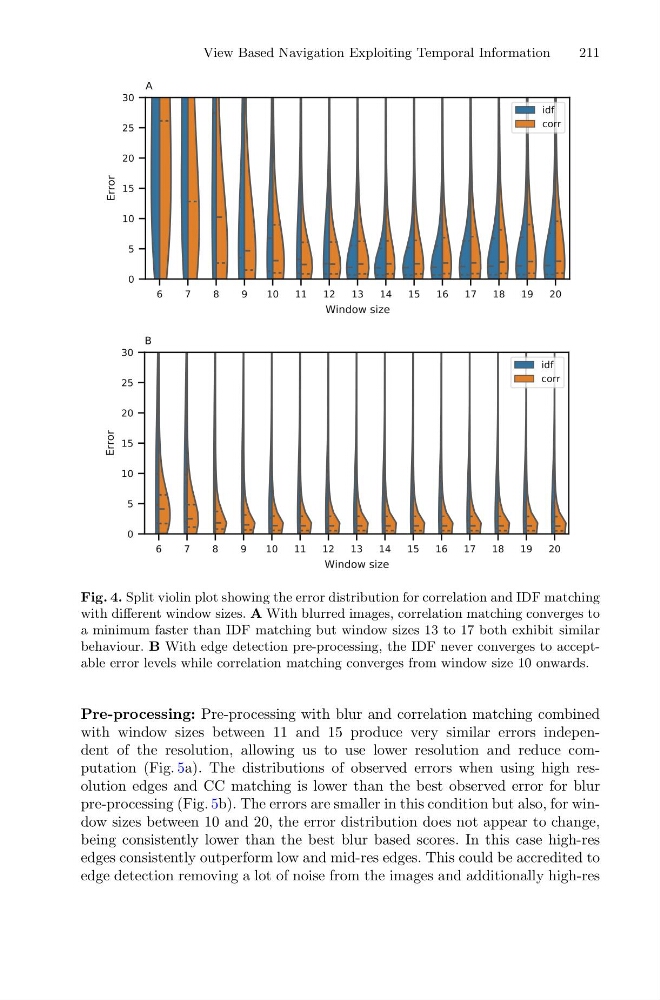
Fig. 4. Split violin plot showing the error distribution for correlation and IDF matching
with different window sizes. A With blurred images, correlation matching converges to
a minimum faster than IDF matching but window sizes 13 to 17 both exhibit similar
behaviour. B With edge detection pre-processing, the IDF never converges to acceptable error levels while correlation matching converges from window size 10 onwards.
Pre-processing: Pre-processing with blur and correlation matching combined
with window sizes between 11 and 15 produce very similar errors independent of the resolution, allowing us to use lower resolution and reduce computation (Fig. 5a). The distributions of observed errors when using high resolution edges and CC matching is lower than the best observed error for blur
pre-processing (Fig. 5b). The errors are smaller in this condition but also, for window sizes between 10 and 20, the error distribution does not appear to change,
being consistently lower than the best blur based scores. In this case high-res
edges consistently outperform low and mid-res edges. This could be accredited to
edge detection removing a lot of noise from the images and additionally high-res
211
Fig. 4. Split violin plot showing the error distribution for correlation and IDF matching
with different window sizes. A With blurred images, correlation matching converges to
a minimum faster than IDF matching but window sizes 13 to 17 both exhibit similar
behaviour. B With edge detection pre-processing, the IDF never converges to acceptable error levels while correlation matching converges from window size 10 onwards.
Pre-processing: Pre-processing with blur and correlation matching combined
with window sizes between 11 and 15 produce very similar errors independent of the resolution, allowing us to use lower resolution and reduce computation (Fig. 5a). The distributions of observed errors when using high resolution edges and CC matching is lower than the best observed error for blur
pre-processing (Fig. 5b). The errors are smaller in this condition but also, for window sizes between 10 and 20, the error distribution does not appear to change,
being consistently lower than the best blur based scores. In this case high-res
edges consistently outperform low and mid-res edges. This could be accredited to
edge detection removing a lot of noise from the images and additionally high-res