

208
E. Kagioulis et al.
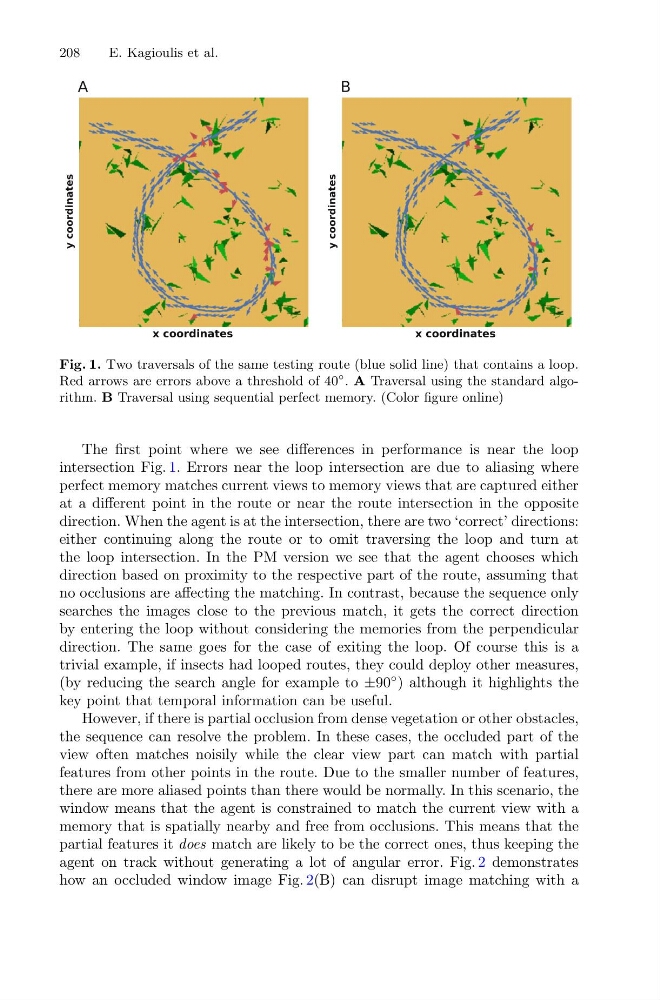
Fig. 1. Two traversals of the same testing route (blue solid line) that contains a loop.
Red arrows are errors above a threshold of 40
◦ . A Traversal using the standard algorithm. B Traversal using sequential perfect memory. (Color figure online)
The first point where we see differences in performance is near the loop
intersection Fig. 1. Errors near the loop intersection are due to aliasing where
perfect memory matches current views to memory views that are captured either
at a different point in the route or near the route intersection in the opposite
direction. When the agent is at the intersection, there are two ‘correct’ directions:
either continuing along the route or to omit traversing the loop and turn at
the loop intersection. In the PM version we see that the agent chooses which
direction based on proximity to the respective part of the route, assuming that
no occlusions are affecting the matching. In contrast, because the sequence only
searches the images close to the previous match, it gets the correct direction
by entering the loop without considering the memories from the perpendicular
direction. The same goes for the case of exiting the loop. Of course this is a
trivial example, if insects had looped routes, they could deploy other measures,
(by reducing the search angle for example to ±90
◦ ) although it highlights the
key point that temporal information can be useful.
However, if there is partial occlusion from dense vegetation or other obstacles,
the sequence can resolve the problem. In these cases, the occluded part of the
view often matches noisily while the clear view part can match with partial
features from other points in the route. Due to the smaller number of features,
there are more aliased points than there would be normally. In this scenario, the
window means that the agent is constrained to match the current view with a
memory that is spatially nearby and free from occlusions. This means that the
partial features it does match are likely to be the correct ones, thus keeping the
agent on track without generating a lot of angular error. Fig. 2 demonstrates
how an occluded window image Fig. 2(B) can disrupt image matching with a
E. Kagioulis et al.
Fig. 1. Two traversals of the same testing route (blue solid line) that contains a loop.
Red arrows are errors above a threshold of 40
◦ . A Traversal using the standard algorithm. B Traversal using sequential perfect memory. (Color figure online)
The first point where we see differences in performance is near the loop
intersection Fig. 1. Errors near the loop intersection are due to aliasing where
perfect memory matches current views to memory views that are captured either
at a different point in the route or near the route intersection in the opposite
direction. When the agent is at the intersection, there are two ‘correct’ directions:
either continuing along the route or to omit traversing the loop and turn at
the loop intersection. In the PM version we see that the agent chooses which
direction based on proximity to the respective part of the route, assuming that
no occlusions are affecting the matching. In contrast, because the sequence only
searches the images close to the previous match, it gets the correct direction
by entering the loop without considering the memories from the perpendicular
direction. The same goes for the case of exiting the loop. Of course this is a
trivial example, if insects had looped routes, they could deploy other measures,
(by reducing the search angle for example to ±90
◦ ) although it highlights the
key point that temporal information can be useful.
However, if there is partial occlusion from dense vegetation or other obstacles,
the sequence can resolve the problem. In these cases, the occluded part of the
view often matches noisily while the clear view part can match with partial
features from other points in the route. Due to the smaller number of features,
there are more aliased points than there would be normally. In this scenario, the
window means that the agent is constrained to match the current view with a
memory that is spatially nearby and free from occlusions. This means that the
partial features it does match are likely to be the correct ones, thus keeping the
agent on track without generating a lot of angular error. Fig. 2 demonstrates
how an occluded window image Fig. 2(B) can disrupt image matching with a