

162
O. G. Rosado and P. F. M. J. Verschure
risky material). To classify these components, robotics arms also will place the parts of
the components into bins coloured according to the material that must be collected in
it. Using a lifting platform, mobile robots can lift the bins and transport it when is full.
A computer placed outside the micro-plant will be running the central control system
that allows synergic performance between all the agents implicated in the recycling
plant. Additionally, a conveyor belt will be used to facilitate intermediate steps in the
development process.
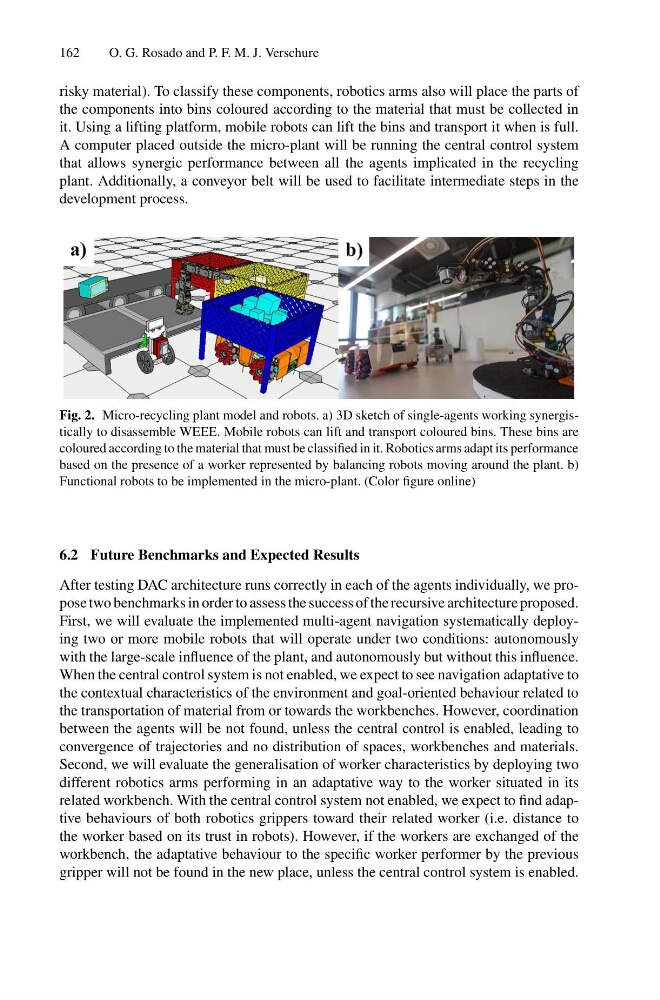
Fig. 2. Micro-recycling plant model and robots. a) 3D sketch of single-agents working synergistically to disassemble WEEE. Mobile robots can lift and transport coloured bins. These bins are
coloured according to the material that must be classified in it. Robotics arms adapt its performance
based on the presence of a worker represented by balancing robots moving around the plant. b)
Functional robots to be implemented in the micro-plant. (Color figure online)
6.2 Future Benchmarks and Expected Results
After testing DAC architecture runs correctly in each of the agents individually, we propose two benchmarks in order to assess the success of the recursive architecture proposed.
First, we will evaluate the implemented multi-agent navigation systematically deploying two or more mobile robots that will operate under two conditions: autonomously
with the large-scale influence of the plant, and autonomously but without this influence.
When the central control system is not enabled, we expect to see navigation adaptative to
the contextual characteristics of the environment and goal-oriented behaviour related to
the transportation of material from or towards the workbenches. However, coordination
between the agents will be not found, unless the central control is enabled, leading to
convergence of trajectories and no distribution of spaces, workbenches and materials.
Second, we will evaluate the generalisation of worker characteristics by deploying two
different robotics arms performing in an adaptative way to the worker situated in its
related workbench. With the central control system not enabled, we expect to find adaptive behaviours of both robotics grippers toward their related worker (i.e. distance to
the worker based on its trust in robots). However, if the workers are exchanged of the
workbench, the adaptative behaviour to the specific worker performer by the previous
gripper will not be found in the new place, unless the central control system is enabled.
O. G. Rosado and P. F. M. J. Verschure
risky material). To classify these components, robotics arms also will place the parts of
the components into bins coloured according to the material that must be collected in
it. Using a lifting platform, mobile robots can lift the bins and transport it when is full.
A computer placed outside the micro-plant will be running the central control system
that allows synergic performance between all the agents implicated in the recycling
plant. Additionally, a conveyor belt will be used to facilitate intermediate steps in the
development process.
Fig. 2. Micro-recycling plant model and robots. a) 3D sketch of single-agents working synergistically to disassemble WEEE. Mobile robots can lift and transport coloured bins. These bins are
coloured according to the material that must be classified in it. Robotics arms adapt its performance
based on the presence of a worker represented by balancing robots moving around the plant. b)
Functional robots to be implemented in the micro-plant. (Color figure online)
6.2 Future Benchmarks and Expected Results
After testing DAC architecture runs correctly in each of the agents individually, we propose two benchmarks in order to assess the success of the recursive architecture proposed.
First, we will evaluate the implemented multi-agent navigation systematically deploying two or more mobile robots that will operate under two conditions: autonomously
with the large-scale influence of the plant, and autonomously but without this influence.
When the central control system is not enabled, we expect to see navigation adaptative to
the contextual characteristics of the environment and goal-oriented behaviour related to
the transportation of material from or towards the workbenches. However, coordination
between the agents will be not found, unless the central control is enabled, leading to
convergence of trajectories and no distribution of spaces, workbenches and materials.
Second, we will evaluate the generalisation of worker characteristics by deploying two
different robotics arms performing in an adaptative way to the worker situated in its
related workbench. With the central control system not enabled, we expect to find adaptive behaviours of both robotics grippers toward their related worker (i.e. distance to
the worker based on its trust in robots). However, if the workers are exchanged of the
workbench, the adaptative behaviour to the specific worker performer by the previous
gripper will not be found in the new place, unless the central control system is enabled.