

Distributed Adaptive Control: An Ideal Cognitive Architecture Candidate
161
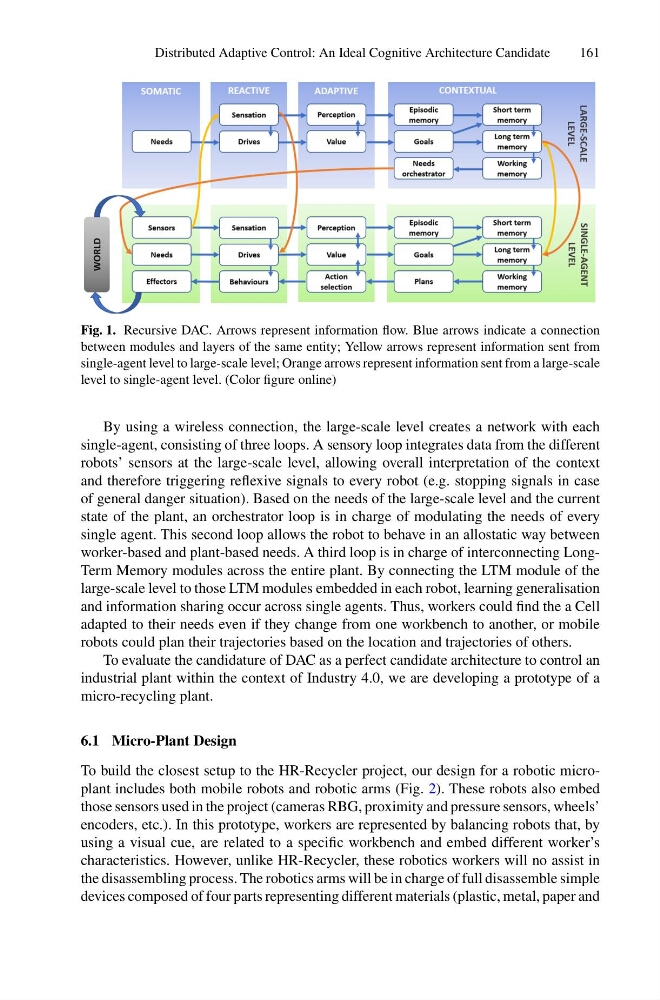
Fig. 1. Recursive DAC. Arrows represent information flow. Blue arrows indicate a connection
between modules and layers of the same entity; Yellow arrows represent information sent from
single-agent level to large-scale level; Orange arrows represent information sent from a large-scale
level to single-agent level. (Color figure online)
By using a wireless connection, the large-scale level creates a network with each
single-agent, consisting of three loops. A sensory loop integrates data from the different
robots’ sensors at the large-scale level, allowing overall interpretation of the context
and therefore triggering reflexive signals to every robot (e.g. stopping signals in case
of general danger situation). Based on the needs of the large-scale level and the current
state of the plant, an orchestrator loop is in charge of modulating the needs of every
single agent. This second loop allows the robot to behave in an allostatic way between
worker-based and plant-based needs. A third loop is in charge of interconnecting LongTerm Memory modules across the entire plant. By connecting the LTM module of the
large-scale level to those LTM modules embedded in each robot, learning generalisation
and information sharing occur across single agents. Thus, workers could find the a Cell
adapted to their needs even if they change from one workbench to another, or mobile
robots could plan their trajectories based on the location and trajectories of others.
To evaluate the candidature of DAC as a perfect candidate architecture to control an
industrial plant within the context of Industry 4.0, we are developing a prototype of a
micro-recycling plant.
6.1 Micro-Plant Design
To build the closest setup to the HR-Recycler project, our design for a robotic microplant includes both mobile robots and robotic arms (Fig. 2). These robots also embed
those sensors used in the project (cameras RBG, proximity and pressure sensors, wheels’
encoders, etc.). In this prototype, workers are represented by balancing robots that, by
using a visual cue, are related to a specific workbench and embed different worker’s
characteristics. However, unlike HR-Recycler, these robotics workers will no assist in
the disassembling process. The robotics arms will be in charge of full disassemble simple
devices composed of four parts representing different materials (plastic, metal, paper and
161
Fig. 1. Recursive DAC. Arrows represent information flow. Blue arrows indicate a connection
between modules and layers of the same entity; Yellow arrows represent information sent from
single-agent level to large-scale level; Orange arrows represent information sent from a large-scale
level to single-agent level. (Color figure online)
By using a wireless connection, the large-scale level creates a network with each
single-agent, consisting of three loops. A sensory loop integrates data from the different
robots’ sensors at the large-scale level, allowing overall interpretation of the context
and therefore triggering reflexive signals to every robot (e.g. stopping signals in case
of general danger situation). Based on the needs of the large-scale level and the current
state of the plant, an orchestrator loop is in charge of modulating the needs of every
single agent. This second loop allows the robot to behave in an allostatic way between
worker-based and plant-based needs. A third loop is in charge of interconnecting LongTerm Memory modules across the entire plant. By connecting the LTM module of the
large-scale level to those LTM modules embedded in each robot, learning generalisation
and information sharing occur across single agents. Thus, workers could find the a Cell
adapted to their needs even if they change from one workbench to another, or mobile
robots could plan their trajectories based on the location and trajectories of others.
To evaluate the candidature of DAC as a perfect candidate architecture to control an
industrial plant within the context of Industry 4.0, we are developing a prototype of a
micro-recycling plant.
6.1 Micro-Plant Design
To build the closest setup to the HR-Recycler project, our design for a robotic microplant includes both mobile robots and robotic arms (Fig. 2). These robots also embed
those sensors used in the project (cameras RBG, proximity and pressure sensors, wheels’
encoders, etc.). In this prototype, workers are represented by balancing robots that, by
using a visual cue, are related to a specific workbench and embed different worker’s
characteristics. However, unlike HR-Recycler, these robotics workers will no assist in
the disassembling process. The robotics arms will be in charge of full disassemble simple
devices composed of four parts representing different materials (plastic, metal, paper and