

Robotics Application of a Method for Analytically Computing Infinitesimal
113
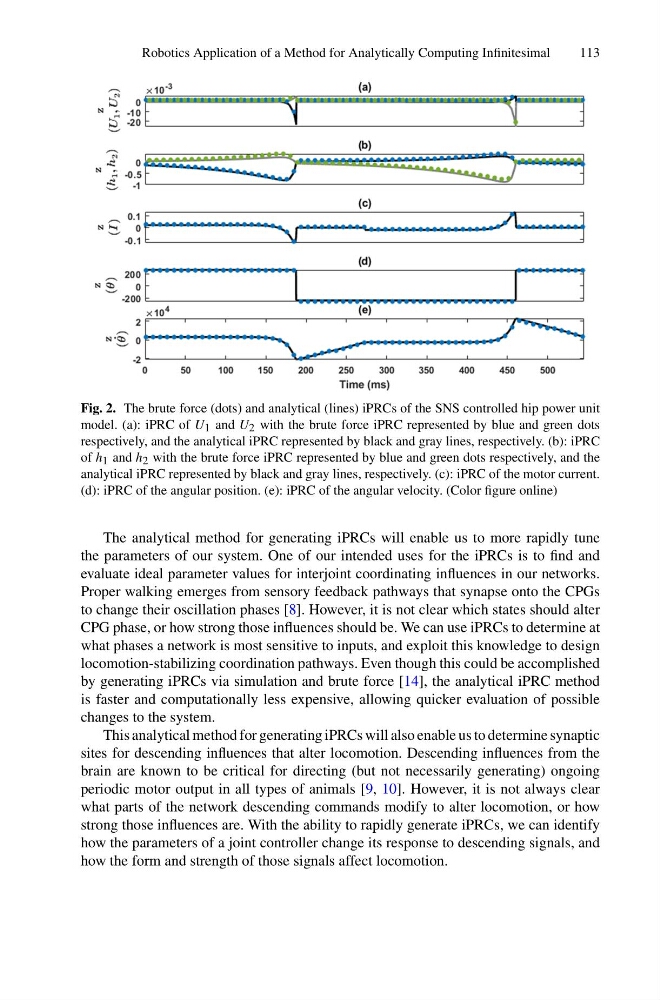
Fig. 2. The brute force (dots) and analytical (lines) iPRCs of the SNS controlled hip power unit
model. (a): iPRC of U 1 and U 2 with the brute force iPRC represented by blue and green dots
respectively, and the analytical iPRC represented by black and gray lines, respectively. (b): iPRC
of h 1 and h 2 with the brute force iPRC represented by blue and green dots respectively, and the
analytical iPRC represented by black and gray lines, respectively. (c): iPRC of the motor current.
(d): iPRC of the angular position. (e): iPRC of the angular velocity. (Color figure online)
The analytical method for generating iPRCs will enable us to more rapidly tune
the parameters of our system. One of our intended uses for the iPRCs is to find and
evaluate ideal parameter values for interjoint coordinating influences in our networks.
Proper walking emerges from sensory feedback pathways that synapse onto the CPGs
to change their oscillation phases [8]. However, it is not clear which states should alter
CPG phase, or how strong those influences should be. We can use iPRCs to determine at
what phases a network is most sensitive to inputs, and exploit this knowledge to design
locomotion-stabilizing coordination pathways. Even though this could be accomplished
by generating iPRCs via simulation and brute force [14], the analytical iPRC method
is faster and computationally less expensive, allowing quicker evaluation of possible
changes to the system.
This analytical method for generating iPRCs will also enable us to determine synaptic
sites for descending influences that alter locomotion. Descending influences from the
brain are known to be critical for directing (but not necessarily generating) ongoing
periodic motor output in all types of animals [9, 10]. However, it is not always clear
what parts of the network descending commands modify to alter locomotion, or how
strong those influences are. With the ability to rapidly generate iPRCs, we can identify
how the parameters of a joint controller change its response to descending signals, and
how the form and strength of those signals affect locomotion.
113
Fig. 2. The brute force (dots) and analytical (lines) iPRCs of the SNS controlled hip power unit
model. (a): iPRC of U 1 and U 2 with the brute force iPRC represented by blue and green dots
respectively, and the analytical iPRC represented by black and gray lines, respectively. (b): iPRC
of h 1 and h 2 with the brute force iPRC represented by blue and green dots respectively, and the
analytical iPRC represented by black and gray lines, respectively. (c): iPRC of the motor current.
(d): iPRC of the angular position. (e): iPRC of the angular velocity. (Color figure online)
The analytical method for generating iPRCs will enable us to more rapidly tune
the parameters of our system. One of our intended uses for the iPRCs is to find and
evaluate ideal parameter values for interjoint coordinating influences in our networks.
Proper walking emerges from sensory feedback pathways that synapse onto the CPGs
to change their oscillation phases [8]. However, it is not clear which states should alter
CPG phase, or how strong those influences should be. We can use iPRCs to determine at
what phases a network is most sensitive to inputs, and exploit this knowledge to design
locomotion-stabilizing coordination pathways. Even though this could be accomplished
by generating iPRCs via simulation and brute force [14], the analytical iPRC method
is faster and computationally less expensive, allowing quicker evaluation of possible
changes to the system.
This analytical method for generating iPRCs will also enable us to determine synaptic
sites for descending influences that alter locomotion. Descending influences from the
brain are known to be critical for directing (but not necessarily generating) ongoing
periodic motor output in all types of animals [9, 10]. However, it is not always clear
what parts of the network descending commands modify to alter locomotion, or how
strong those influences are. With the ability to rapidly generate iPRCs, we can identify
how the parameters of a joint controller change its response to descending signals, and
how the form and strength of those signals affect locomotion.