

90
J. Fan et al.
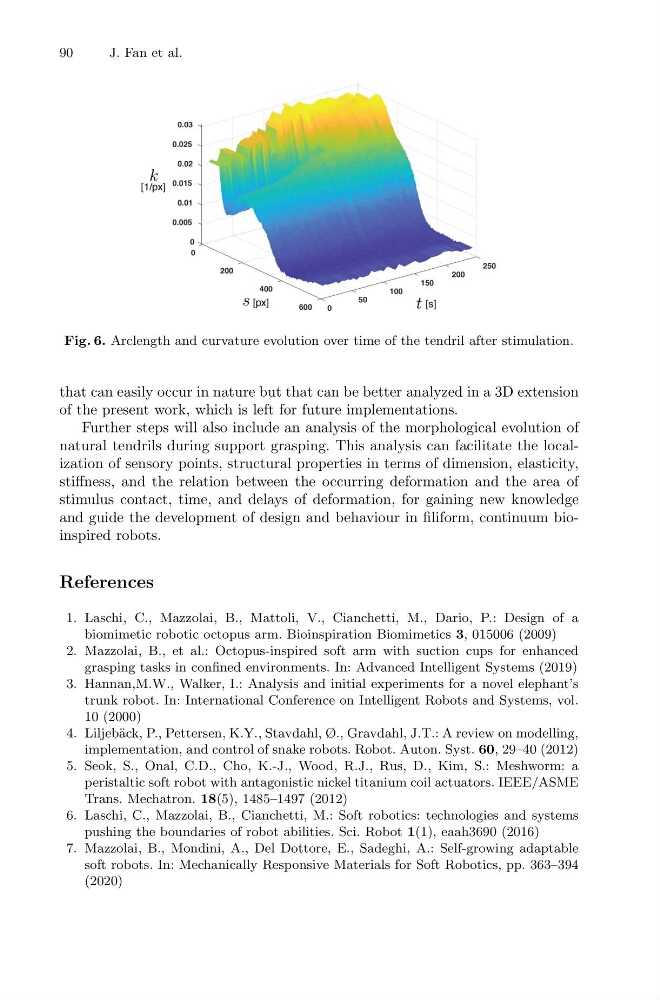
Fig. 6. Arclength and curvature evolution over time of the tendril after stimulation.
that can easily occur in nature but that can be better analyzed in a 3D extension
of the present work, which is left for future implementations.
Further steps will also include an analysis of the morphological evolution of
natural tendrils during support grasping. This analysis can facilitate the localization of sensory points, structural properties in terms of dimension, elasticity,
stiffness, and the relation between the occurring deformation and the area of
stimulus contact, time, and delays of deformation, for gaining new knowledge
and guide the development of design and behaviour in filiform, continuum bioinspired robots.
References
1. Laschi, C., Mazzolai, B., Mattoli, V., Cianchetti, M., Dario, P.: Design of a
biomimetic robotic octopus arm. Bioinspiration Biomimetics 3, 015006 (2009)
2. Mazzolai, B., et al.: Octopus-inspired soft arm with suction cups for enhanced
grasping tasks in confined environments. In: Advanced Intelligent Systems (2019)
3. Hannan,M.W., Walker, I.: Analysis and initial experiments for a novel elephant’s
trunk robot. In: International Conference on Intelligent Robots and Systems, vol.
10 (2000)
4. Liljeb¨ ack, P., Pettersen, K.Y., Stavdahl, Ø., Gravdahl, J.T.: A review on modelling,
implementation, and control of snake robots. Robot. Auton. Syst. 60, 29–40 (2012)
5. Seok, S., Onal, C.D., Cho, K.-J., Wood, R.J., Rus, D., Kim, S.: Meshworm: a
peristaltic soft robot with antagonistic nickel titanium coil actuators. IEEE/ASME
Trans. Mechatron. 18(5), 1485–1497 (2012)
6. Laschi, C., Mazzolai, B., Cianchetti, M.: Soft robotics: technologies and systems
pushing the boundaries of robot abilities. Sci. Robot 1(1), eaah3690 (2016)
7. Mazzolai, B., Mondini, A., Del Dottore, E., Sadeghi, A.: Self-growing adaptable
soft robots. In: Mechanically Responsive Materials for Soft Robotics, pp. 363–394
(2020)
J. Fan et al.
Fig. 6. Arclength and curvature evolution over time of the tendril after stimulation.
that can easily occur in nature but that can be better analyzed in a 3D extension
of the present work, which is left for future implementations.
Further steps will also include an analysis of the morphological evolution of
natural tendrils during support grasping. This analysis can facilitate the localization of sensory points, structural properties in terms of dimension, elasticity,
stiffness, and the relation between the occurring deformation and the area of
stimulus contact, time, and delays of deformation, for gaining new knowledge
and guide the development of design and behaviour in filiform, continuum bioinspired robots.
References
1. Laschi, C., Mazzolai, B., Mattoli, V., Cianchetti, M., Dario, P.: Design of a
biomimetic robotic octopus arm. Bioinspiration Biomimetics 3, 015006 (2009)
2. Mazzolai, B., et al.: Octopus-inspired soft arm with suction cups for enhanced
grasping tasks in confined environments. In: Advanced Intelligent Systems (2019)
3. Hannan,M.W., Walker, I.: Analysis and initial experiments for a novel elephant’s
trunk robot. In: International Conference on Intelligent Robots and Systems, vol.
10 (2000)
4. Liljeb¨ ack, P., Pettersen, K.Y., Stavdahl, Ø., Gravdahl, J.T.: A review on modelling,
implementation, and control of snake robots. Robot. Auton. Syst. 60, 29–40 (2012)
5. Seok, S., Onal, C.D., Cho, K.-J., Wood, R.J., Rus, D., Kim, S.: Meshworm: a
peristaltic soft robot with antagonistic nickel titanium coil actuators. IEEE/ASME
Trans. Mechatron. 18(5), 1485–1497 (2012)
6. Laschi, C., Mazzolai, B., Cianchetti, M.: Soft robotics: technologies and systems
pushing the boundaries of robot abilities. Sci. Robot 1(1), eaah3690 (2016)
7. Mazzolai, B., Mondini, A., Del Dottore, E., Sadeghi, A.: Self-growing adaptable
soft robots. In: Mechanically Responsive Materials for Soft Robotics, pp. 363–394
(2020)