

Image-Based 2D PCD for Morphological Analysis of Tendrils-Like Structure
87
We apply the dynamic programming method to update the matrix J by
traversing all pairs of (p i , p j ). Then, from the optimized cost, we select n elements, p si with i = 1, . . . , n, that identify the junction points of the piece-wise
segments.
2.4 2D Piece-Wise Clothoid Representation
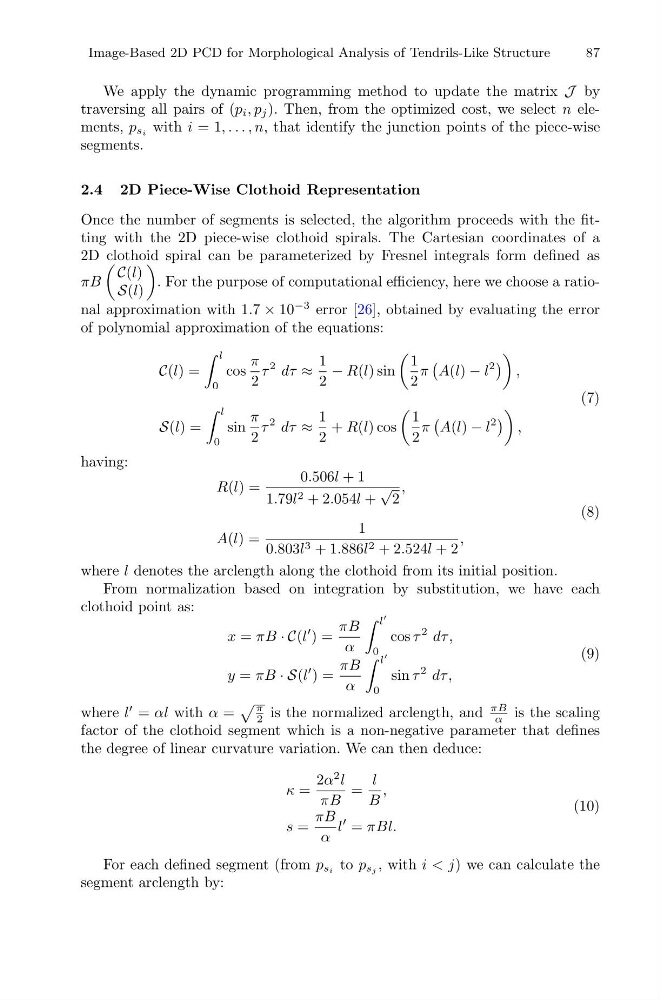
Once the number of segments is selected, the algorithm proceeds with the fitting with the 2D piece-wise clothoid spirals. The Cartesian coordinates of a
2D clothoid spiral can be parameterized by Fresnel integrals form defined as
πB
C(l)
S(l)
. For the purpose of computational efficiency, here we choose a rational approximation with 1.7 × 10
−3 error [26], obtained by evaluating the error
of polynomial approximation of the equations:
C(l) =
l
0
cos
π
2
τ
2 dτ ≈
1
2
− R(l) sin
1
2
π
A(l) − l
2
,
S(l) =
l
0
sin
π
2
τ
2 dτ ≈
1
2
+ R(l) cos
1
2
π
A(l) − l
2
,
(7)
having:
R(l) =
0.506l + 1
1.79l 2 + 2.054l +
√
2
,
A(l) =
1
0.803l 3 + 1.886l 2 + 2.524l + 2
,
(8)
where l denotes the arclength along the clothoid from its initial position.
From normalization based on integration by substitution, we have each
clothoid point as:
x = πB · C(l
) =
πB
α
l
0
cos τ
2 dτ ,
y = πB · S(l
) =
πB
α
l
0
sin τ
2 dτ ,
(9)
where l
= αl with α =
π
2 is the normalized arclength, and
πB
α is the scaling
factor of the clothoid segment which is a non-negative parameter that defines
the degree of linear curvature variation. We can then deduce:
κ =
2α
2 l
πB
=
l
B
,
s =
πB
α
l
= πBl.
(10)
For each defined segment (from p si to p sj , with i < j) we can calculate the
segment arclength by:
87
We apply the dynamic programming method to update the matrix J by
traversing all pairs of (p i , p j ). Then, from the optimized cost, we select n elements, p si with i = 1, . . . , n, that identify the junction points of the piece-wise
segments.
2.4 2D Piece-Wise Clothoid Representation
Once the number of segments is selected, the algorithm proceeds with the fitting with the 2D piece-wise clothoid spirals. The Cartesian coordinates of a
2D clothoid spiral can be parameterized by Fresnel integrals form defined as
πB
C(l)
S(l)
. For the purpose of computational efficiency, here we choose a rational approximation with 1.7 × 10
−3 error [26], obtained by evaluating the error
of polynomial approximation of the equations:
C(l) =
l
0
cos
π
2
τ
2 dτ ≈
1
2
− R(l) sin
1
2
π
A(l) − l
2
,
S(l) =
l
0
sin
π
2
τ
2 dτ ≈
1
2
+ R(l) cos
1
2
π
A(l) − l
2
,
(7)
having:
R(l) =
0.506l + 1
1.79l 2 + 2.054l +
√
2
,
A(l) =
1
0.803l 3 + 1.886l 2 + 2.524l + 2
,
(8)
where l denotes the arclength along the clothoid from its initial position.
From normalization based on integration by substitution, we have each
clothoid point as:
x = πB · C(l
) =
πB
α
l
0
cos τ
2 dτ ,
y = πB · S(l
) =
πB
α
l
0
sin τ
2 dτ ,
(9)
where l
= αl with α =
π
2 is the normalized arclength, and
πB
α is the scaling
factor of the clothoid segment which is a non-negative parameter that defines
the degree of linear curvature variation. We can then deduce:
κ =
2α
2 l
πB
=
l
B
,
s =
πB
α
l
= πBl.
(10)
For each defined segment (from p si to p sj , with i < j) we can calculate the
segment arclength by: