

3.7 5
0 -End-Labeled
DNA Oligonucleotide
Probe (Fig. 4b)
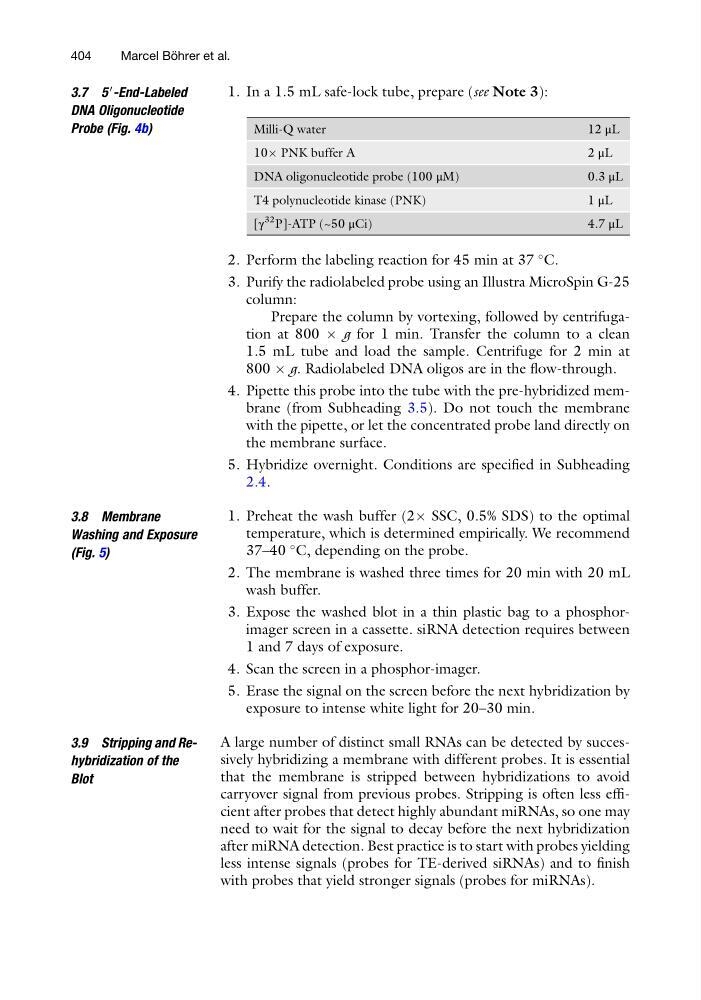
1. In a 1.5 mL safe-lock tube, prepare (see Note 3):
Milli-Q water
12 μL
10Â PNK buffer A
2 μL
DNA oligonucleotide probe (100 μM)
0.3 μL
T4 polynucleotide kinase (PNK)
1 μL
[γ
32 P]-ATP (~50 μCi)
4.7 μL
2. Perform the labeling reaction for 45 min at 37
C.
3. Purify the radiolabeled probe using an Illustra MicroSpin G-25
column:
Prepare the column by vortexing, followed by centrifugation at 800 Â g for 1 min. Transfer the column to a clean
1.5 mL tube and load the sample. Centrifuge for 2 min at
800 Â g. Radiolabeled DNA oligos are in the flow-through.
4. Pipette this probe into the tube with the pre-hybridized membrane (from Subheading 3.5). Do not touch the membrane
with the pipette, or let the concentrated probe land directly on
the membrane surface.
5. Hybridize overnight. Conditions are specified in Subheading
2.4.
3.8 Membrane
Washing and Exposure
(Fig. 5)
1. Preheat the wash buffer (2Â SSC, 0.5% SDS) to the optimal
temperature, which is determined empirically. We recommend
37–40
C, depending on the probe.
2. The membrane is washed three times for 20 min with 20 mL
wash buffer.
3. Expose the washed blot in a thin plastic bag to a phosphorimager screen in a cassette. siRNA detection requires between
1 and 7 days of exposure.
4. Scan the screen in a phosphor-imager.
5. Erase the signal on the screen before the next hybridization by
exposure to intense white light for 20–30 min.
3.9 Stripping and Rehybridization of the
Blot
A large number of distinct small RNAs can be detected by successively hybridizing a membrane with different probes. It is essential
that the membrane is stripped between hybridizations to avoid
carryover signal from previous probes. Stripping is often less efficient after probes that detect highly abundant miRNAs, so one may
need to wait for the signal to decay before the next hybridization
after miRNA detection. Best practice is to start with probes yielding
less intense signals (probes for TE-derived siRNAs) and to finish
with probes that yield stronger signals (probes for miRNAs).
404
Marcel Bo ¨ hrer et al.
0 -End-Labeled
DNA Oligonucleotide
Probe (Fig. 4b)
1. In a 1.5 mL safe-lock tube, prepare (see Note 3):
Milli-Q water
12 μL
10Â PNK buffer A
2 μL
DNA oligonucleotide probe (100 μM)
0.3 μL
T4 polynucleotide kinase (PNK)
1 μL
[γ
32 P]-ATP (~50 μCi)
4.7 μL
2. Perform the labeling reaction for 45 min at 37
C.
3. Purify the radiolabeled probe using an Illustra MicroSpin G-25
column:
Prepare the column by vortexing, followed by centrifugation at 800 Â g for 1 min. Transfer the column to a clean
1.5 mL tube and load the sample. Centrifuge for 2 min at
800 Â g. Radiolabeled DNA oligos are in the flow-through.
4. Pipette this probe into the tube with the pre-hybridized membrane (from Subheading 3.5). Do not touch the membrane
with the pipette, or let the concentrated probe land directly on
the membrane surface.
5. Hybridize overnight. Conditions are specified in Subheading
2.4.
3.8 Membrane
Washing and Exposure
(Fig. 5)
1. Preheat the wash buffer (2Â SSC, 0.5% SDS) to the optimal
temperature, which is determined empirically. We recommend
37–40
C, depending on the probe.
2. The membrane is washed three times for 20 min with 20 mL
wash buffer.
3. Expose the washed blot in a thin plastic bag to a phosphorimager screen in a cassette. siRNA detection requires between
1 and 7 days of exposure.
4. Scan the screen in a phosphor-imager.
5. Erase the signal on the screen before the next hybridization by
exposure to intense white light for 20–30 min.
3.9 Stripping and Rehybridization of the
Blot
A large number of distinct small RNAs can be detected by successively hybridizing a membrane with different probes. It is essential
that the membrane is stripped between hybridizations to avoid
carryover signal from previous probes. Stripping is often less efficient after probes that detect highly abundant miRNAs, so one may
need to wait for the signal to decay before the next hybridization
after miRNA detection. Best practice is to start with probes yielding
less intense signals (probes for TE-derived siRNAs) and to finish
with probes that yield stronger signals (probes for miRNAs).
404
Marcel Bo ¨ hrer et al.