

3 Label-Free, Ultrahigh-Speed, Direct Imaging and Tracking …
73
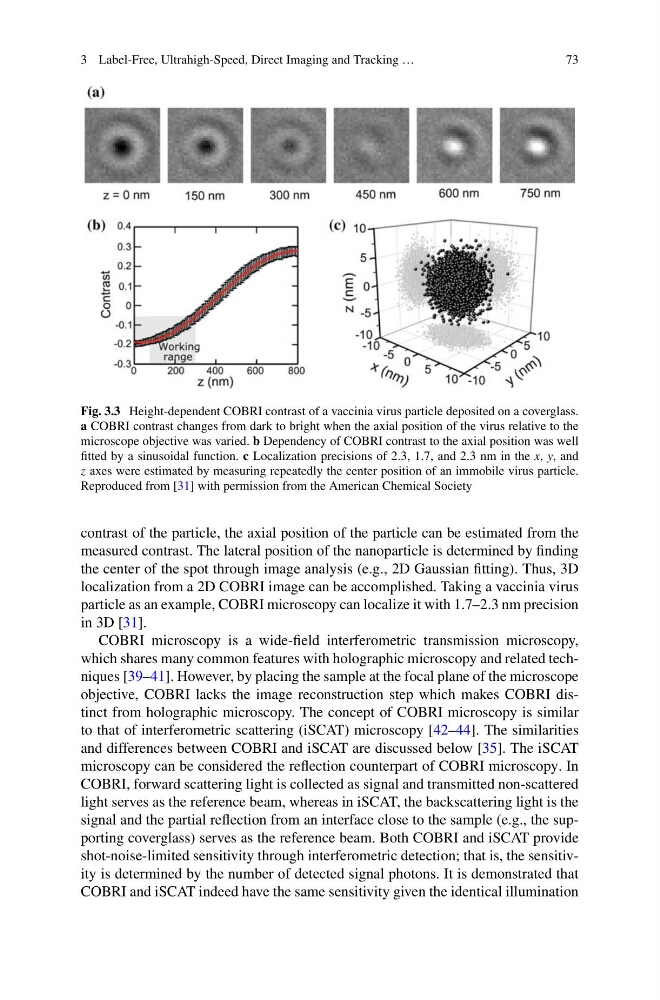
Fig. 3.3 Height-dependent COBRI contrast of a vaccinia virus particle deposited on a coverglass.
a COBRI contrast changes from dark to bright when the axial position of the virus relative to the
microscope objective was varied. b Dependency of COBRI contrast to the axial position was well
fitted by a sinusoidal function. c Localization precisions of 2.3, 1.7, and 2.3 nm in the x, y, and
z axes were estimated by measuring repeatedly the center position of an immobile virus particle.
Reproduced from [31] with permission from the American Chemical Society
contrast of the particle, the axial position of the particle can be estimated from the
measured contrast. The lateral position of the nanoparticle is determined by finding
the center of the spot through image analysis (e.g., 2D Gaussian fitting). Thus, 3D
localization from a 2D COBRI image can be accomplished. Taking a vaccinia virus
particle as an example, COBRI microscopy can localize it with 1.7–2.3 nm precision
in 3D [31].
COBRI microscopy is a wide-field interferometric transmission microscopy,
which shares many common features with holographic microscopy and related techniques [39–41]. However, by placing the sample at the focal plane of the microscope
objective, COBRI lacks the image reconstruction step which makes COBRI distinct from holographic microscopy. The concept of COBRI microscopy is similar
to that of interferometric scattering (iSCAT) microscopy [42–44]. The similarities
and differences between COBRI and iSCAT are discussed below [35]. The iSCAT
microscopy can be considered the reflection counterpart of COBRI microscopy. In
COBRI, forward scattering light is collected as signal and transmitted non-scattered
light serves as the reference beam, whereas in iSCAT, the backscattering light is the
signal and the partial reflection from an interface close to the sample (e.g., the supporting coverglass) serves as the reference beam. Both COBRI and iSCAT provide
shot-noise-limited sensitivity through interferometric detection; that is, the sensitivity is determined by the number of detected signal photons. It is demonstrated that
COBRI and iSCAT indeed have the same sensitivity given the identical illumination
73
Fig. 3.3 Height-dependent COBRI contrast of a vaccinia virus particle deposited on a coverglass.
a COBRI contrast changes from dark to bright when the axial position of the virus relative to the
microscope objective was varied. b Dependency of COBRI contrast to the axial position was well
fitted by a sinusoidal function. c Localization precisions of 2.3, 1.7, and 2.3 nm in the x, y, and
z axes were estimated by measuring repeatedly the center position of an immobile virus particle.
Reproduced from [31] with permission from the American Chemical Society
contrast of the particle, the axial position of the particle can be estimated from the
measured contrast. The lateral position of the nanoparticle is determined by finding
the center of the spot through image analysis (e.g., 2D Gaussian fitting). Thus, 3D
localization from a 2D COBRI image can be accomplished. Taking a vaccinia virus
particle as an example, COBRI microscopy can localize it with 1.7–2.3 nm precision
in 3D [31].
COBRI microscopy is a wide-field interferometric transmission microscopy,
which shares many common features with holographic microscopy and related techniques [39–41]. However, by placing the sample at the focal plane of the microscope
objective, COBRI lacks the image reconstruction step which makes COBRI distinct from holographic microscopy. The concept of COBRI microscopy is similar
to that of interferometric scattering (iSCAT) microscopy [42–44]. The similarities
and differences between COBRI and iSCAT are discussed below [35]. The iSCAT
microscopy can be considered the reflection counterpart of COBRI microscopy. In
COBRI, forward scattering light is collected as signal and transmitted non-scattered
light serves as the reference beam, whereas in iSCAT, the backscattering light is the
signal and the partial reflection from an interface close to the sample (e.g., the supporting coverglass) serves as the reference beam. Both COBRI and iSCAT provide
shot-noise-limited sensitivity through interferometric detection; that is, the sensitivity is determined by the number of detected signal photons. It is demonstrated that
COBRI and iSCAT indeed have the same sensitivity given the identical illumination