

46
R. W. Taylor and V. Sandoghdar
(a)
(b)
(c)
(d)
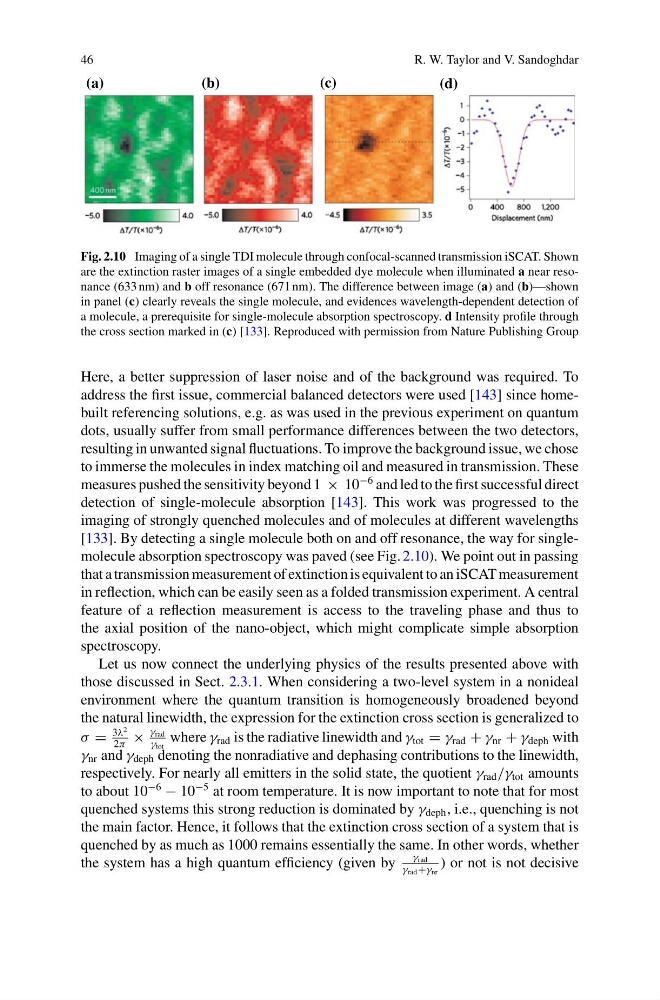
Fig. 2.10 Imaging of a single TDI molecule through confocal-scanned transmission iSCAT. Shown
are the extinction raster images of a single embedded dye molecule when illuminated a near resonance (633 nm) and b off resonance (671 nm). The difference between image (a) and (b)—shown
in panel (c) clearly reveals the single molecule, and evidences wavelength-dependent detection of
a molecule, a prerequisite for single-molecule absorption spectroscopy. d Intensity profile through
the cross section marked in (c) [133]. Reproduced with permission from Nature Publishing Group
Here, a better suppression of laser noise and of the background was required. To
address the first issue, commercial balanced detectors were used [143] since homebuilt referencing solutions, e.g. as was used in the previous experiment on quantum
dots, usually suffer from small performance differences between the two detectors,
resulting in unwanted signal fluctuations. To improve the background issue, we chose
to immerse the molecules in index matching oil and measured in transmission. These
measures pushed the sensitivity beyond 1 × 10
−6 and led to the first successful direct
detection of single-molecule absorption [143]. This work was progressed to the
imaging of strongly quenched molecules and of molecules at different wavelengths
[133]. By detecting a single molecule both on and off resonance, the way for singlemolecule absorption spectroscopy was paved (see Fig. 2.10). We point out in passing
that a transmission measurement of extinction is equivalent to an iSCAT measurement
in reflection, which can be easily seen as a folded transmission experiment. A central
feature of a reflection measurement is access to the traveling phase and thus to
the axial position of the nano-object, which might complicate simple absorption
spectroscopy.
Let us now connect the underlying physics of the results presented above with
those discussed in Sect. 2.3.1. When considering a two-level system in a nonideal
environment where the quantum transition is homogeneously broadened beyond
the natural linewidth, the expression for the extinction cross section is generalized to
σ =
3λ
2
2π
×
γ rad
γ tot
where γ rad is the radiative linewidth and γ tot = γ rad + γ nr + γ deph with
γ nr and γ deph denoting the nonradiative and dephasing contributions to the linewidth,
respectively. For nearly all emitters in the solid state, the quotient γ rad /γ tot amounts
to about 10
−6
− 10
−5 at room temperature. It is now important to note that for most
quenched systems this strong reduction is dominated by γ deph , i.e., quenching is not
the main factor. Hence, it follows that the extinction cross section of a system that is
quenched by as much as 1000 remains essentially the same. In other words, whether
the system has a high quantum efficiency (given by
γ rad
γ rad +γ nr
) or not is not decisive
R. W. Taylor and V. Sandoghdar
(a)
(b)
(c)
(d)
Fig. 2.10 Imaging of a single TDI molecule through confocal-scanned transmission iSCAT. Shown
are the extinction raster images of a single embedded dye molecule when illuminated a near resonance (633 nm) and b off resonance (671 nm). The difference between image (a) and (b)—shown
in panel (c) clearly reveals the single molecule, and evidences wavelength-dependent detection of
a molecule, a prerequisite for single-molecule absorption spectroscopy. d Intensity profile through
the cross section marked in (c) [133]. Reproduced with permission from Nature Publishing Group
Here, a better suppression of laser noise and of the background was required. To
address the first issue, commercial balanced detectors were used [143] since homebuilt referencing solutions, e.g. as was used in the previous experiment on quantum
dots, usually suffer from small performance differences between the two detectors,
resulting in unwanted signal fluctuations. To improve the background issue, we chose
to immerse the molecules in index matching oil and measured in transmission. These
measures pushed the sensitivity beyond 1 × 10
−6 and led to the first successful direct
detection of single-molecule absorption [143]. This work was progressed to the
imaging of strongly quenched molecules and of molecules at different wavelengths
[133]. By detecting a single molecule both on and off resonance, the way for singlemolecule absorption spectroscopy was paved (see Fig. 2.10). We point out in passing
that a transmission measurement of extinction is equivalent to an iSCAT measurement
in reflection, which can be easily seen as a folded transmission experiment. A central
feature of a reflection measurement is access to the traveling phase and thus to
the axial position of the nano-object, which might complicate simple absorption
spectroscopy.
Let us now connect the underlying physics of the results presented above with
those discussed in Sect. 2.3.1. When considering a two-level system in a nonideal
environment where the quantum transition is homogeneously broadened beyond
the natural linewidth, the expression for the extinction cross section is generalized to
σ =
3λ
2
2π
×
γ rad
γ tot
where γ rad is the radiative linewidth and γ tot = γ rad + γ nr + γ deph with
γ nr and γ deph denoting the nonradiative and dephasing contributions to the linewidth,
respectively. For nearly all emitters in the solid state, the quotient γ rad /γ tot amounts
to about 10
−6
− 10
−5 at room temperature. It is now important to note that for most
quenched systems this strong reduction is dominated by γ deph , i.e., quenching is not
the main factor. Hence, it follows that the extinction cross section of a system that is
quenched by as much as 1000 remains essentially the same. In other words, whether
the system has a high quantum efficiency (given by
γ rad
γ rad +γ nr
) or not is not decisive