

42
R. W. Taylor and V. Sandoghdar
pixel is acquired sequentially in time. Another noteworthy feature of a scanning
mode is better mode matching between the spherical scattered and wave and the
strongly focused reference beam wavefront, which renders the PSF without distinct
ring features.
For applications requiring fast imaging, wide-field illumination with camerabased detection is the most popular modality. By measuring in reflection, higher
contrasts are obtained than for transmission because of the lower amplitude of the
reference field in the former (r = 0.06 for the reflected beam, see (2.3)). This assists
greatly with visual inspection of the raw iSCAT image. In the case where one wishes to
better the contrast for real-time inspection, phase-masks that attenuate the reference
field have been introduced (recalling Lister’s dark-field stop, or the Zernike phase
plate) [128–130]. In the absence of computational real-time background removal,
such a physical contrast enhancement can serve a useful function.
The great advantage of reflection iSCAT is its sensitivity to the axial position of
the nanoparticle. Transmission measurements, on the other hand, suffer less from
the background since the disappearance of phase differences between E r and E s
(see Fig. 2.3) minimizes speckle. This advantage was used in conjunction with index
matching for detecting single small organic molecules [133, 143]. What is important
to realize, however, is that while most iSCAT measurements are performed with a
laser, this is not a necessity if the distance between the nanoparticle and the place
where the reference is picked up is not larger than the coherence length of the source.
In other words, measurements involving nanoparticles very close to a cover glass can
be just as well done using incoherent sources such as LEDs [75, 83, 85, 144].
(a)
(b)
(c)
(d)
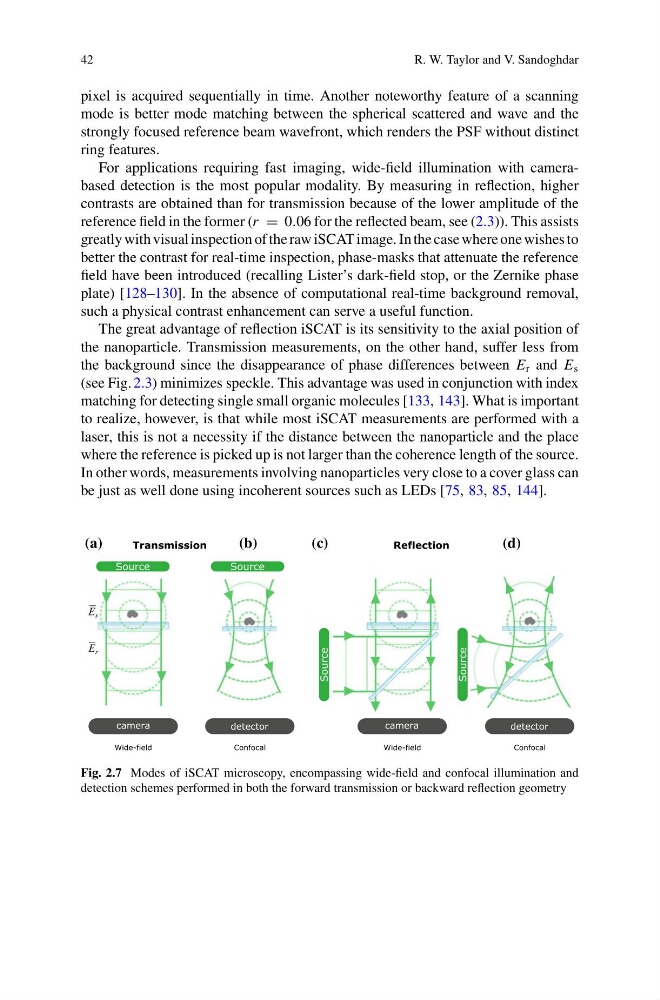
Fig. 2.7 Modes of iSCAT microscopy, encompassing wide-field and confocal illumination and
detection schemes performed in both the forward transmission or backward reflection geometry
R. W. Taylor and V. Sandoghdar
pixel is acquired sequentially in time. Another noteworthy feature of a scanning
mode is better mode matching between the spherical scattered and wave and the
strongly focused reference beam wavefront, which renders the PSF without distinct
ring features.
For applications requiring fast imaging, wide-field illumination with camerabased detection is the most popular modality. By measuring in reflection, higher
contrasts are obtained than for transmission because of the lower amplitude of the
reference field in the former (r = 0.06 for the reflected beam, see (2.3)). This assists
greatly with visual inspection of the raw iSCAT image. In the case where one wishes to
better the contrast for real-time inspection, phase-masks that attenuate the reference
field have been introduced (recalling Lister’s dark-field stop, or the Zernike phase
plate) [128–130]. In the absence of computational real-time background removal,
such a physical contrast enhancement can serve a useful function.
The great advantage of reflection iSCAT is its sensitivity to the axial position of
the nanoparticle. Transmission measurements, on the other hand, suffer less from
the background since the disappearance of phase differences between E r and E s
(see Fig. 2.3) minimizes speckle. This advantage was used in conjunction with index
matching for detecting single small organic molecules [133, 143]. What is important
to realize, however, is that while most iSCAT measurements are performed with a
laser, this is not a necessity if the distance between the nanoparticle and the place
where the reference is picked up is not larger than the coherence length of the source.
In other words, measurements involving nanoparticles very close to a cover glass can
be just as well done using incoherent sources such as LEDs [75, 83, 85, 144].
(a)
(b)
(c)
(d)
Fig. 2.7 Modes of iSCAT microscopy, encompassing wide-field and confocal illumination and
detection schemes performed in both the forward transmission or backward reflection geometry