

40
R. W. Taylor and V. Sandoghdar
(a)
(b)
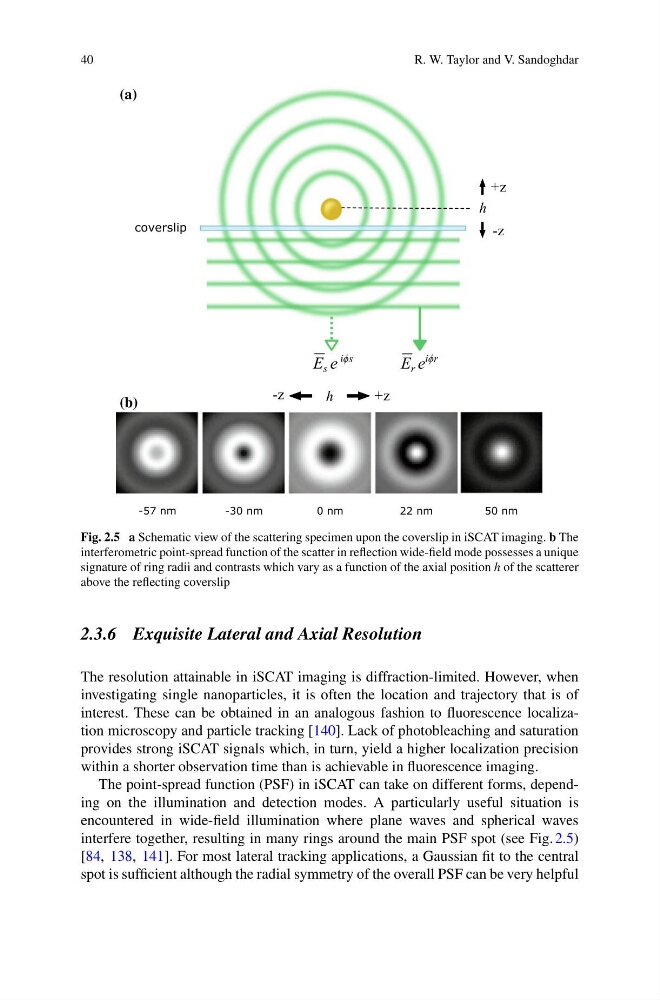
Fig. 2.5 a Schematic view of the scattering specimen upon the coverslip in iSCAT imaging. b The
interferometric point-spread function of the scatter in reflection wide-field mode possesses a unique
signature of ring radii and contrasts which vary as a function of the axial position h of the scatterer
above the reflecting coverslip
2.3.6 Exquisite Lateral and Axial Resolution
The resolution attainable in iSCAT imaging is diffraction-limited. However, when
investigating single nanoparticles, it is often the location and trajectory that is of
interest. These can be obtained in an analogous fashion to fluorescence localization microscopy and particle tracking [140]. Lack of photobleaching and saturation
provides strong iSCAT signals which, in turn, yield a higher localization precision
within a shorter observation time than is achievable in fluorescence imaging.
The point-spread function (PSF) in iSCAT can take on different forms, depending on the illumination and detection modes. A particularly useful situation is
encountered in wide-field illumination where plane waves and spherical waves
interfere together, resulting in many rings around the main PSF spot (see Fig. 2.5)
[84, 138, 141]. For most lateral tracking applications, a Gaussian fit to the central
spot is sufficient although the radial symmetry of the overall PSF can be very helpful
R. W. Taylor and V. Sandoghdar
(a)
(b)
Fig. 2.5 a Schematic view of the scattering specimen upon the coverslip in iSCAT imaging. b The
interferometric point-spread function of the scatter in reflection wide-field mode possesses a unique
signature of ring radii and contrasts which vary as a function of the axial position h of the scatterer
above the reflecting coverslip
2.3.6 Exquisite Lateral and Axial Resolution
The resolution attainable in iSCAT imaging is diffraction-limited. However, when
investigating single nanoparticles, it is often the location and trajectory that is of
interest. These can be obtained in an analogous fashion to fluorescence localization microscopy and particle tracking [140]. Lack of photobleaching and saturation
provides strong iSCAT signals which, in turn, yield a higher localization precision
within a shorter observation time than is achievable in fluorescence imaging.
The point-spread function (PSF) in iSCAT can take on different forms, depending on the illumination and detection modes. A particularly useful situation is
encountered in wide-field illumination where plane waves and spherical waves
interfere together, resulting in many rings around the main PSF spot (see Fig. 2.5)
[84, 138, 141]. For most lateral tracking applications, a Gaussian fit to the central
spot is sufficient although the radial symmetry of the overall PSF can be very helpful