

17 Microsphere-Assisted Interference Microscopy
455
refractive index contrast, i.e. the ratio between the refractive indices of the microsphere and the surrounding medium, must also be considered in the super-resolution
imaging formation [129]. Indeed, increasing the refractive index ratio makes it possible to improve the super-resolution phenomenon [111, 130]. A partial immersion
of the microsphere also contributes to the enhancement of the sub-diffraction-limit
imaging [131].
17.2.3 Image Formation
Usually, the magnified image generated by the microsphere is virtual as for example
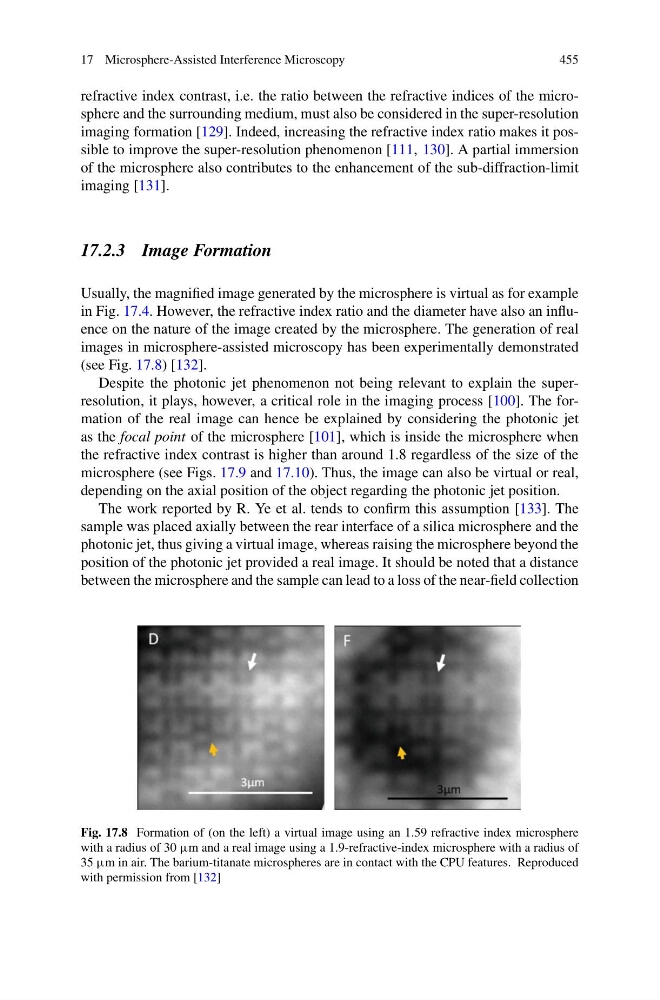
in Fig. 17.4. However, the refractive index ratio and the diameter have also an influence on the nature of the image created by the microsphere. The generation of real
images in microsphere-assisted microscopy has been experimentally demonstrated
(see Fig. 17.8) [132].
Despite the photonic jet phenomenon not being relevant to explain the superresolution, it plays, however, a critical role in the imaging process [100]. The formation of the real image can hence be explained by considering the photonic jet
as the focal point of the microsphere [101], which is inside the microsphere when
the refractive index contrast is higher than around 1.8 regardless of the size of the
microsphere (see Figs. 17.9 and 17.10). Thus, the image can also be virtual or real,
depending on the axial position of the object regarding the photonic jet position.
The work reported by R. Ye et al. tends to confirm this assumption [133]. The
sample was placed axially between the rear interface of a silica microsphere and the
photonic jet, thus giving a virtual image, whereas raising the microsphere beyond the
position of the photonic jet provided a real image. It should be noted that a distance
between the microsphere and the sample can lead to a loss of the near-field collection
Fig. 17.8 Formation of (on the left) a virtual image using an 1.59 refractive index microsphere
with a radius of 30 µm and a real image using a 1.9-refractive-index microsphere with a radius of
35 µm in air. The barium-titanate microspheres are in contact with the CPU features. Reproduced
with permission from [132]
455
refractive index contrast, i.e. the ratio between the refractive indices of the microsphere and the surrounding medium, must also be considered in the super-resolution
imaging formation [129]. Indeed, increasing the refractive index ratio makes it possible to improve the super-resolution phenomenon [111, 130]. A partial immersion
of the microsphere also contributes to the enhancement of the sub-diffraction-limit
imaging [131].
17.2.3 Image Formation
Usually, the magnified image generated by the microsphere is virtual as for example
in Fig. 17.4. However, the refractive index ratio and the diameter have also an influence on the nature of the image created by the microsphere. The generation of real
images in microsphere-assisted microscopy has been experimentally demonstrated
(see Fig. 17.8) [132].
Despite the photonic jet phenomenon not being relevant to explain the superresolution, it plays, however, a critical role in the imaging process [100]. The formation of the real image can hence be explained by considering the photonic jet
as the focal point of the microsphere [101], which is inside the microsphere when
the refractive index contrast is higher than around 1.8 regardless of the size of the
microsphere (see Figs. 17.9 and 17.10). Thus, the image can also be virtual or real,
depending on the axial position of the object regarding the photonic jet position.
The work reported by R. Ye et al. tends to confirm this assumption [133]. The
sample was placed axially between the rear interface of a silica microsphere and the
photonic jet, thus giving a virtual image, whereas raising the microsphere beyond the
position of the photonic jet provided a real image. It should be noted that a distance
between the microsphere and the sample can lead to a loss of the near-field collection
Fig. 17.8 Formation of (on the left) a virtual image using an 1.59 refractive index microsphere
with a radius of 30 µm and a real image using a 1.9-refractive-index microsphere with a radius of
35 µm in air. The barium-titanate microspheres are in contact with the CPU features. Reproduced
with permission from [132]