

16 Theoretical Foundations of Super-Resolution in Microspherical Nanoscopy
425
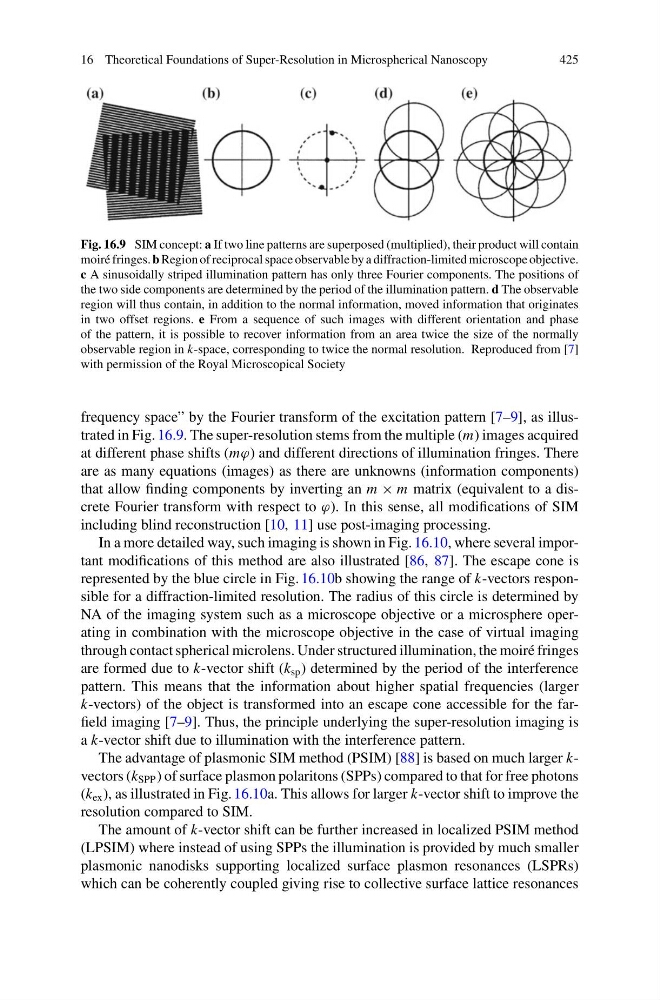
Fig. 16.9 SIM concept: a If two line patterns are superposed (multiplied), their product will contain
moiré fringes. b Region of reciprocal space observable by a diffraction-limited microscope objective.
c A sinusoidally striped illumination pattern has only three Fourier components. The positions of
the two side components are determined by the period of the illumination pattern. d The observable
region will thus contain, in addition to the normal information, moved information that originates
in two offset regions. e From a sequence of such images with different orientation and phase
of the pattern, it is possible to recover information from an area twice the size of the normally
observable region in k-space, corresponding to twice the normal resolution. Reproduced from [7]
with permission of the Royal Microscopical Society
frequency space” by the Fourier transform of the excitation pattern [7–9], as illustrated in Fig. 16.9. The super-resolution stems from the multiple (m) images acquired
at different phase shifts (mϕ) and different directions of illumination fringes. There
are as many equations (images) as there are unknowns (information components)
that allow finding components by inverting an m × m matrix (equivalent to a discrete Fourier transform with respect to ϕ). In this sense, all modifications of SIM
including blind reconstruction [10, 11] use post-imaging processing.
In a more detailed way, such imaging is shown in Fig. 16.10, where several important modifications of this method are also illustrated [86, 87]. The escape cone is
represented by the blue circle in Fig. 16.10b showing the range of k-vectors responsible for a diffraction-limited resolution. The radius of this circle is determined by
NA of the imaging system such as a microscope objective or a microsphere operating in combination with the microscope objective in the case of virtual imaging
through contact spherical microlens. Under structured illumination, the moiré fringes
are formed due to k-vector shift (k sp ) determined by the period of the interference
pattern. This means that the information about higher spatial frequencies (larger
k-vectors) of the object is transformed into an escape cone accessible for the farfield imaging [7–9]. Thus, the principle underlying the super-resolution imaging is
a k-vector shift due to illumination with the interference pattern.
The advantage of plasmonic SIM method (PSIM) [88] is based on much larger kvectors (k SPP ) of surface plasmon polaritons (SPPs) compared to that for free photons
(k ex ), as illustrated in Fig. 16.10a. This allows for larger k-vector shift to improve the
resolution compared to SIM.
The amount of k-vector shift can be further increased in localized PSIM method
(LPSIM) where instead of using SPPs the illumination is provided by much smaller
plasmonic nanodisks supporting localized surface plasmon resonances (LSPRs)
which can be coherently coupled giving rise to collective surface lattice resonances
425
Fig. 16.9 SIM concept: a If two line patterns are superposed (multiplied), their product will contain
moiré fringes. b Region of reciprocal space observable by a diffraction-limited microscope objective.
c A sinusoidally striped illumination pattern has only three Fourier components. The positions of
the two side components are determined by the period of the illumination pattern. d The observable
region will thus contain, in addition to the normal information, moved information that originates
in two offset regions. e From a sequence of such images with different orientation and phase
of the pattern, it is possible to recover information from an area twice the size of the normally
observable region in k-space, corresponding to twice the normal resolution. Reproduced from [7]
with permission of the Royal Microscopical Society
frequency space” by the Fourier transform of the excitation pattern [7–9], as illustrated in Fig. 16.9. The super-resolution stems from the multiple (m) images acquired
at different phase shifts (mϕ) and different directions of illumination fringes. There
are as many equations (images) as there are unknowns (information components)
that allow finding components by inverting an m × m matrix (equivalent to a discrete Fourier transform with respect to ϕ). In this sense, all modifications of SIM
including blind reconstruction [10, 11] use post-imaging processing.
In a more detailed way, such imaging is shown in Fig. 16.10, where several important modifications of this method are also illustrated [86, 87]. The escape cone is
represented by the blue circle in Fig. 16.10b showing the range of k-vectors responsible for a diffraction-limited resolution. The radius of this circle is determined by
NA of the imaging system such as a microscope objective or a microsphere operating in combination with the microscope objective in the case of virtual imaging
through contact spherical microlens. Under structured illumination, the moiré fringes
are formed due to k-vector shift (k sp ) determined by the period of the interference
pattern. This means that the information about higher spatial frequencies (larger
k-vectors) of the object is transformed into an escape cone accessible for the farfield imaging [7–9]. Thus, the principle underlying the super-resolution imaging is
a k-vector shift due to illumination with the interference pattern.
The advantage of plasmonic SIM method (PSIM) [88] is based on much larger kvectors (k SPP ) of surface plasmon polaritons (SPPs) compared to that for free photons
(k ex ), as illustrated in Fig. 16.10a. This allows for larger k-vector shift to improve the
resolution compared to SIM.
The amount of k-vector shift can be further increased in localized PSIM method
(LPSIM) where instead of using SPPs the illumination is provided by much smaller
plasmonic nanodisks supporting localized surface plasmon resonances (LSPRs)
which can be coherently coupled giving rise to collective surface lattice resonances