

15 Super-Resolution Imaging and Microscopy by Dielectric …
399
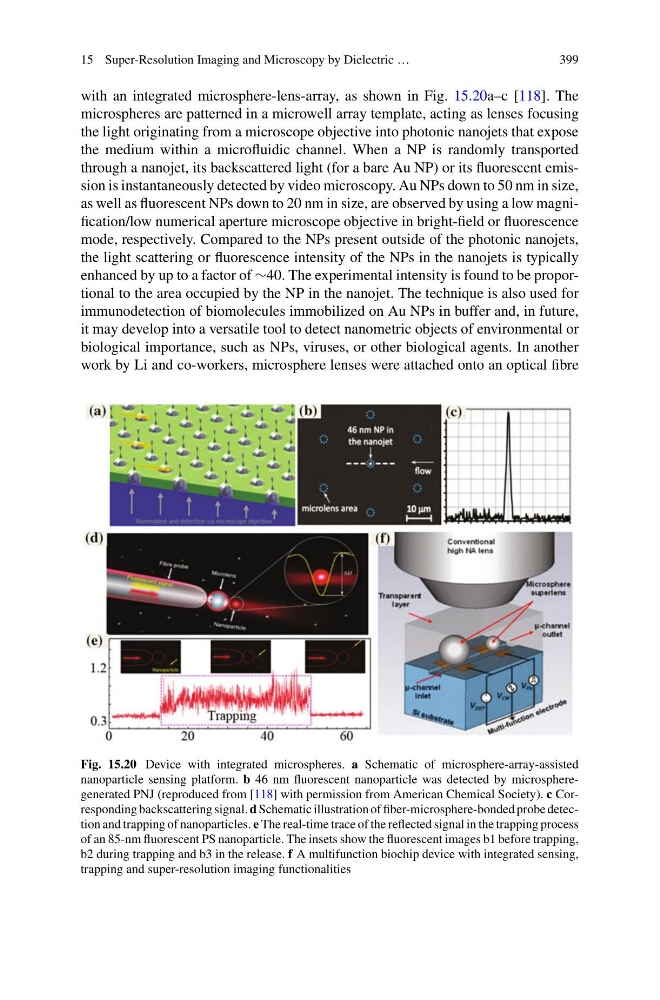
with an integrated microsphere-lens-array, as shown in Fig. 15.20a–c [118]. The
microspheres are patterned in a microwell array template, acting as lenses focusing
the light originating from a microscope objective into photonic nanojets that expose
the medium within a microfluidic channel. When a NP is randomly transported
through a nanojet, its backscattered light (for a bare Au NP) or its fluorescent emission is instantaneously detected by video microscopy. Au NPs down to 50 nm in size,
as well as fluorescent NPs down to 20 nm in size, are observed by using a low magnification/low numerical aperture microscope objective in bright-field or fluorescence
mode, respectively. Compared to the NPs present outside of the photonic nanojets,
the light scattering or fluorescence intensity of the NPs in the nanojets is typically
enhanced by up to a factor of ∼40. The experimental intensity is found to be proportional to the area occupied by the NP in the nanojet. The technique is also used for
immunodetection of biomolecules immobilized on Au NPs in buffer and, in future,
it may develop into a versatile tool to detect nanometric objects of environmental or
biological importance, such as NPs, viruses, or other biological agents. In another
work by Li and co-workers, microsphere lenses were attached onto an optical fibre
Fig. 15.20 Device with integrated microspheres. a Schematic of microsphere-array-assisted
nanoparticle sensing platform. b 46 nm fluorescent nanoparticle was detected by microspheregenerated PNJ (reproduced from [118] with permission from American Chemical Society). c Corresponding backscattering signal. d Schematic illustration of fiber-microsphere-bonded probe detection and trapping of nanoparticles. e The real-time trace of the reflected signal in the trapping process
of an 85-nm fluorescent PS nanoparticle. The insets show the fluorescent images b1 before trapping,
b2 during trapping and b3 in the release. f A multifunction biochip device with integrated sensing,
trapping and super-resolution imaging functionalities
399
with an integrated microsphere-lens-array, as shown in Fig. 15.20a–c [118]. The
microspheres are patterned in a microwell array template, acting as lenses focusing
the light originating from a microscope objective into photonic nanojets that expose
the medium within a microfluidic channel. When a NP is randomly transported
through a nanojet, its backscattered light (for a bare Au NP) or its fluorescent emission is instantaneously detected by video microscopy. Au NPs down to 50 nm in size,
as well as fluorescent NPs down to 20 nm in size, are observed by using a low magnification/low numerical aperture microscope objective in bright-field or fluorescence
mode, respectively. Compared to the NPs present outside of the photonic nanojets,
the light scattering or fluorescence intensity of the NPs in the nanojets is typically
enhanced by up to a factor of ∼40. The experimental intensity is found to be proportional to the area occupied by the NP in the nanojet. The technique is also used for
immunodetection of biomolecules immobilized on Au NPs in buffer and, in future,
it may develop into a versatile tool to detect nanometric objects of environmental or
biological importance, such as NPs, viruses, or other biological agents. In another
work by Li and co-workers, microsphere lenses were attached onto an optical fibre
Fig. 15.20 Device with integrated microspheres. a Schematic of microsphere-array-assisted
nanoparticle sensing platform. b 46 nm fluorescent nanoparticle was detected by microspheregenerated PNJ (reproduced from [118] with permission from American Chemical Society). c Corresponding backscattering signal. d Schematic illustration of fiber-microsphere-bonded probe detection and trapping of nanoparticles. e The real-time trace of the reflected signal in the trapping process
of an 85-nm fluorescent PS nanoparticle. The insets show the fluorescent images b1 before trapping,
b2 during trapping and b3 in the release. f A multifunction biochip device with integrated sensing,
trapping and super-resolution imaging functionalities