

388
Z. Wang and B. Luk’yanchuk
15.3.2.1 Microsphere-Embedded Coverslip
One of the earliest but important developments is the use of liquid-immersed BTG
microspheres for super-resolution imaging (compatible with bio-samples). This configuration is still widely used today, with resolution between λ/4 and λ/7 depending
on the particle size, as demonstrated experimentally [29, 69]. The liquid-immersion
design was soon extended to solid-immersion design in a coverslip form [20, 112,
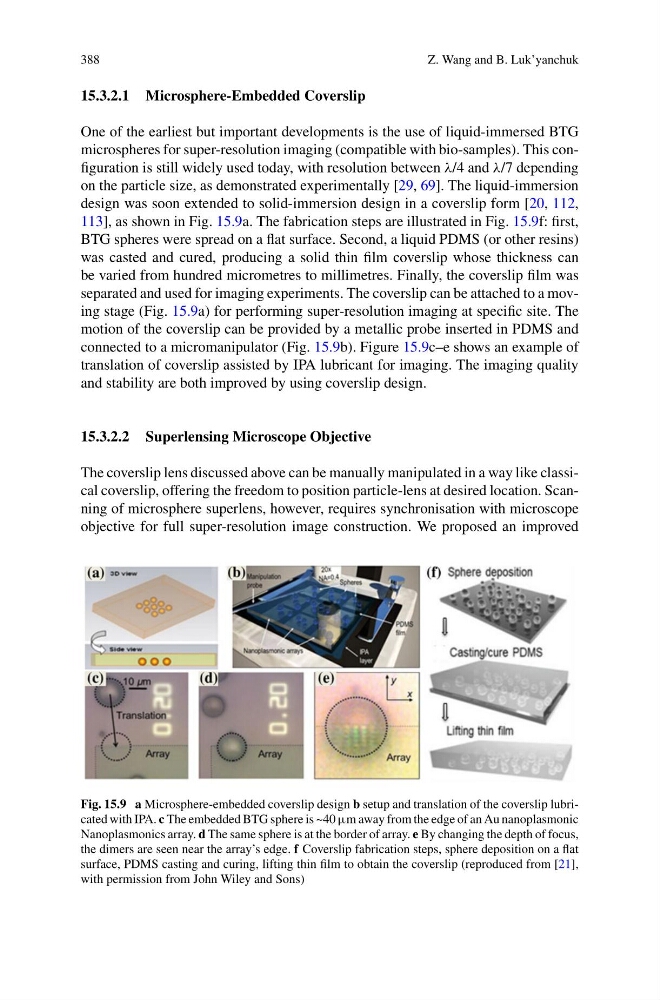
113], as shown in Fig. 15.9a. The fabrication steps are illustrated in Fig. 15.9f: first,
BTG spheres were spread on a flat surface. Second, a liquid PDMS (or other resins)
was casted and cured, producing a solid thin film coverslip whose thickness can
be varied from hundred micrometres to millimetres. Finally, the coverslip film was
separated and used for imaging experiments. The coverslip can be attached to a moving stage (Fig. 15.9a) for performing super-resolution imaging at specific site. The
motion of the coverslip can be provided by a metallic probe inserted in PDMS and
connected to a micromanipulator (Fig. 15.9b). Figure 15.9c–e shows an example of
translation of coverslip assisted by IPA lubricant for imaging. The imaging quality
and stability are both improved by using coverslip design.
15.3.2.2 Superlensing Microscope Objective
The coverslip lens discussed above can be manually manipulated in a way like classical coverslip, offering the freedom to position particle-lens at desired location. Scanning of microsphere superlens, however, requires synchronisation with microscope
objective for full super-resolution image construction. We proposed an improved
Fig. 15.9 a Microsphere-embedded coverslip design b setup and translation of the coverslip lubricated with IPA. c The embedded BTG sphere is ~40 μm away from the edge of an Au nanoplasmonic
Nanoplasmonics array. d The same sphere is at the border of array. e By changing the depth of focus,
the dimers are seen near the array’s edge. f Coverslip fabrication steps, sphere deposition on a flat
surface, PDMS casting and curing, lifting thin film to obtain the coverslip (reproduced from [21],
with permission from John Wiley and Sons)
Z. Wang and B. Luk’yanchuk
15.3.2.1 Microsphere-Embedded Coverslip
One of the earliest but important developments is the use of liquid-immersed BTG
microspheres for super-resolution imaging (compatible with bio-samples). This configuration is still widely used today, with resolution between λ/4 and λ/7 depending
on the particle size, as demonstrated experimentally [29, 69]. The liquid-immersion
design was soon extended to solid-immersion design in a coverslip form [20, 112,
113], as shown in Fig. 15.9a. The fabrication steps are illustrated in Fig. 15.9f: first,
BTG spheres were spread on a flat surface. Second, a liquid PDMS (or other resins)
was casted and cured, producing a solid thin film coverslip whose thickness can
be varied from hundred micrometres to millimetres. Finally, the coverslip film was
separated and used for imaging experiments. The coverslip can be attached to a moving stage (Fig. 15.9a) for performing super-resolution imaging at specific site. The
motion of the coverslip can be provided by a metallic probe inserted in PDMS and
connected to a micromanipulator (Fig. 15.9b). Figure 15.9c–e shows an example of
translation of coverslip assisted by IPA lubricant for imaging. The imaging quality
and stability are both improved by using coverslip design.
15.3.2.2 Superlensing Microscope Objective
The coverslip lens discussed above can be manually manipulated in a way like classical coverslip, offering the freedom to position particle-lens at desired location. Scanning of microsphere superlens, however, requires synchronisation with microscope
objective for full super-resolution image construction. We proposed an improved
Fig. 15.9 a Microsphere-embedded coverslip design b setup and translation of the coverslip lubricated with IPA. c The embedded BTG sphere is ~40 μm away from the edge of an Au nanoplasmonic
Nanoplasmonics array. d The same sphere is at the border of array. e By changing the depth of focus,
the dimers are seen near the array’s edge. f Coverslip fabrication steps, sphere deposition on a flat
surface, PDMS casting and curing, lifting thin film to obtain the coverslip (reproduced from [21],
with permission from John Wiley and Sons)