

15 Super-Resolution Imaging and Microscopy by Dielectric …
385
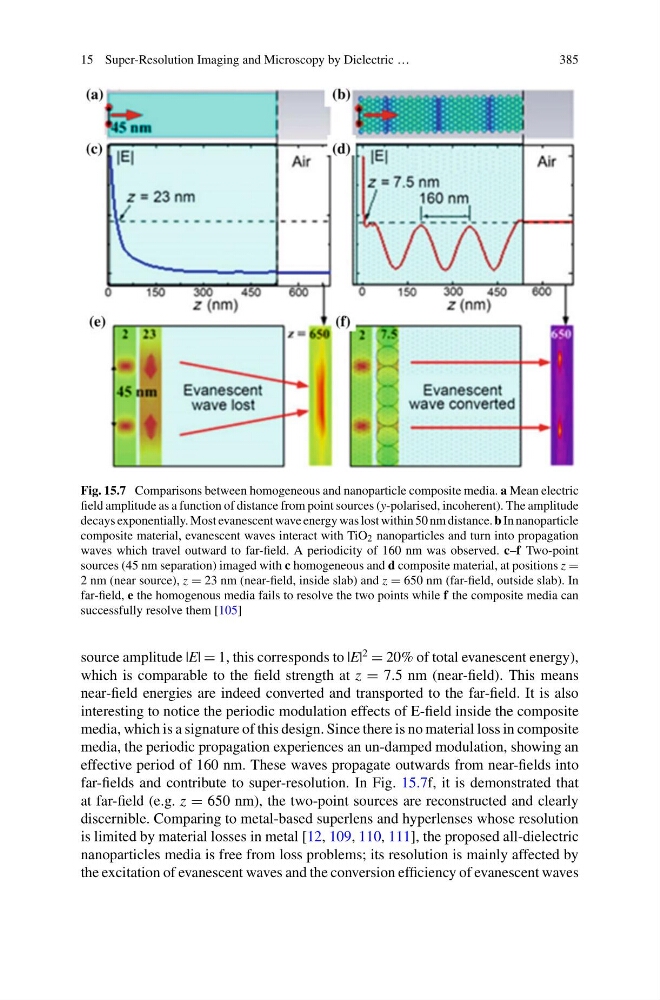
Fig. 15.7 Comparisons between homogeneous and nanoparticle composite media. a Mean electric
field amplitude as a function of distance from point sources (y-polarised, incoherent). The amplitude
decays exponentially. Most evanescent wave energy was lost within 50 nm distance. b In nanoparticle
composite material, evanescent waves interact with TiO 2 nanoparticles and turn into propagation
waves which travel outward to far-field. A periodicity of 160 nm was observed. c–f Two-point
sources (45 nm separation) imaged with c homogeneous and d composite material, at positions z =
2 nm (near source), z = 23 nm (near-field, inside slab) and z = 650 nm (far-field, outside slab). In
far-field, e the homogenous media fails to resolve the two points while f the composite media can
successfully resolve them [105]
source amplitude |E| = 1, this corresponds to |E|
2
= 20% of total evanescent energy),
which is comparable to the field strength at z = 7.5 nm (near-field). This means
near-field energies are indeed converted and transported to the far-field. It is also
interesting to notice the periodic modulation effects of E-field inside the composite
media, which is a signature of this design. Since there is no material loss in composite
media, the periodic propagation experiences an un-damped modulation, showing an
effective period of 160 nm. These waves propagate outwards from near-fields into
far-fields and contribute to super-resolution. In Fig. 15.7f, it is demonstrated that
at far-field (e.g. z = 650 nm), the two-point sources are reconstructed and clearly
discernible. Comparing to metal-based superlens and hyperlenses whose resolution
is limited by material losses in metal [12, 109, 110, 111], the proposed all-dielectric
nanoparticles media is free from loss problems; its resolution is mainly affected by
the excitation of evanescent waves and the conversion efficiency of evanescent waves
385
Fig. 15.7 Comparisons between homogeneous and nanoparticle composite media. a Mean electric
field amplitude as a function of distance from point sources (y-polarised, incoherent). The amplitude
decays exponentially. Most evanescent wave energy was lost within 50 nm distance. b In nanoparticle
composite material, evanescent waves interact with TiO 2 nanoparticles and turn into propagation
waves which travel outward to far-field. A periodicity of 160 nm was observed. c–f Two-point
sources (45 nm separation) imaged with c homogeneous and d composite material, at positions z =
2 nm (near source), z = 23 nm (near-field, inside slab) and z = 650 nm (far-field, outside slab). In
far-field, e the homogenous media fails to resolve the two points while f the composite media can
successfully resolve them [105]
source amplitude |E| = 1, this corresponds to |E|
2
= 20% of total evanescent energy),
which is comparable to the field strength at z = 7.5 nm (near-field). This means
near-field energies are indeed converted and transported to the far-field. It is also
interesting to notice the periodic modulation effects of E-field inside the composite
media, which is a signature of this design. Since there is no material loss in composite
media, the periodic propagation experiences an un-damped modulation, showing an
effective period of 160 nm. These waves propagate outwards from near-fields into
far-fields and contribute to super-resolution. In Fig. 15.7f, it is demonstrated that
at far-field (e.g. z = 650 nm), the two-point sources are reconstructed and clearly
discernible. Comparing to metal-based superlens and hyperlenses whose resolution
is limited by material losses in metal [12, 109, 110, 111], the proposed all-dielectric
nanoparticles media is free from loss problems; its resolution is mainly affected by
the excitation of evanescent waves and the conversion efficiency of evanescent waves