

16
C. Hu and G. Popescu
small point, ϕ 0 and ϕ are essentially the ideal PSF and measured PSF, respectively.
Equation 1.20 states that the high-pass filtered version of the ideal phase is due to
the partial spatial coherence from the source. The phase information is completely
lost when the source is incoherent, meaning, when h i (r) reduces to δ(r). Though
methods have been developed to mitigate these artifacts [83, 134, 135], this partial
spatial coherence essentially affects the measurement accuracy, and furthermore,
brings into question whether the conventional resolution definition can be applied to
characterize QPI and coherent imaging in general.
1.5.2 Defining Resolution
In microscopy, imaging contrast and spatial resolution are typical metrics to characterize the performance of an imaging system. The definition of magnification and
contrast are well understood, the meaning of spatial resolution, however, appears to be
ambiguous, especially for coherent imaging. The resolution of intensity-based imaging system, fluorescence for instance, is relatively straightforward. Due to the linear
response between the optical intensity emitted from the object and those detected at
the image plane, the resolution for incoherent imaging system is well characterized
by its point spread function (PSF). The criteria for resolution include the maximum spatial frequency (Abbe criterion) [136] or the distance to the PSF’s first root
(Rayleigh criterion) [137]. However, a measurability issue arises when switched to
the case of coherent imaging, due to the fact that the system has a linear response in
the optical field but not its intensity, which is the measured quantity [138, 139]. Consider the case where two point sources are imaged by a microscope. Let us assume
the two sources produce mutually incoherent light, and they are spatially separated
by a distance larger than the diffraction limit, which makes them resolvable using an
incoherent microscope. However, under the same microscope, if generating coherent
light with 0 phase delay, these two point sources become fully unresolved (see, e.g.,
Chap. 8 in [2]). This simple illustration suggests that measuring and reporting its
intensity profile is not a suitable means to characterize resolution.
With this context in mind, a practical unambiguous resolution standard is highly
desirable to reliably assess the merits of coherent microscopic techniques. Several
theoretical and practical methods have been proposed [138, 140, 141]. Here, we
briefly discuss the resolution problem from the perspective of uncertainty relation.
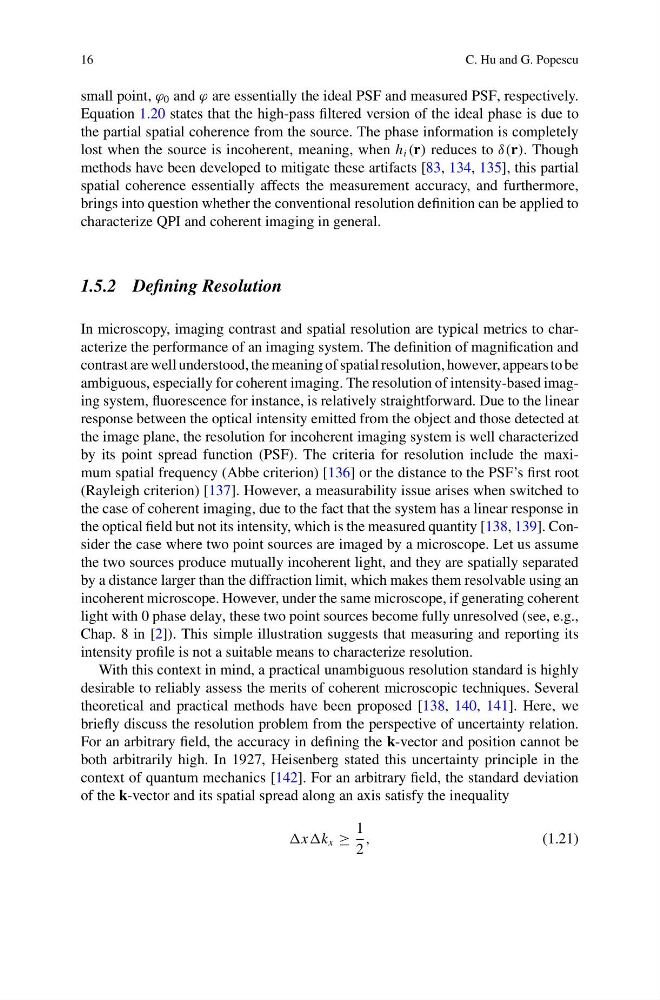
For an arbitrary field, the accuracy in defining the k-vector and position cannot be
both arbitrarily high. In 1927, Heisenberg stated this uncertainty principle in the
context of quantum mechanics [142]. For an arbitrary field, the standard deviation
of the k-vector and its spatial spread along an axis satisfy the inequality
xk x ≥
1
2
,
(1.21)
C. Hu and G. Popescu
small point, ϕ 0 and ϕ are essentially the ideal PSF and measured PSF, respectively.
Equation 1.20 states that the high-pass filtered version of the ideal phase is due to
the partial spatial coherence from the source. The phase information is completely
lost when the source is incoherent, meaning, when h i (r) reduces to δ(r). Though
methods have been developed to mitigate these artifacts [83, 134, 135], this partial
spatial coherence essentially affects the measurement accuracy, and furthermore,
brings into question whether the conventional resolution definition can be applied to
characterize QPI and coherent imaging in general.
1.5.2 Defining Resolution
In microscopy, imaging contrast and spatial resolution are typical metrics to characterize the performance of an imaging system. The definition of magnification and
contrast are well understood, the meaning of spatial resolution, however, appears to be
ambiguous, especially for coherent imaging. The resolution of intensity-based imaging system, fluorescence for instance, is relatively straightforward. Due to the linear
response between the optical intensity emitted from the object and those detected at
the image plane, the resolution for incoherent imaging system is well characterized
by its point spread function (PSF). The criteria for resolution include the maximum spatial frequency (Abbe criterion) [136] or the distance to the PSF’s first root
(Rayleigh criterion) [137]. However, a measurability issue arises when switched to
the case of coherent imaging, due to the fact that the system has a linear response in
the optical field but not its intensity, which is the measured quantity [138, 139]. Consider the case where two point sources are imaged by a microscope. Let us assume
the two sources produce mutually incoherent light, and they are spatially separated
by a distance larger than the diffraction limit, which makes them resolvable using an
incoherent microscope. However, under the same microscope, if generating coherent
light with 0 phase delay, these two point sources become fully unresolved (see, e.g.,
Chap. 8 in [2]). This simple illustration suggests that measuring and reporting its
intensity profile is not a suitable means to characterize resolution.
With this context in mind, a practical unambiguous resolution standard is highly
desirable to reliably assess the merits of coherent microscopic techniques. Several
theoretical and practical methods have been proposed [138, 140, 141]. Here, we
briefly discuss the resolution problem from the perspective of uncertainty relation.
For an arbitrary field, the accuracy in defining the k-vector and position cannot be
both arbitrarily high. In 1927, Heisenberg stated this uncertainty principle in the
context of quantum mechanics [142]. For an arbitrary field, the standard deviation
of the k-vector and its spatial spread along an axis satisfy the inequality
xk x ≥
1
2
,
(1.21)